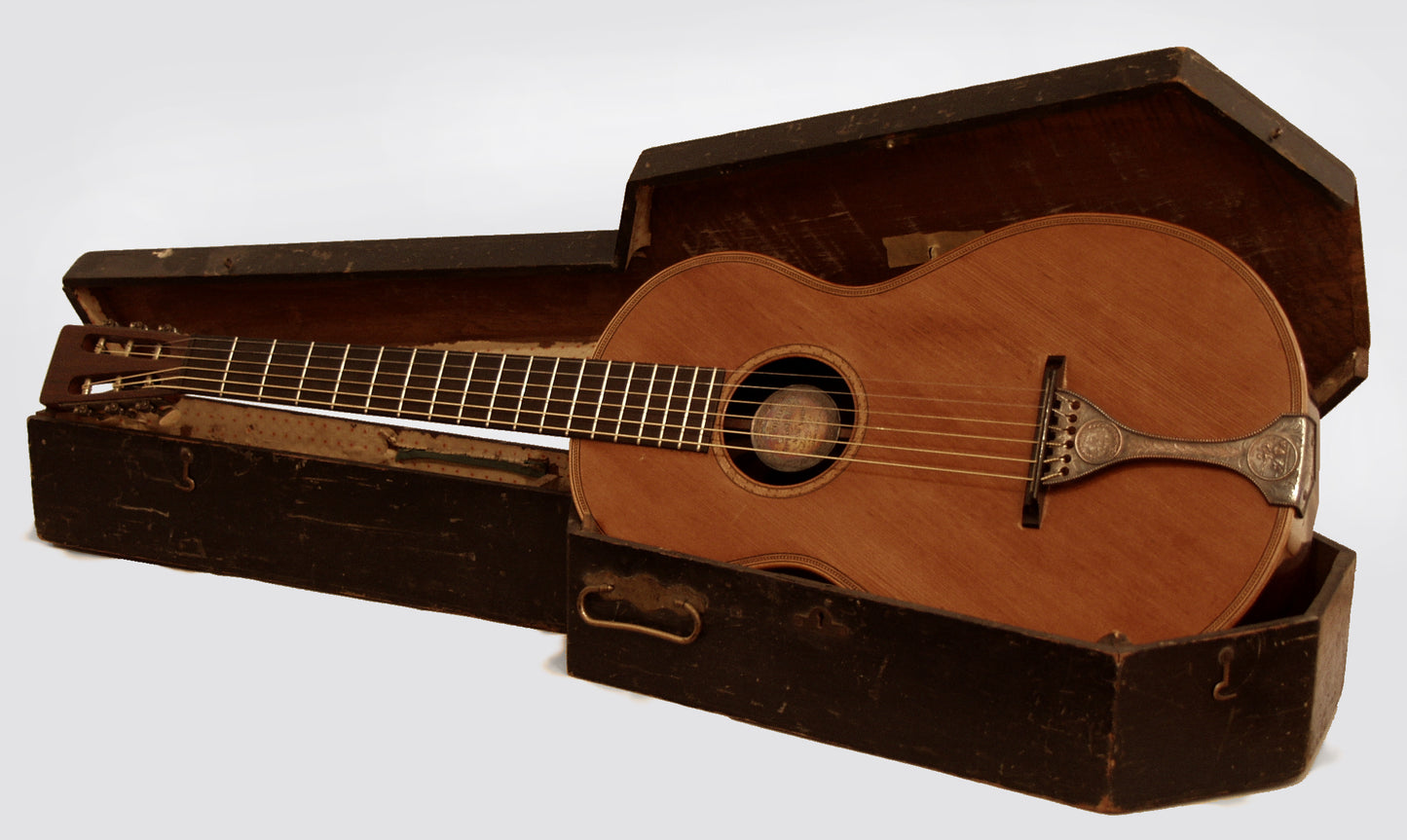
Wm. B. Tilton Flat Top Acoustic Guitar, c. 1870's, made in N.Y. City, natural varnish finish, Brazilian rosewood back and sides, diagonal grain spruce top, ebony fingerboard, original black coffin case.
This fascinating nineteenth century guitar is a superbly preserved and fancy example of the work of one of the era's more celebrated designers, as well as a fine playable guitar. New Yorker William B. Tilton's patented "Improvements" to guitar design essentially consisted of an internal longitudinal post, intended to take some of the stress off the body.
A long ornate metal tailpiece, movable ebony bridge, and the curious metal disc suspended in the soundhole are also Tilton trademarks, all claimed to have a beneficial effect on sound. Whether or not that is really true, this is a very well-crafted little guitar with quite a vibrant tone.
The back and sides are beautifully grained Brazilian rosewood, with a chain pattern wood backstrip. The neck is mahogany with an ebony fingerboard, ebony nut and engraved nickel-plated tuners with bone buttons. The unusual diagonal-grained spruce top (another Tilton eccentricity) is bound in herringbone and five layers of contrasting wood, with a multicolored half-herringbone soundhole inlay.
The silver plated tailpiece is beautifully engraved in an ornate floral pattern with two award medals displayed on it. The "Tilton's Improvement" disc in the soundhole bears the patent date of March 4th, 1856 and the distributor's mark of Zogbaum and Fairchild, New York. This guitar is sturdily built for its age, extremely playable with gut or steel strings, and can be well recommended for playing situations such as Civil War re-enacting where a sturdy and functional 1860's guitar is required!
Overall length is 36 15/16 in. (93.8 cm.), 12 1/16 in. (30.6 cm.) wide at lower bout, and 3 1/2 in. (8.9 cm.) in depth at side, taken at the end block. Scale length is 24 1/2 in. (622 mm.). Width of nut is 1 3/4 in. (44 mm.).
Very nice original condition with an old neck set and a couple of back crack repairs; unusually well-preserved for an instrument of this vintage. Plays and sounds very well. Excellent Condition.