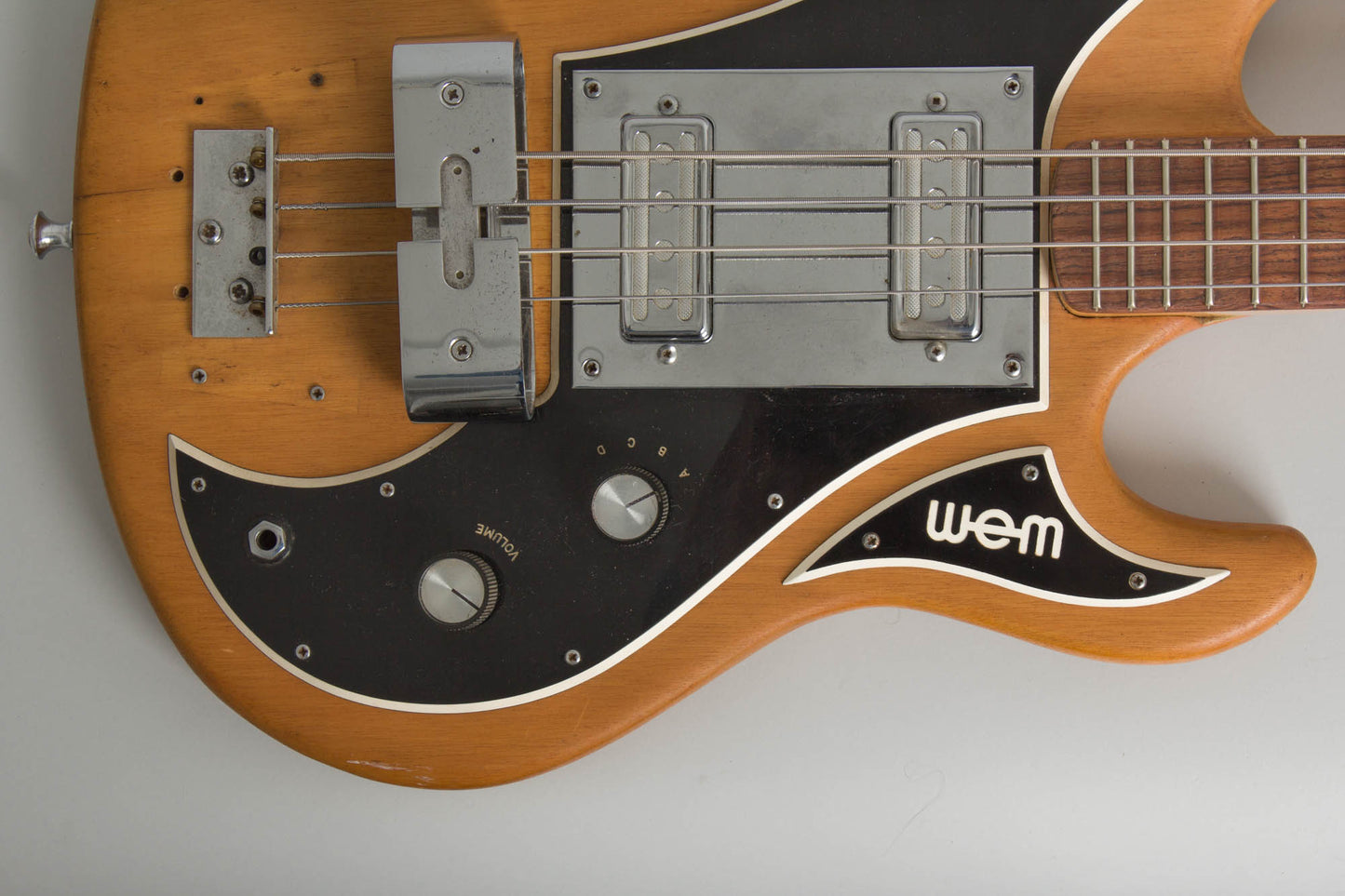
Watkins Electric Music (WEM) Rapier Bass Owned by Jeff Tweedy of Wilco Solid Body Electric Bass Guitar (1967)
1
/
of
15
Regular price
$900.00
Regular price
$900.00
Sale price
$900.00
Unit price
/
per
Item #13305
Watkins Electric Music (WEM) Rapier Bass Owned by Jeff Tweedy of Wilco Model Solid Body Electric Bass Guitar (1967), made in London, England, serial # 9250, natural re- finish, African mahogany body, maple neck with rosewood fingerboard, black chipboard case.
Watkins Electric Music (later abbreviated as WEM) was a notable British electronics company perhaps known best for their PA systems and amplifiers such as the Dominator; they also dabbled in a modest line of fairly budget-level guitars. The Rapier guitar series was their best known instrument; this 4-string version is one of only a few bass designs they offered. This example has an original finish neck and a stripped body. Admirers of these UK-made basses and guitars know that the thick polyester finishes were prone to serious cracking and checking, often largely flaking off with time. At some point a previous owner of this bass simply stripped the body to bare wood.
The African mahogany body has a look and feel reminiscent of a period Burns bass, but much thinner at the rim. The Fender-esque maple neck has a dot-inlaid rosewood fingerboard, zero fret and an adjustable truss rod. This later model is outfitted with chrome hardware, a brass nut, and Dutch made Van Gent plastic-button tuners. The electronics include two metal-covered single coil pickups wired to a master volume and 4-way tone selector knob. The fully adjustable bridge has an extremely large metal cage/cover surrounding it (that looks like a giant horseshoe pickup) housing an adjustable mute; the strings run to a very basic bent metal tailpiece.
Several different versions of this Watkins/ WEM/Wilson bass exist with slightly different configurations, some carrying the "Sapphire" name. The company would shortly rebrand the guitars as "Wilson" and eventually by the early-1980s the instrument line was discontinued. Watkins/WEM/Wilson survivors have been relegated to being mostly appreciated in their own niche circles of aficionados or as fun thrift shop finds. This one made its way to Chicago and found itself in the service of Wilco's Jeff Tweedy, who is now passing it on to the world.
Overall length is 46 in. (116.8 cm.), 14 in. (35.6 cm.) wide at lower bout, and 1 3/8 in. (3.5 cm.) in depth, measured at side of rim. Scale length is 30 1/2 in. (775 mm.). Width of nut is 1 5/8 in. (41 mm.).
This is a fun and funky player's grade bass that sounds good and plays well. The finish on the body was stripped to bare natural wood, the clear Poly on the neck is intact while headstock face had the logo sanded off. The body finish is right down to the wood, sanded and smoothed but not resprayed with any additional lacquer. Within that refinish are only a scattering of small dings and dents and not a tremendous amount of additional wear; there are some scars and additional holes from a now-lost tailpiece cover. The neck has some heavy check lines and small dings and dents.
The hardware and the electronics appear otherwise original and in tact including the Burns-like multi-piece plastic pickguard, elaborate bridge/mute assembly and tuners. It remains a comfortable and playful little bass with a rocker spirit; the frets and fingerboard are healthy, with a brass nut added above the zero fret. It is currently strung up with Jeff's choice of mix-and-match roundwound strings but would surely sound great with a thumpy set of flats. It resides in a period softshell case with the Wilco Loft markings in the standard spot along the bottom edge. Also inside the case lives a certificate of authenticity from the Wilco Loft validating the provenance of this piece. Overall Very Good Condition.
Watkins Electric Music (later abbreviated as WEM) was a notable British electronics company perhaps known best for their PA systems and amplifiers such as the Dominator; they also dabbled in a modest line of fairly budget-level guitars. The Rapier guitar series was their best known instrument; this 4-string version is one of only a few bass designs they offered. This example has an original finish neck and a stripped body. Admirers of these UK-made basses and guitars know that the thick polyester finishes were prone to serious cracking and checking, often largely flaking off with time. At some point a previous owner of this bass simply stripped the body to bare wood.
The African mahogany body has a look and feel reminiscent of a period Burns bass, but much thinner at the rim. The Fender-esque maple neck has a dot-inlaid rosewood fingerboard, zero fret and an adjustable truss rod. This later model is outfitted with chrome hardware, a brass nut, and Dutch made Van Gent plastic-button tuners. The electronics include two metal-covered single coil pickups wired to a master volume and 4-way tone selector knob. The fully adjustable bridge has an extremely large metal cage/cover surrounding it (that looks like a giant horseshoe pickup) housing an adjustable mute; the strings run to a very basic bent metal tailpiece.
Several different versions of this Watkins/ WEM/Wilson bass exist with slightly different configurations, some carrying the "Sapphire" name. The company would shortly rebrand the guitars as "Wilson" and eventually by the early-1980s the instrument line was discontinued. Watkins/WEM/Wilson survivors have been relegated to being mostly appreciated in their own niche circles of aficionados or as fun thrift shop finds. This one made its way to Chicago and found itself in the service of Wilco's Jeff Tweedy, who is now passing it on to the world.
Overall length is 46 in. (116.8 cm.), 14 in. (35.6 cm.) wide at lower bout, and 1 3/8 in. (3.5 cm.) in depth, measured at side of rim. Scale length is 30 1/2 in. (775 mm.). Width of nut is 1 5/8 in. (41 mm.).
This is a fun and funky player's grade bass that sounds good and plays well. The finish on the body was stripped to bare natural wood, the clear Poly on the neck is intact while headstock face had the logo sanded off. The body finish is right down to the wood, sanded and smoothed but not resprayed with any additional lacquer. Within that refinish are only a scattering of small dings and dents and not a tremendous amount of additional wear; there are some scars and additional holes from a now-lost tailpiece cover. The neck has some heavy check lines and small dings and dents.
The hardware and the electronics appear otherwise original and in tact including the Burns-like multi-piece plastic pickguard, elaborate bridge/mute assembly and tuners. It remains a comfortable and playful little bass with a rocker spirit; the frets and fingerboard are healthy, with a brass nut added above the zero fret. It is currently strung up with Jeff's choice of mix-and-match roundwound strings but would surely sound great with a thumpy set of flats. It resides in a period softshell case with the Wilco Loft markings in the standard spot along the bottom edge. Also inside the case lives a certificate of authenticity from the Wilco Loft validating the provenance of this piece. Overall Very Good Condition.
Share