


Wandre Waid Bass Semi-Hollow Body Electric Bass Guitar (1962)


1
/
of
19
Regular price
$6,950.00
Regular price
$6,950.00
Sale price
$6,950.00
Unit price
/
per
Item #13988
Wandre Waid Bass Model Semi-Hollow Body Electric Bass Guitar (1962), made in Cavriago, Italy, blue sparkle with pink sparkle sides finish, plywood and plastic body; plastic sheathed aluminum neck with rosewood headstock, black tolex hard shell case.
The Wandre story is a book-length tale of the constant battle between creativity and commerce; there is an (unfortunately hard to find) 2014 book "WANDRE-The Artist Of The Electric Guitar" by Marco Ballestri for the curious! While Italian artist/dreamer/luthier Wandre Pioli started his professional lutherie career with upright basses his early electric bass guitars are quirky at best; still they are rare and of interest to fans of his instruments. This is a late production "Waid" bass, one of his older late 1950s models but this '60s version has a number of evolutionary changes including the headstock configuration, a shorter aluminum centerpiece and controls mounted in a metal box on the body
There are many titles one could bestow upon Wandre Pioli, "romantic" certainly among them. Pioli designed a number of instruments he cited as abstractly inspired by non-musical subjects, from film stars to his wife and child. The beautiful if eccentric "Waid" model he claimed was a tribute to his love for his wife; the name "WAID" combines Wandre and Ida, and the fluid body shape was intended to suggest the couple entwined in a dance.
Whatever its theoretical origins, the Waid launched in 1958 as a semi-hollow guitar built on a thin but very wide body, initially with two abstract soundholes. By the time this 4-string bass example was built around 1962 the design had evolved considerably, including losing the soundholes. The body is very wide, well over 17" at the lower bout but only 1 3/4" at the rim. The shape is more conventional than many Pioli creations but has a bulging contour on the upper edge, with a sloping-back cutaway on the treble side. The most unusual feature is the top, which is concave instead of convex like almost every other guitar ever made. The top slopes inward and downward from the rims, leaving the metal neck extension/centerpiece fully exposed. While this looks wildly eccentric, the "negative space" effect does not affect playability in any negative way!
The back is arched in the conventional manner and both edges are bound with heavy white plastic, the sides covered with pinkish/lavender sparkle plastic. The top and back are covered with a thick coating of the unusually heavy Poly compounds Wandre worked with, in a deep azure blue with a rich celestial coating of gold sparkles achieving far more depth than the familiar sparkly Silvertone look; it really does resemble a deep blue starry sky creating a truly dramatic effect on the top and back.
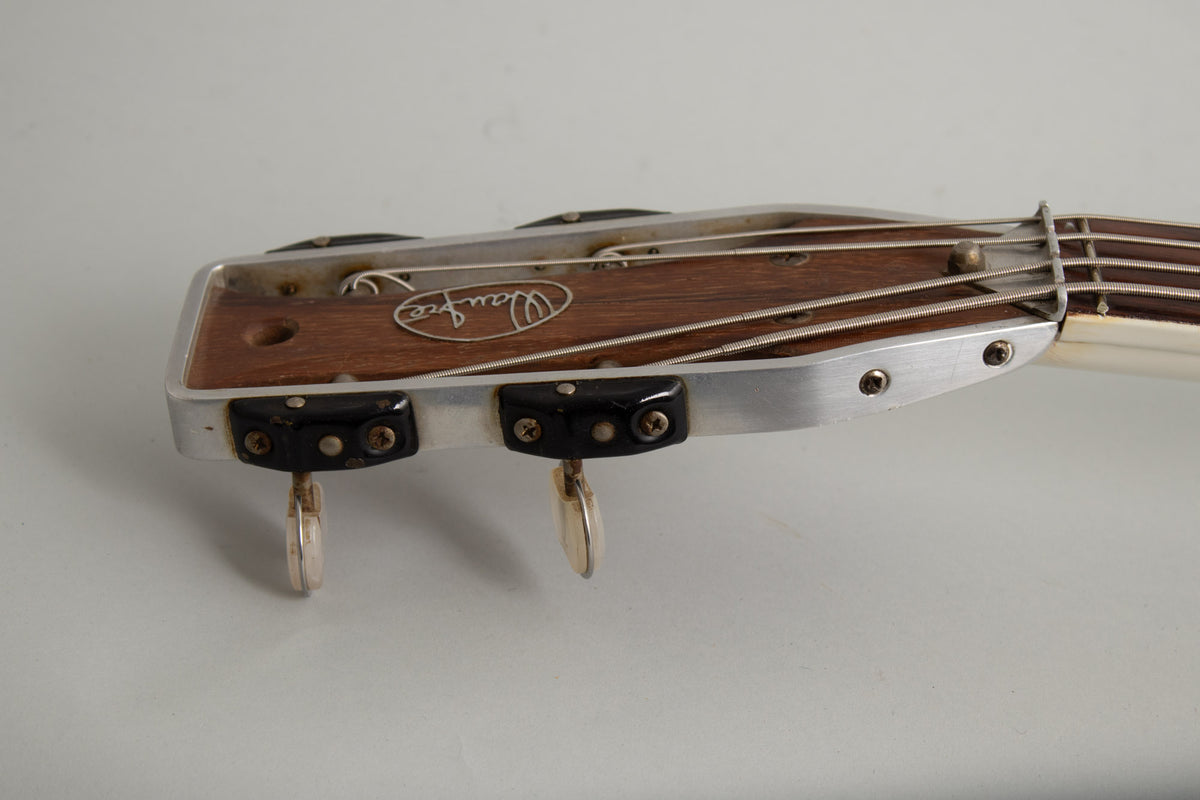
Besides the unique aesthetics, the most trailblazing aspect of Wandre guitars is the aluminum neck/body centerpiece. Over a decade before Travis Bean or Veleno, Pioli's instruments featured a thin, rounded aluminum neck/body section running from nut to tail, in this case plainly revealed by the concave body. This example has the back of the neck encased in a white plastic sheath which gives more traditional feel than the raw aluminum. The rosewood fingerboard features Wandre's charming decorative shaped multicolor plastic inlays, with his logo and the crest of Cavriago incised in the upper two. Bolted to the neck is a metal-framed slotted wood headstock with individual guitar-style plastic button tuners on either side and an aluminum nut spacer; this in particular puts the bass in the 1962 timeframe. A metal-cutout Wandre logo is attached to the headstock face.
Like all early Wandre bass guitars this instrument has a guitar-scale neck. Up into the mid '60s guitars and electric basses from the round Cavriago factory share the same layout, design and materials; basses are simply 4-string guitars with heavier strings. Perhaps Wandre did not want to invest in the tooling required to make a longer scale neck or maybe he just liked the concept, but not until the mid-60s did Wandre offer a long scale bass. This idea was also used by some US companies including Valco (with the National Style 85 and the Supro Pocket Bass), Carvin, Kay with their Value Leaders and a few others, but generally players expected at least a 29 1/2 to 30" scale on a bass guitar.
Despite the guitar-length neck the single Davoli pickup mounted just under the fingerboard gives this bass a surprisingly full sound that mellows nicely at lower volume. It is mounted solidly to the body floating over the exposed aluminum spine. The bridge is a Hofner-style slotted rosewood piece with fretwire saddles with the strings running on to a sleek minimalist milled metal tailpiece. This is solidly attached to the back end of the central aluminum neck/body section. The output jack, volume and tone controls (with color-coded caps on the "space age" knobs) are mounted to a pressed-metal box situated by the lower edge of the face.
Overall this rather unusually wide and flat-feeling short-necked bass is another rare, wonderful and iconic piece of the Wandre puzzle, incredible looking in its multi-hued sparkling livery, unique as they all are, an extremely eccentric but cheerfully fun instrument to play.
Overall length is 44 1/4 in. (112.4 cm.), 17 5/8 in. (44.8 cm.) wide at lower bout, and 1 3/4 in. (4.4 cm.) in depth, measured at side of rim. Scale length is 24 3/4 in. (629 mm.). Width of nut is 1 5/8 in. (41 mm.).
This very rare bass guitar has survived in original and quite decent condition; all original hardware is intact including the often cracked plastic sheath covering the aluminum neck. Wandre instruments often appear today missing parts or with damaged bodies due to the quirky nature of their construction; this one has survived solid and all original.
There are some long checking lines to the top but no cracking off or chipping to the starry covering. The back is cleaner with only some scratches and scuffing. The heavy plastic body binding has some scuffing and discoloration but no real damage. The fragile thin plastic neck sheath has some discoloration and checking along the centerline but no notable damage, remaining still smooth to the touch. The headstock has some nicks and dents along the edges.
The somewhat fragile stamped metal jack housing with the tone and volume knobs mounted on it is fully intact; the extra holes in the top are signs of its modular nature, not modifications. The binding around it appears a bit shrunken up. The jack is the original now-obsolete 5mm Geloso jack fitted to Wandres made for the Italian market; a specially-made cable is included. The adjustable bridge with its 4 fretwire saddles is fully intact as is the rest of the fairly minimal hardware; the original frets show minimal wear.
This single-pickup bass plays fine and sounds as good as any 24 3/4" scale 4-string we have heard; actually a usable instrument if not a pro-grade bass by modern standards. It is not particularly versatile but the Davoli pickup works well in bass mode, imparting a tight clarity even to the lowest notes. Wandre's space-age construction results in a fairly ethereal feeling semi-hollow bass but this is a very nice example ready to go in a modern hardshell case. Overall Excellent - Condition.
View full details
The Wandre story is a book-length tale of the constant battle between creativity and commerce; there is an (unfortunately hard to find) 2014 book "WANDRE-The Artist Of The Electric Guitar" by Marco Ballestri for the curious! While Italian artist/dreamer/luthier Wandre Pioli started his professional lutherie career with upright basses his early electric bass guitars are quirky at best; still they are rare and of interest to fans of his instruments. This is a late production "Waid" bass, one of his older late 1950s models but this '60s version has a number of evolutionary changes including the headstock configuration, a shorter aluminum centerpiece and controls mounted in a metal box on the body
There are many titles one could bestow upon Wandre Pioli, "romantic" certainly among them. Pioli designed a number of instruments he cited as abstractly inspired by non-musical subjects, from film stars to his wife and child. The beautiful if eccentric "Waid" model he claimed was a tribute to his love for his wife; the name "WAID" combines Wandre and Ida, and the fluid body shape was intended to suggest the couple entwined in a dance.
Whatever its theoretical origins, the Waid launched in 1958 as a semi-hollow guitar built on a thin but very wide body, initially with two abstract soundholes. By the time this 4-string bass example was built around 1962 the design had evolved considerably, including losing the soundholes. The body is very wide, well over 17" at the lower bout but only 1 3/4" at the rim. The shape is more conventional than many Pioli creations but has a bulging contour on the upper edge, with a sloping-back cutaway on the treble side. The most unusual feature is the top, which is concave instead of convex like almost every other guitar ever made. The top slopes inward and downward from the rims, leaving the metal neck extension/centerpiece fully exposed. While this looks wildly eccentric, the "negative space" effect does not affect playability in any negative way!
The back is arched in the conventional manner and both edges are bound with heavy white plastic, the sides covered with pinkish/lavender sparkle plastic. The top and back are covered with a thick coating of the unusually heavy Poly compounds Wandre worked with, in a deep azure blue with a rich celestial coating of gold sparkles achieving far more depth than the familiar sparkly Silvertone look; it really does resemble a deep blue starry sky creating a truly dramatic effect on the top and back.
Besides the unique aesthetics, the most trailblazing aspect of Wandre guitars is the aluminum neck/body centerpiece. Over a decade before Travis Bean or Veleno, Pioli's instruments featured a thin, rounded aluminum neck/body section running from nut to tail, in this case plainly revealed by the concave body. This example has the back of the neck encased in a white plastic sheath which gives more traditional feel than the raw aluminum. The rosewood fingerboard features Wandre's charming decorative shaped multicolor plastic inlays, with his logo and the crest of Cavriago incised in the upper two. Bolted to the neck is a metal-framed slotted wood headstock with individual guitar-style plastic button tuners on either side and an aluminum nut spacer; this in particular puts the bass in the 1962 timeframe. A metal-cutout Wandre logo is attached to the headstock face.
Like all early Wandre bass guitars this instrument has a guitar-scale neck. Up into the mid '60s guitars and electric basses from the round Cavriago factory share the same layout, design and materials; basses are simply 4-string guitars with heavier strings. Perhaps Wandre did not want to invest in the tooling required to make a longer scale neck or maybe he just liked the concept, but not until the mid-60s did Wandre offer a long scale bass. This idea was also used by some US companies including Valco (with the National Style 85 and the Supro Pocket Bass), Carvin, Kay with their Value Leaders and a few others, but generally players expected at least a 29 1/2 to 30" scale on a bass guitar.
Despite the guitar-length neck the single Davoli pickup mounted just under the fingerboard gives this bass a surprisingly full sound that mellows nicely at lower volume. It is mounted solidly to the body floating over the exposed aluminum spine. The bridge is a Hofner-style slotted rosewood piece with fretwire saddles with the strings running on to a sleek minimalist milled metal tailpiece. This is solidly attached to the back end of the central aluminum neck/body section. The output jack, volume and tone controls (with color-coded caps on the "space age" knobs) are mounted to a pressed-metal box situated by the lower edge of the face.
Overall this rather unusually wide and flat-feeling short-necked bass is another rare, wonderful and iconic piece of the Wandre puzzle, incredible looking in its multi-hued sparkling livery, unique as they all are, an extremely eccentric but cheerfully fun instrument to play.
Overall length is 44 1/4 in. (112.4 cm.), 17 5/8 in. (44.8 cm.) wide at lower bout, and 1 3/4 in. (4.4 cm.) in depth, measured at side of rim. Scale length is 24 3/4 in. (629 mm.). Width of nut is 1 5/8 in. (41 mm.).
This very rare bass guitar has survived in original and quite decent condition; all original hardware is intact including the often cracked plastic sheath covering the aluminum neck. Wandre instruments often appear today missing parts or with damaged bodies due to the quirky nature of their construction; this one has survived solid and all original.
There are some long checking lines to the top but no cracking off or chipping to the starry covering. The back is cleaner with only some scratches and scuffing. The heavy plastic body binding has some scuffing and discoloration but no real damage. The fragile thin plastic neck sheath has some discoloration and checking along the centerline but no notable damage, remaining still smooth to the touch. The headstock has some nicks and dents along the edges.
The somewhat fragile stamped metal jack housing with the tone and volume knobs mounted on it is fully intact; the extra holes in the top are signs of its modular nature, not modifications. The binding around it appears a bit shrunken up. The jack is the original now-obsolete 5mm Geloso jack fitted to Wandres made for the Italian market; a specially-made cable is included. The adjustable bridge with its 4 fretwire saddles is fully intact as is the rest of the fairly minimal hardware; the original frets show minimal wear.
This single-pickup bass plays fine and sounds as good as any 24 3/4" scale 4-string we have heard; actually a usable instrument if not a pro-grade bass by modern standards. It is not particularly versatile but the Davoli pickup works well in bass mode, imparting a tight clarity even to the lowest notes. Wandre's space-age construction results in a fairly ethereal feeling semi-hollow bass but this is a very nice example ready to go in a modern hardshell case. Overall Excellent - Condition.


Loading...
Just arrived!
Item #