


Wandre Soloist Semi-Hollow Body Electric Guitar (1964)


1
/
of
14
Couldn't load pickup availability
Item #14049
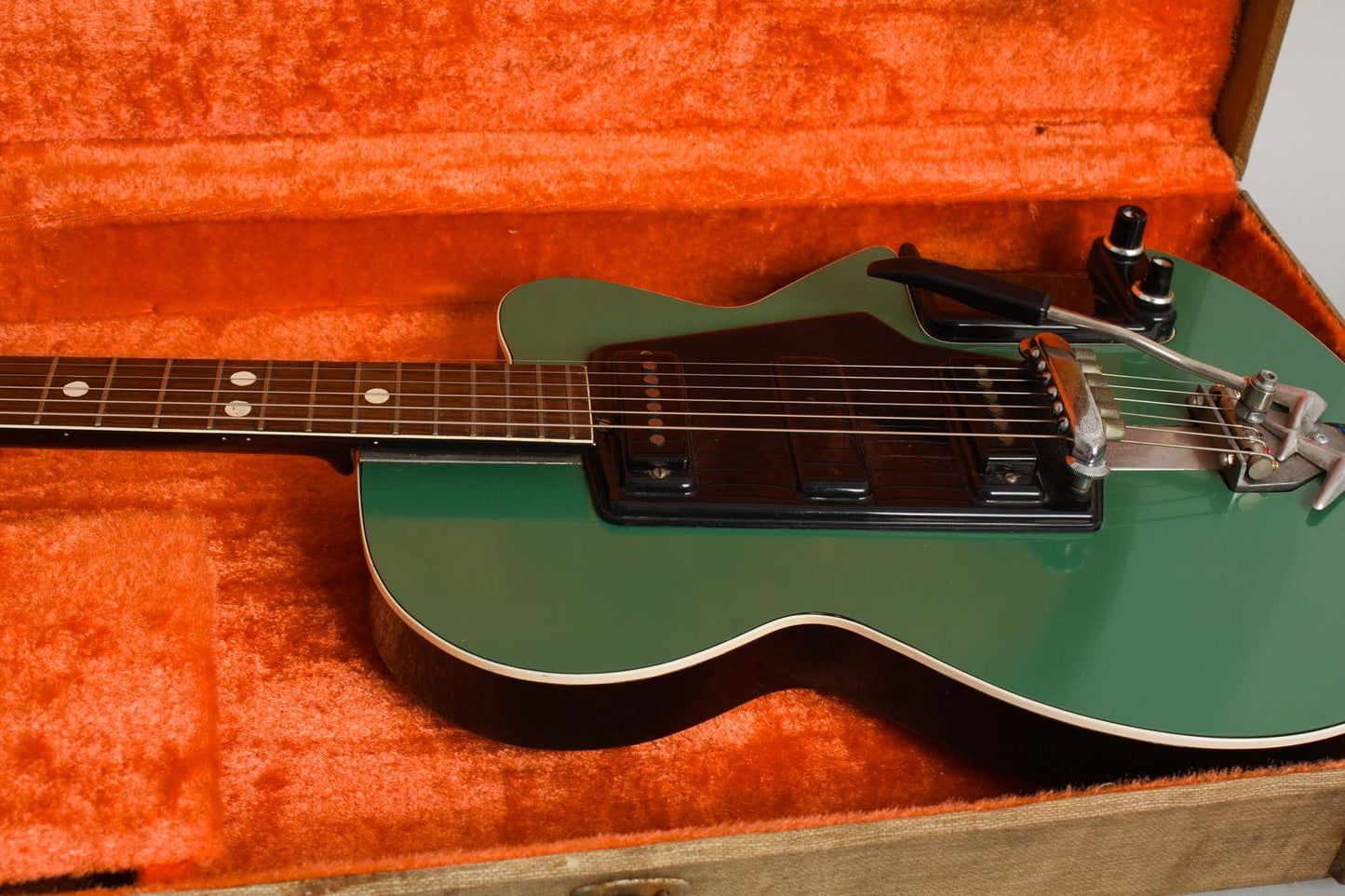
Wandre Soloist Model Semi-Hollow Body Electric Guitar (1964), made in Cavriago, Italy, green top, black back and sides finish, plywood and plastic body, plastic sheathed aluminum neck with rosewood fingerboard, period hard shell case.
In the wake of some wildly eccentric designs like the extreme cutaway Rock Oval by 1963-4 Italian guitar artist Wandre Pioli was convinced to put a few more broadly marketable instruments into production largely at the suggestion of his distributors. This Soloist model was mostly designed to please American distributor Don Noble and is one of the better known of these, largely due to decades of use by Nashville Ace Buddy Miller. Unlike Miller's famous Noble-Wandres, this Soloist is not equipped with the trapezoidal chrome Davoli pickups most associated with the brand but smaller-coil more Fender-like units.
This overtly "conventional" Wandre model was produced mostly around 1964. It features a fully hollow plastic-over-wood body in a form that resembles a number of smaller body semi acoustics like the 1950s Gretsch Jets or Guild Aristocrat. The body itself is thin laminate wood sheathed in black on the back with a medium-green covering on the single-bound top. While many Soloists sold in the US market carry a "Noble" plastic emblem glued to the front of the headstock this one has no branding at all; it appeared in Canada so who sold it originally may be lost to history.
By this point Pioli had begun to explore cheaper sources of pickups than the trapezoidal Davoli units virtually synonymous with his brand. This Soloist is a rare variation carrying smaller twin single coil pickups with individual magnet poles of type occasionally seen on Wandre instruments. They are housed in a molded black plastic pickguard screwed down hard to the body rather than floating above it. Unlike the Davoli pickups which are simply glued in these are screw-mounted and individually adjustable for height. The controls are housed in a modular molded black plastic sub-assembly in the lower body and consist of a master tone and volume knobs with three white push buttons to engage the pickups singly or together. The output jack is a regular 1/4" phone plug style for the non-Italian market, housed in a molded box at the back of the electronics assembly with the knobs mounted above.
Most of the other parts are standard Wandre fittings for guitars well into the company's tenure. The open slotted metal-framed wood headstock is bolted to the neck with staggered side-mounted pearloid button tuners under small sheathed coverplates. This Soloist features one of Pioli's more unique inventions: The bridge mounts OVER the strings, with small cradles for them hanging off the underside. It is fully adjustable for height and intonation, if very eccentric in feel. The vibrato assembly is solidly attached to the tail end of the central aluminum neck/body section, with a tubular plastic-tipped arm and a "W" logo at the tail.
Besides the unique aesthetics, the most trailblazing aspect of Wandre guitars is the bolt-on aluminum neck. Over a decade before the likes of Travis Bean or Veleno, Pioli's instruments featured a thin, rounded aluminum neck/body centerpiece attached so the angle is adjustable to the body. The rosewood fingerboard has simple large-dot inlays and a zero fret. This example retains the fitted plastic neck sheath which many Wandre players feel contributes greatly to a more traditionally playable feel than the raw aluminum below. Overall, this is another rare, wonderful and iconic instrument from the most inspired oddball Italian '60s guitar designer: Wandre Pioli, a true artist of the electric guitar.
Overall length is 40 1/4 in. (102.2 cm.), 13 3/8 in. (34 cm.) wide at lower bout, and 1 1/2 in. (3.8 cm.) in depth, measured at side of rim. Scale length is 25 in. (635 mm.). Width of nut is 1 5/8 in. (41 mm.).
This tasteful green Soloist remains in nice original condition overall with some signs of age and use. The body has noticeable scratching into center of the back and one impact chip on the back edge a bit behind the controls. The top has some scuffing but no serious wear. The somewhat fragile pickguard assembly has scuffing to the face and a small crack off the front end retaining screw, which is visible but not causing any problems. The headstock has a heavier lacquer finish than most Wandres; this has noticeable checking and may have been over or re-finished long ago. It is possible that this was done when the guitar was new, especially if an American export logo was removed for the Canadian market. It shows some wear especially along the edges but nothing too severe.
The electronics appear original except for one of the black-and-silver knobs, which is period but not a correct match to the other. The pickup covers show some pick scratching to the tops. The eccentric bridge and tailpiece are original and the black-tipped tubular vibrato arm is intact. The bridge has scuffing and plating loss on the top where the player's hand rests. There are marks showing the vibrato may have had a black plastic cover originally; The "W" Wandre logo plate on the tailpiece may have been added as the screw securing it is not original; with these modular Wandres it can be hard to say for sure. The somewhat fragile tuners and the often cracked plastic sheath covering the neck are all intact.
The original frets and fingerboard have some light wear and are still quite playable. This fun and rare 2-pickup Soloist is very light and easy to handle; it plays and sounds extremely well, offering a different flavor of the completely unique Wandre experience, a delight for connoisseurs of the fretted world of weird. It comes with a period rectangular hardshell case, which may have been with it since the beginning but is not Wandre-issue. Excellent - Condition.
View full details
In the wake of some wildly eccentric designs like the extreme cutaway Rock Oval by 1963-4 Italian guitar artist Wandre Pioli was convinced to put a few more broadly marketable instruments into production largely at the suggestion of his distributors. This Soloist model was mostly designed to please American distributor Don Noble and is one of the better known of these, largely due to decades of use by Nashville Ace Buddy Miller. Unlike Miller's famous Noble-Wandres, this Soloist is not equipped with the trapezoidal chrome Davoli pickups most associated with the brand but smaller-coil more Fender-like units.
This overtly "conventional" Wandre model was produced mostly around 1964. It features a fully hollow plastic-over-wood body in a form that resembles a number of smaller body semi acoustics like the 1950s Gretsch Jets or Guild Aristocrat. The body itself is thin laminate wood sheathed in black on the back with a medium-green covering on the single-bound top. While many Soloists sold in the US market carry a "Noble" plastic emblem glued to the front of the headstock this one has no branding at all; it appeared in Canada so who sold it originally may be lost to history.
By this point Pioli had begun to explore cheaper sources of pickups than the trapezoidal Davoli units virtually synonymous with his brand. This Soloist is a rare variation carrying smaller twin single coil pickups with individual magnet poles of type occasionally seen on Wandre instruments. They are housed in a molded black plastic pickguard screwed down hard to the body rather than floating above it. Unlike the Davoli pickups which are simply glued in these are screw-mounted and individually adjustable for height. The controls are housed in a modular molded black plastic sub-assembly in the lower body and consist of a master tone and volume knobs with three white push buttons to engage the pickups singly or together. The output jack is a regular 1/4" phone plug style for the non-Italian market, housed in a molded box at the back of the electronics assembly with the knobs mounted above.
Most of the other parts are standard Wandre fittings for guitars well into the company's tenure. The open slotted metal-framed wood headstock is bolted to the neck with staggered side-mounted pearloid button tuners under small sheathed coverplates. This Soloist features one of Pioli's more unique inventions: The bridge mounts OVER the strings, with small cradles for them hanging off the underside. It is fully adjustable for height and intonation, if very eccentric in feel. The vibrato assembly is solidly attached to the tail end of the central aluminum neck/body section, with a tubular plastic-tipped arm and a "W" logo at the tail.
Besides the unique aesthetics, the most trailblazing aspect of Wandre guitars is the bolt-on aluminum neck. Over a decade before the likes of Travis Bean or Veleno, Pioli's instruments featured a thin, rounded aluminum neck/body centerpiece attached so the angle is adjustable to the body. The rosewood fingerboard has simple large-dot inlays and a zero fret. This example retains the fitted plastic neck sheath which many Wandre players feel contributes greatly to a more traditionally playable feel than the raw aluminum below. Overall, this is another rare, wonderful and iconic instrument from the most inspired oddball Italian '60s guitar designer: Wandre Pioli, a true artist of the electric guitar.
Overall length is 40 1/4 in. (102.2 cm.), 13 3/8 in. (34 cm.) wide at lower bout, and 1 1/2 in. (3.8 cm.) in depth, measured at side of rim. Scale length is 25 in. (635 mm.). Width of nut is 1 5/8 in. (41 mm.).
This tasteful green Soloist remains in nice original condition overall with some signs of age and use. The body has noticeable scratching into center of the back and one impact chip on the back edge a bit behind the controls. The top has some scuffing but no serious wear. The somewhat fragile pickguard assembly has scuffing to the face and a small crack off the front end retaining screw, which is visible but not causing any problems. The headstock has a heavier lacquer finish than most Wandres; this has noticeable checking and may have been over or re-finished long ago. It is possible that this was done when the guitar was new, especially if an American export logo was removed for the Canadian market. It shows some wear especially along the edges but nothing too severe.
The electronics appear original except for one of the black-and-silver knobs, which is period but not a correct match to the other. The pickup covers show some pick scratching to the tops. The eccentric bridge and tailpiece are original and the black-tipped tubular vibrato arm is intact. The bridge has scuffing and plating loss on the top where the player's hand rests. There are marks showing the vibrato may have had a black plastic cover originally; The "W" Wandre logo plate on the tailpiece may have been added as the screw securing it is not original; with these modular Wandres it can be hard to say for sure. The somewhat fragile tuners and the often cracked plastic sheath covering the neck are all intact.
The original frets and fingerboard have some light wear and are still quite playable. This fun and rare 2-pickup Soloist is very light and easy to handle; it plays and sounds extremely well, offering a different flavor of the completely unique Wandre experience, a delight for connoisseurs of the fretted world of weird. It comes with a period rectangular hardshell case, which may have been with it since the beginning but is not Wandre-issue. Excellent - Condition.


Loading...
Just arrived!
Item #