


Wandre Roby Basso 63 Semi-Hollow Body Electric Bass Guitar (1963)


1
/
of
14
Regular price
$4,950.00
Regular price
$4,950.00
Sale price
$4,950.00
Unit price
/
per
Item #13983
Wandre Roby Basso 63 Model Semi-Hollow Body Electric Bass Guitar (1963), made in Cavriago, Italy, black with sparkles finish, plywood body, plastic sheathed aluminum neck with rosewood fingerboard, black tolex hard shell case.
The Wandre story is a book-length tale of the battle between creativity and commerce, and there is a (unfortunately rare) 2014 book "WANDRE-The Artist Of The Electric Guitar" by Marco Ballestri available for the curious! Italian artist/dreamer Wandre Pioli started his lutherie career with upright basses; still his earlier electric bass guitars are quirky at best but very rare and hold a strong fascination for fans of his instruments.
Wandre bass guitars up into the mid '60s share the same fantastical looking materials and cosmetics as the guitars; essentially they ARE simply 4-string guitars with heavier strings. Perhaps Wandre did not want to invest in the tooling required to make a longer scale neck or maybe he just liked the concept, but all the early basses out of his round Cavriago factory have 25" guitar-scale necks. This idea was also used by some US companies, especially Valco (with the National Style 85 and the Supro Pocket Bass), Carvin, Kay with their Value Leaders and a few others, but most players generally expected at least a 29 1/2 to 30" scale as the minimum on a true bass guitar.
The "Roby" extreme double cutaway design debuted in 1962, named for Wandre's newly born second son; supposedly it conjures up a small child with open arms! The wide but thin hollow body is thin plywood with a gold glitter-speckled black coating, oddly recessed in the center to accommodate the long aluminum neck/body centerpiece. This design was offered in several guitar versions before this single-pickup bass was added to the line in 1963. This bass model was never imported to the US, although the Roby guitars briefly were.
Despite the guitar-length neck the single Davoli pickups gives this bass a surprisingly full sound that mellows nicely at lower volume. It is mounted solidly in a molded white plastic pickguard assembly floating above the body running all the way back to the bridge, which sits on its back end. The bridge itself is a Hofner-style slotted rosewood piece with fretwire saddles with the strings running on to a sleek minimalist milled metal tailpiece. This is solidly attached to the back end of the central aluminum neck/body section and has a decorative black "W" logo screwed on. The output jack, volume and tone controls (with white tipped black knobs) are mounted to a pressed-metal box situated by the lower edge of the face.
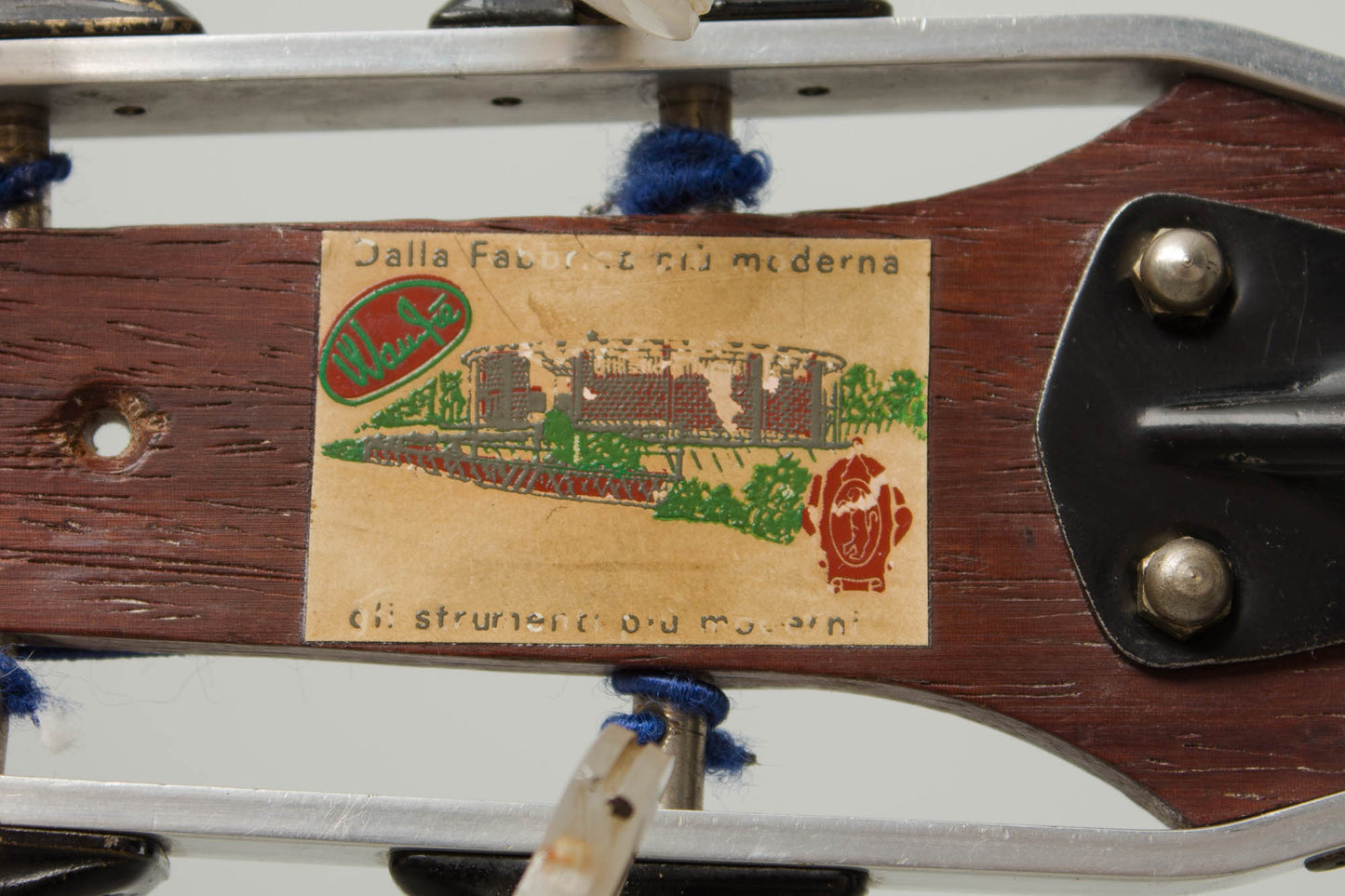
Besides the unique aesthetics, the most trailblazing aspect of Wandre guitars is the bolt-on aluminum neck. Over a decade before the likes of Travis Bean or Veleno, Pioli's instruments featured a thin, rounded aluminum neck/body centerpiece attached so the angle is adjustable to the body. The rosewood fingerboard has simple large-dot inlays and a zero fret. This example has the white plastic neck sheath which many players feel contributes to a more traditionally playable feel than the raw aluminum below. Bolted to the top is a metal-framed slotted headstock with a wooden center, four individual guitar-style plastic button tuners on either side and an aluminum nut. A Wandre logo is faintly stamped into the headstock face, with a less-common colorful sticker on the back.
Overall this rather minimalist mini-bass is another rare, wonderful and iconic piece of the Wandre puzzle, unique as they all are and simply an incredibly handy and cheerfully fun instrument to play.
Overall length is 42 in. (106.7 cm.), 15 3/8 in. (39.1 cm.) wide at lower bout, and 1 1/2 in. (3.8 cm.) in depth, measured at side of rim. Scale length is 25 in. (635 mm.). Width of nut is 1 5/8 in. (41 mm.).
This rare bass guitar has survived in original and quite decent condition; all original hardware is intact including the often lost or cracked plastic sheath covering the aluminum neck. Wandre instruments are often missing parts or have damaged bodies due to the quirky nature of their construction; this one has survived solid and all original. There are some long checking lines to the body covering mostly around the tailpiece and jack box as well as the back but only a few small edge chips. The fragile thin plastic neck sheath has some very small checks but no notable damage still smooth to the touch, the headstock has some nicks and dents and the sticker is a bit faded.
The single-unit molded plastic pickguard holding the pickup and bridge is fully intact with no cracks or breaks, as is the somewhat fragile stamped metal jack housing with the tone and volume knobs mounted on it. This is slightly dented in but intact; the jack is standard 1/4" piece likely replacing an original obsolete 5mm Geloso jack originally fitted to many Wandres; this the most common modification to a non-import Wandre. The adjustable bridge with its 4 fretwire saddles is fully intact as is the rest of the fairly minimal hardware. The saddles are all the way back; intonation is a bit iffy on this guitar scale bass, but that is common with these very short scale 4-strings.
This single-pickup bass plays fine and sounds as good as any 24 3/4" scale 4-string we have heard; actually a usable instrument if not a pro-grade bass by modern standards. It is not particularly versatile but the Davoli pickup works well in bass mode, imparting a tight clarity even to the lowest notes. Wandre's space-age construction results in a fairly ethereal feeling semi-hollow bass but this is a very nice example ready to go in a modern hardshell case. Overall Excellent - Condition.
View full details
The Wandre story is a book-length tale of the battle between creativity and commerce, and there is a (unfortunately rare) 2014 book "WANDRE-The Artist Of The Electric Guitar" by Marco Ballestri available for the curious! Italian artist/dreamer Wandre Pioli started his lutherie career with upright basses; still his earlier electric bass guitars are quirky at best but very rare and hold a strong fascination for fans of his instruments.
Wandre bass guitars up into the mid '60s share the same fantastical looking materials and cosmetics as the guitars; essentially they ARE simply 4-string guitars with heavier strings. Perhaps Wandre did not want to invest in the tooling required to make a longer scale neck or maybe he just liked the concept, but all the early basses out of his round Cavriago factory have 25" guitar-scale necks. This idea was also used by some US companies, especially Valco (with the National Style 85 and the Supro Pocket Bass), Carvin, Kay with their Value Leaders and a few others, but most players generally expected at least a 29 1/2 to 30" scale as the minimum on a true bass guitar.
The "Roby" extreme double cutaway design debuted in 1962, named for Wandre's newly born second son; supposedly it conjures up a small child with open arms! The wide but thin hollow body is thin plywood with a gold glitter-speckled black coating, oddly recessed in the center to accommodate the long aluminum neck/body centerpiece. This design was offered in several guitar versions before this single-pickup bass was added to the line in 1963. This bass model was never imported to the US, although the Roby guitars briefly were.
Despite the guitar-length neck the single Davoli pickups gives this bass a surprisingly full sound that mellows nicely at lower volume. It is mounted solidly in a molded white plastic pickguard assembly floating above the body running all the way back to the bridge, which sits on its back end. The bridge itself is a Hofner-style slotted rosewood piece with fretwire saddles with the strings running on to a sleek minimalist milled metal tailpiece. This is solidly attached to the back end of the central aluminum neck/body section and has a decorative black "W" logo screwed on. The output jack, volume and tone controls (with white tipped black knobs) are mounted to a pressed-metal box situated by the lower edge of the face.
Besides the unique aesthetics, the most trailblazing aspect of Wandre guitars is the bolt-on aluminum neck. Over a decade before the likes of Travis Bean or Veleno, Pioli's instruments featured a thin, rounded aluminum neck/body centerpiece attached so the angle is adjustable to the body. The rosewood fingerboard has simple large-dot inlays and a zero fret. This example has the white plastic neck sheath which many players feel contributes to a more traditionally playable feel than the raw aluminum below. Bolted to the top is a metal-framed slotted headstock with a wooden center, four individual guitar-style plastic button tuners on either side and an aluminum nut. A Wandre logo is faintly stamped into the headstock face, with a less-common colorful sticker on the back.
Overall this rather minimalist mini-bass is another rare, wonderful and iconic piece of the Wandre puzzle, unique as they all are and simply an incredibly handy and cheerfully fun instrument to play.
Overall length is 42 in. (106.7 cm.), 15 3/8 in. (39.1 cm.) wide at lower bout, and 1 1/2 in. (3.8 cm.) in depth, measured at side of rim. Scale length is 25 in. (635 mm.). Width of nut is 1 5/8 in. (41 mm.).
This rare bass guitar has survived in original and quite decent condition; all original hardware is intact including the often lost or cracked plastic sheath covering the aluminum neck. Wandre instruments are often missing parts or have damaged bodies due to the quirky nature of their construction; this one has survived solid and all original. There are some long checking lines to the body covering mostly around the tailpiece and jack box as well as the back but only a few small edge chips. The fragile thin plastic neck sheath has some very small checks but no notable damage still smooth to the touch, the headstock has some nicks and dents and the sticker is a bit faded.
The single-unit molded plastic pickguard holding the pickup and bridge is fully intact with no cracks or breaks, as is the somewhat fragile stamped metal jack housing with the tone and volume knobs mounted on it. This is slightly dented in but intact; the jack is standard 1/4" piece likely replacing an original obsolete 5mm Geloso jack originally fitted to many Wandres; this the most common modification to a non-import Wandre. The adjustable bridge with its 4 fretwire saddles is fully intact as is the rest of the fairly minimal hardware. The saddles are all the way back; intonation is a bit iffy on this guitar scale bass, but that is common with these very short scale 4-strings.
This single-pickup bass plays fine and sounds as good as any 24 3/4" scale 4-string we have heard; actually a usable instrument if not a pro-grade bass by modern standards. It is not particularly versatile but the Davoli pickup works well in bass mode, imparting a tight clarity even to the lowest notes. Wandre's space-age construction results in a fairly ethereal feeling semi-hollow bass but this is a very nice example ready to go in a modern hardshell case. Overall Excellent - Condition.


Loading...
Just arrived!
Item #