


Wandre Polyphon Alpha 2 Semi-Hollow Body Electric Guitar (1964)


1
/
of
14
Couldn't load pickup availability
Item #13569
Wandre Polyphon Alpha 2 Model Semi-Hollow Body Electric Guitar (1964), made in Cavriago, Italy, natural finish, wood and plastic body, plastic sheathed aluminum neck with rosewood fingerboard, black tolex hard shell case.
"What are those guitars -- man, we don't have those in the STATES!" So spoke Bob Dylan in 1965, captured on film looking into the window of an English music store full of Wandre guitars. These amazingly futuristic and defiantly original instruments were sold through the 1960s under several different brand names in Europe, and occasionally the US. Wandre Pioli's singular creations have fascinated adventurous electric guitar fans since then, but most players have never seen or handled one. All of Italian artist/engineer Wandre Pioli's instruments are eccentric, sometimes to the extreme and the sheer variety of designs his round factory produced over less than a decade is staggering. This one has some of the best of his concepts wedded to a more functional semi-hollow guitar superstructure than some.
The Wandre story is a book-length epic tale of the battle between creativity and commerce, and there is an (unfortunately rare) 2014 book "WANDRE-The Artist Of The Electric Guitar" by Marco Ballestri available for the curious! This rare guitar is a nice example of the two-pickup version of the 1964-era "Alpha Polyphon" model, one of the more varied series in the extensive Wandre line. "Polyphon" models were offered in a full line of pickup options and neck variations, all built on this semi-hollow plastic-sheathed body, in this case veneered with a wood-grained Formica face. One model even had an internal reverb system!
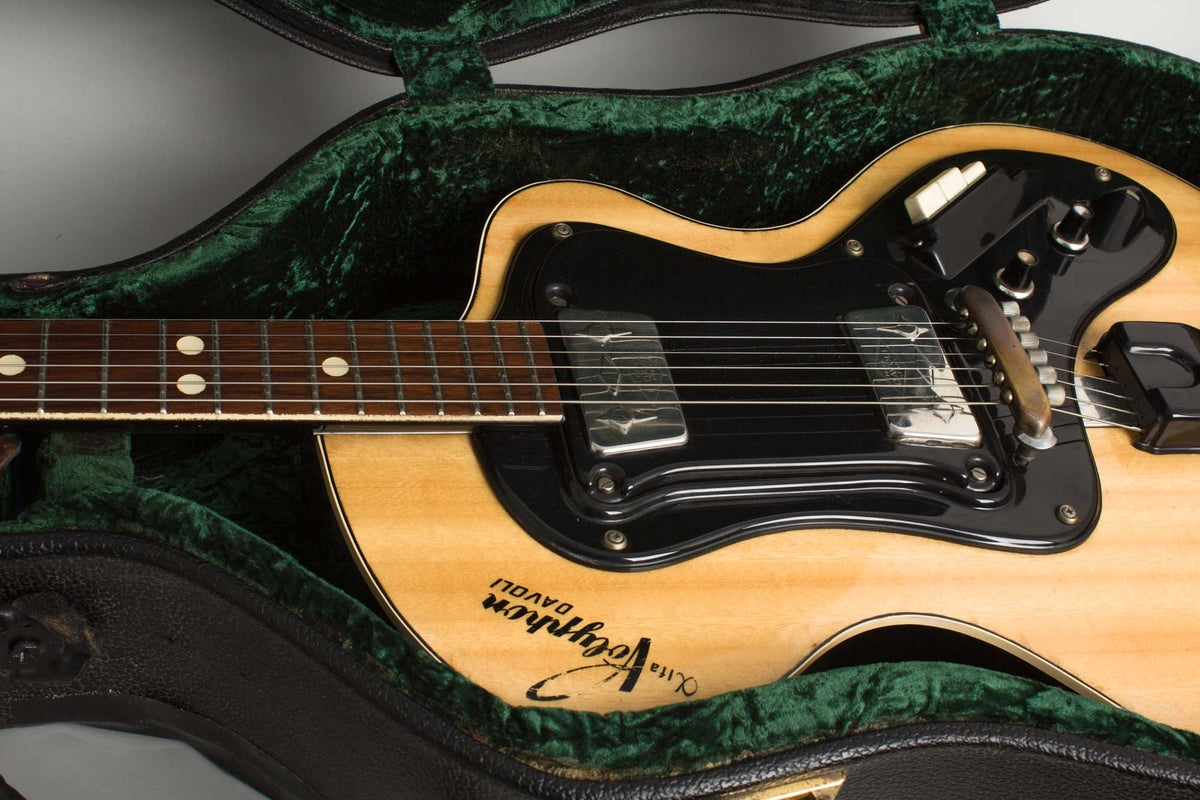
The Polyphon body is 16" wide but thin at the rim, built of thin plywood and plastic with an arched back, flat top, and sloping soft cutaway on the treble side. This Polyphon Alpha 2 mounts a pair of the trapezoidal Davoli pickups that Pioli favored in a two-stage pickguard/pickup/bridge assembly made of vac-u-formed plastic. These are controlled by a single master volume and a tone knob, with a bank of three accordion-style selector switches below turning them on or off. The jack is mounted in a raised plastic bay similar to Hagstrom practice. Wandre's proprietary plastic-sheathed aluminum neck is fitted here with a more traditional 3-on-3 wood and metal headstock. This style was designated Polyphon "Alpha"; "Beta" models had a single-sided tuner arrangement.
This Polyphon is a "hardtail' with no tremolo system, the strings anchored to an aluminum extension of the neck core under a black plastic cover. The adjustable bridge is a Wandre creation; the body of it mounts OVER the strings, with 6 small individual cradles for them hanging off the underside. It is fully adjustable for height and intonation, if very eccentric in feel.
This guitar offers the best playing and engineering features of the Wandre line combined with a more conventional body shape than some. In recent times Wandre guitars are most associated with Buddy Miller, who has exploited their unique sonic signature for many years. This Polyphon is similar generally to the Soloist model he prefers, if a larger instrument all around. If not for his patronage, most American players at least would likely never have seen any of them! A very limited line was imported to the US by Noble around 1963, but most Wandre guitars are only found in Europe unless an American collector has brought one to our shores. We are always on the lookout for them and this Polyphon is a nice player-friendly example.
Overall length is 44 1/4 in. (112.4 cm.), 16 in. (40.6 cm.) wide at lower bout, and 1 7/8 in. (4.8 cm.) in depth, measured at side of rim. Scale length is 24 3/4 in. (629 mm.). Width of nut is 1 5/8 in. (41 mm.).
While showing signs of use this rare 60+ year old guitar remains in fine playing condition with no major damage or repair and, rarely and critically, all the original hardware present and intact. This is no small feat for a Wandre guitar, which are notoriously prone to plastic parts breaking or bits and pieces going missing. There is scuffing and playing wear overall, most heavily to the upper surface of the large two-stage plastic pickguard assembly. This is however intact with no cracks or breaks, even at the fragile raised jack housing. As is typical, the heavy sheathing on the back of the body has a number of long deep checking lines but is not flaking away; there are a couple of chips to the edges.
The often damaged plastic neck sheath shows no aging distress at all and still plays smooth and easy. The "natural" Formica top shows small nicks and dings, but one larger chip off the rear edge the only major wear. The "Alpha Polyphon Davoli" applique on the upper bass bout is mostly intact with less paint rubbed off than many, mostly some loss to the large looping "P". The headstock is heavily lacquered showing light wear; this appears original with an incomplete "Wandre" stamp on the back mostly obscured.
The original bridge on this model is a rather complicated affair with saddles hanging downwards, the strings passing through V-shaped apertures underneath. Often lost or replaced, this one is in good working order with noticeable wear to the plating on top where the player's hand rests. Wandre made several sizes of this bridge that are ever so slightly off while appearing nearly identical, making it a nice plus that this was never misplaced or re-outfitted with a different bridge as often happened with these models.
The somewhat fragile tailpiece cover is intact and original as are the knobs, pushbutton switches, tuners and all other trimmings on the guitar. The 1/4" jack also appears period but may be an old replacement; the original was often a proprietary small-plug European style and a real headache in use. Overall, this is a nice example of one of these unique Italian gems, an excellent player and very good sounding guitar. It resides in a fairly modern Dreadnought case, a functional if inexact fit; most of these came originally in flimsy vinyl gig bags and original cases are pretty much non-existent. Overall Very Good + Condition.
View full details
"What are those guitars -- man, we don't have those in the STATES!" So spoke Bob Dylan in 1965, captured on film looking into the window of an English music store full of Wandre guitars. These amazingly futuristic and defiantly original instruments were sold through the 1960s under several different brand names in Europe, and occasionally the US. Wandre Pioli's singular creations have fascinated adventurous electric guitar fans since then, but most players have never seen or handled one. All of Italian artist/engineer Wandre Pioli's instruments are eccentric, sometimes to the extreme and the sheer variety of designs his round factory produced over less than a decade is staggering. This one has some of the best of his concepts wedded to a more functional semi-hollow guitar superstructure than some.
The Wandre story is a book-length epic tale of the battle between creativity and commerce, and there is an (unfortunately rare) 2014 book "WANDRE-The Artist Of The Electric Guitar" by Marco Ballestri available for the curious! This rare guitar is a nice example of the two-pickup version of the 1964-era "Alpha Polyphon" model, one of the more varied series in the extensive Wandre line. "Polyphon" models were offered in a full line of pickup options and neck variations, all built on this semi-hollow plastic-sheathed body, in this case veneered with a wood-grained Formica face. One model even had an internal reverb system!
The Polyphon body is 16" wide but thin at the rim, built of thin plywood and plastic with an arched back, flat top, and sloping soft cutaway on the treble side. This Polyphon Alpha 2 mounts a pair of the trapezoidal Davoli pickups that Pioli favored in a two-stage pickguard/pickup/bridge assembly made of vac-u-formed plastic. These are controlled by a single master volume and a tone knob, with a bank of three accordion-style selector switches below turning them on or off. The jack is mounted in a raised plastic bay similar to Hagstrom practice. Wandre's proprietary plastic-sheathed aluminum neck is fitted here with a more traditional 3-on-3 wood and metal headstock. This style was designated Polyphon "Alpha"; "Beta" models had a single-sided tuner arrangement.
This Polyphon is a "hardtail' with no tremolo system, the strings anchored to an aluminum extension of the neck core under a black plastic cover. The adjustable bridge is a Wandre creation; the body of it mounts OVER the strings, with 6 small individual cradles for them hanging off the underside. It is fully adjustable for height and intonation, if very eccentric in feel.
This guitar offers the best playing and engineering features of the Wandre line combined with a more conventional body shape than some. In recent times Wandre guitars are most associated with Buddy Miller, who has exploited their unique sonic signature for many years. This Polyphon is similar generally to the Soloist model he prefers, if a larger instrument all around. If not for his patronage, most American players at least would likely never have seen any of them! A very limited line was imported to the US by Noble around 1963, but most Wandre guitars are only found in Europe unless an American collector has brought one to our shores. We are always on the lookout for them and this Polyphon is a nice player-friendly example.
Overall length is 44 1/4 in. (112.4 cm.), 16 in. (40.6 cm.) wide at lower bout, and 1 7/8 in. (4.8 cm.) in depth, measured at side of rim. Scale length is 24 3/4 in. (629 mm.). Width of nut is 1 5/8 in. (41 mm.).
While showing signs of use this rare 60+ year old guitar remains in fine playing condition with no major damage or repair and, rarely and critically, all the original hardware present and intact. This is no small feat for a Wandre guitar, which are notoriously prone to plastic parts breaking or bits and pieces going missing. There is scuffing and playing wear overall, most heavily to the upper surface of the large two-stage plastic pickguard assembly. This is however intact with no cracks or breaks, even at the fragile raised jack housing. As is typical, the heavy sheathing on the back of the body has a number of long deep checking lines but is not flaking away; there are a couple of chips to the edges.
The often damaged plastic neck sheath shows no aging distress at all and still plays smooth and easy. The "natural" Formica top shows small nicks and dings, but one larger chip off the rear edge the only major wear. The "Alpha Polyphon Davoli" applique on the upper bass bout is mostly intact with less paint rubbed off than many, mostly some loss to the large looping "P". The headstock is heavily lacquered showing light wear; this appears original with an incomplete "Wandre" stamp on the back mostly obscured.
The original bridge on this model is a rather complicated affair with saddles hanging downwards, the strings passing through V-shaped apertures underneath. Often lost or replaced, this one is in good working order with noticeable wear to the plating on top where the player's hand rests. Wandre made several sizes of this bridge that are ever so slightly off while appearing nearly identical, making it a nice plus that this was never misplaced or re-outfitted with a different bridge as often happened with these models.
The somewhat fragile tailpiece cover is intact and original as are the knobs, pushbutton switches, tuners and all other trimmings on the guitar. The 1/4" jack also appears period but may be an old replacement; the original was often a proprietary small-plug European style and a real headache in use. Overall, this is a nice example of one of these unique Italian gems, an excellent player and very good sounding guitar. It resides in a fairly modern Dreadnought case, a functional if inexact fit; most of these came originally in flimsy vinyl gig bags and original cases are pretty much non-existent. Overall Very Good + Condition.


Loading...
Just arrived!
Item #