


Wandre Etrurian II Solid Body Electric Bass Guitar (1965)


1
/
of
15
Regular price
$9,250.00
Regular price
$9,250.00
Sale price
$9,250.00
Unit price
/
per
Item #14001
Wandre Etrurian II Model Solid Body Electric Bass Guitar (1965), made in Cavriago, Italy, black lacquer finish, ayous wood body, plastic sheathed aluminum neck with rosewood fingerboard, molded plastic hard shell case.
"What are those guitars -- man, we don't have those in the STATES!" So spoke Bob Dylan in 1965, captured on film looking into the window of an English music store full of Wandre guitars. These amazingly futuristic and completely original instruments were sold under different brand names in Europe through the 1960s. They have fascinated adventurous electric guitar fans since then, but most players have never seen or handled one. All Wandre instruments are eccentric, sometimes to the extreme; this rare Etrurian II bass is a shining example of the outer bounds of Wandre Pioli's creative eye.
By the mid-60s Wandre's hand had been convinced to develop some more conventional designs for broader market appeal but by the end of 1964 after marketing a few less wild-looking models, he debuted the Etrurian as a patriotic ode to his beloved Tuscany. The distinct tapered doublecut body design is fashioned after the shape of an Etruscan bucchero, a vase-like vessel emblematic of this ancient pre-Roman Italian culture.
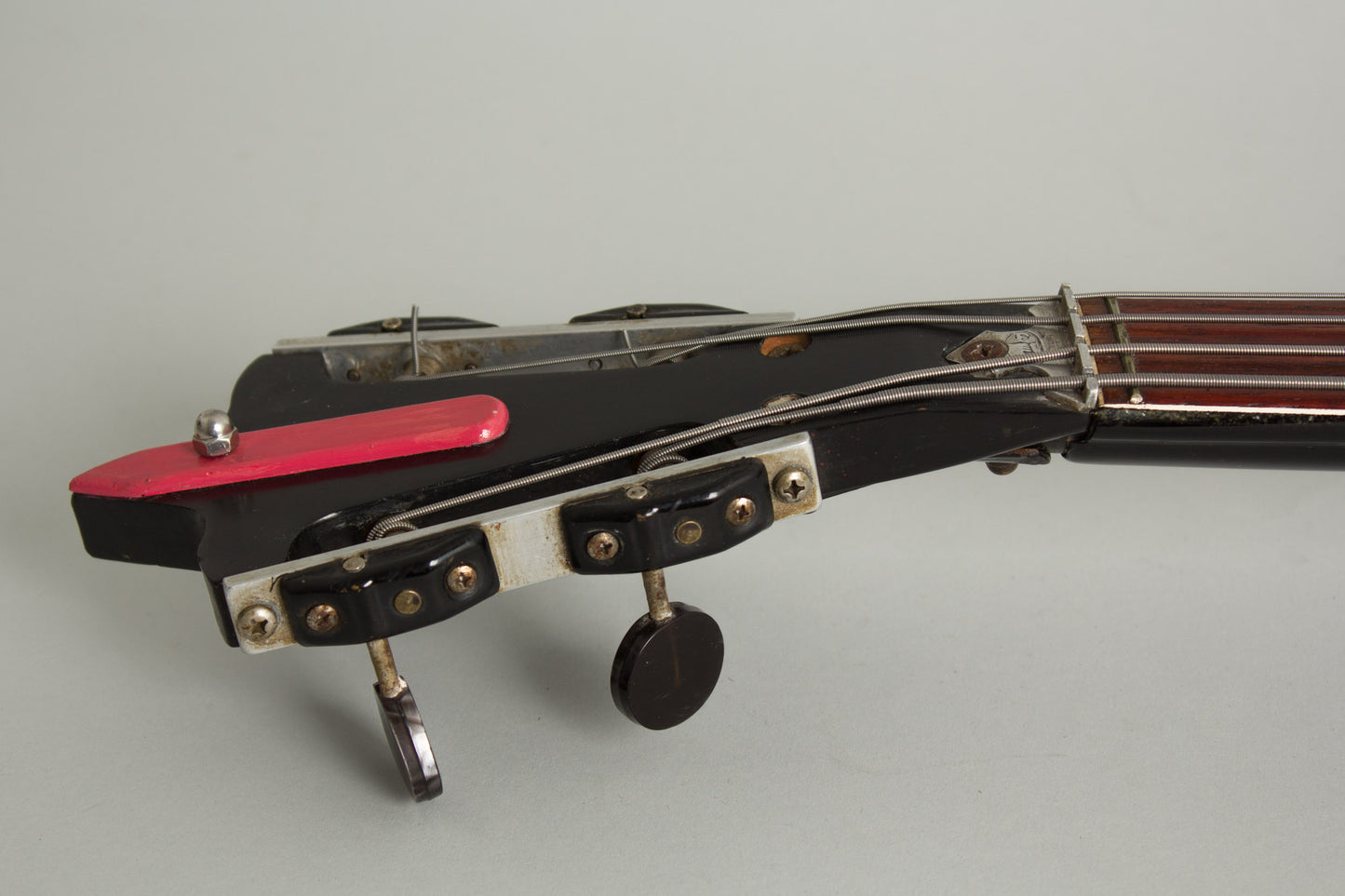
While earlier Wander basses were mostly very short-scale instruments, the Etrurian is a full 34" long scale professional grade instrument. Aside from the unique aesthetics and the inherent quirky qualities of Wandre construction, this is otherwise a relatively straightforward solidbody electric bass. Unlike many earlier plywood-and-plastic Wandre creations, it uses a solid ayous wood body with Wandre's signature (and ahead of its time) aluminum bolt on neck covered with a black plastic sheath for more comfortable playability. The headstock is very eccentric for a bass, slotted with side-mounted guitar-style tuners and angled out in reverse with the widest part at the top.
The bass features a single Davoli pickup mounted in the neck position. The hot pink pickguard covering most of the face is one of several color schemes offered on this rare Wandre creation; a few other pink guard basses exist and there are also examples of tortoise shell, faux woodgrain and even fleur-de-lis print. The wiring scheme is single volume and tone knobs and a three-way switch functioning as essentially a 3-way tone modifier for the single pickup. The strings run to a fully adjustable aluminum bridge under a molded plastic cover; a plastic handrest is positioned in the center of the body. Etrurian basses were offered with two pickups as well; This is a second generation model; the "II" in the name refers to the treble-side switch placement, not the number of pickups.
While Marco Ballestri's extravagant Wandre book is usually a useful tool to taxonomize and study Mr. Pioli's work, the information given about the Etrurian bass is a bit, for lack of a better word, eroticized�generally not suitable for work! While we cannot say that we share his explicit thoughts about the erotic nature of this instrument, it undeniably evokes a very romantic (or rather, pre-Romantic) image of ancient Italy and serves as Wandre's biggest celebration of his beloved mother country. It also happens to be an excellent player's instrument, with a powerful punchy sound from the Davoli pickup (not as muddy as many basses with this neck-position layout) and a very comfortable neck.
Overall length is 44 in. (111.8 cm.), 12 in. (30.5 cm.) across at the widest point, and 1 1/2 in. (3.8 cm.) in depth, measured at side of rim. Scale length is 34 in. (864 mm.). Width of nut is 1 5/8 in. (41 mm.).
This big black Etrurian has lasted over 60 years in overall good order; the lacquer on the body is shiny, smooth showing only generally light scratches and dents mostly to the back. There are a couple small screw holes left behind from a previous owner: two very, very small ones stealthily placed on the back of the upper treble-side bout and one on the treble-side horn that likely once held a somewhat unorthodox strap button in place; usually that would have meant someone tried stringing this up lefty, which seems difficult with the slot size of that original aluminum Wandre nut but not impossible perhaps (certainly possible with the original adjustable bridge).
The bass remains original including the often cracked sheath covering the aluminum neck, the fragile plastic bridge cover and handrest are all fully intact and undamaged. The fragile small plastic tuner buttons are undamaged as well, despite decades of tuning heavy bass strings. The only missing piece is the removable plastic headstock cover that was likely discarded long ago revealing the slotted headstock, a change we actually find more becoming.
The incredibly cool hot pink pickguard appears original to the instrument; the stenciled writing on it we cannot absolutely guarantee as original. Etrurian pickguards came from the factory both with and without lettering but the execution of this graphic appears more homespun; also the description of the knob functions is reversed! The single Davoli pickup sounds strong and clear, all electronics are original.
The original frets have been crowned just a bit; they show signs of use but are in fine playing shape and the rosewood fingerboard shows minimal wear. This is one of the more unusual electric (non-upright) basses to come from Mr. Pioli, set up with roundwound strings and ready to rock once one becomes accustomed to the eccentric balance of the long neck and small "reverse" body shape. It comes in a more recent non-original black molded plastic hardshell case. Overall Excellent - Condition.
View full details
"What are those guitars -- man, we don't have those in the STATES!" So spoke Bob Dylan in 1965, captured on film looking into the window of an English music store full of Wandre guitars. These amazingly futuristic and completely original instruments were sold under different brand names in Europe through the 1960s. They have fascinated adventurous electric guitar fans since then, but most players have never seen or handled one. All Wandre instruments are eccentric, sometimes to the extreme; this rare Etrurian II bass is a shining example of the outer bounds of Wandre Pioli's creative eye.
By the mid-60s Wandre's hand had been convinced to develop some more conventional designs for broader market appeal but by the end of 1964 after marketing a few less wild-looking models, he debuted the Etrurian as a patriotic ode to his beloved Tuscany. The distinct tapered doublecut body design is fashioned after the shape of an Etruscan bucchero, a vase-like vessel emblematic of this ancient pre-Roman Italian culture.
While earlier Wander basses were mostly very short-scale instruments, the Etrurian is a full 34" long scale professional grade instrument. Aside from the unique aesthetics and the inherent quirky qualities of Wandre construction, this is otherwise a relatively straightforward solidbody electric bass. Unlike many earlier plywood-and-plastic Wandre creations, it uses a solid ayous wood body with Wandre's signature (and ahead of its time) aluminum bolt on neck covered with a black plastic sheath for more comfortable playability. The headstock is very eccentric for a bass, slotted with side-mounted guitar-style tuners and angled out in reverse with the widest part at the top.
The bass features a single Davoli pickup mounted in the neck position. The hot pink pickguard covering most of the face is one of several color schemes offered on this rare Wandre creation; a few other pink guard basses exist and there are also examples of tortoise shell, faux woodgrain and even fleur-de-lis print. The wiring scheme is single volume and tone knobs and a three-way switch functioning as essentially a 3-way tone modifier for the single pickup. The strings run to a fully adjustable aluminum bridge under a molded plastic cover; a plastic handrest is positioned in the center of the body. Etrurian basses were offered with two pickups as well; This is a second generation model; the "II" in the name refers to the treble-side switch placement, not the number of pickups.
While Marco Ballestri's extravagant Wandre book is usually a useful tool to taxonomize and study Mr. Pioli's work, the information given about the Etrurian bass is a bit, for lack of a better word, eroticized�generally not suitable for work! While we cannot say that we share his explicit thoughts about the erotic nature of this instrument, it undeniably evokes a very romantic (or rather, pre-Romantic) image of ancient Italy and serves as Wandre's biggest celebration of his beloved mother country. It also happens to be an excellent player's instrument, with a powerful punchy sound from the Davoli pickup (not as muddy as many basses with this neck-position layout) and a very comfortable neck.
Overall length is 44 in. (111.8 cm.), 12 in. (30.5 cm.) across at the widest point, and 1 1/2 in. (3.8 cm.) in depth, measured at side of rim. Scale length is 34 in. (864 mm.). Width of nut is 1 5/8 in. (41 mm.).
This big black Etrurian has lasted over 60 years in overall good order; the lacquer on the body is shiny, smooth showing only generally light scratches and dents mostly to the back. There are a couple small screw holes left behind from a previous owner: two very, very small ones stealthily placed on the back of the upper treble-side bout and one on the treble-side horn that likely once held a somewhat unorthodox strap button in place; usually that would have meant someone tried stringing this up lefty, which seems difficult with the slot size of that original aluminum Wandre nut but not impossible perhaps (certainly possible with the original adjustable bridge).
The bass remains original including the often cracked sheath covering the aluminum neck, the fragile plastic bridge cover and handrest are all fully intact and undamaged. The fragile small plastic tuner buttons are undamaged as well, despite decades of tuning heavy bass strings. The only missing piece is the removable plastic headstock cover that was likely discarded long ago revealing the slotted headstock, a change we actually find more becoming.
The incredibly cool hot pink pickguard appears original to the instrument; the stenciled writing on it we cannot absolutely guarantee as original. Etrurian pickguards came from the factory both with and without lettering but the execution of this graphic appears more homespun; also the description of the knob functions is reversed! The single Davoli pickup sounds strong and clear, all electronics are original.
The original frets have been crowned just a bit; they show signs of use but are in fine playing shape and the rosewood fingerboard shows minimal wear. This is one of the more unusual electric (non-upright) basses to come from Mr. Pioli, set up with roundwound strings and ready to rock once one becomes accustomed to the eccentric balance of the long neck and small "reverse" body shape. It comes in a more recent non-original black molded plastic hardshell case. Overall Excellent - Condition.


Loading...
Just arrived!
Item #