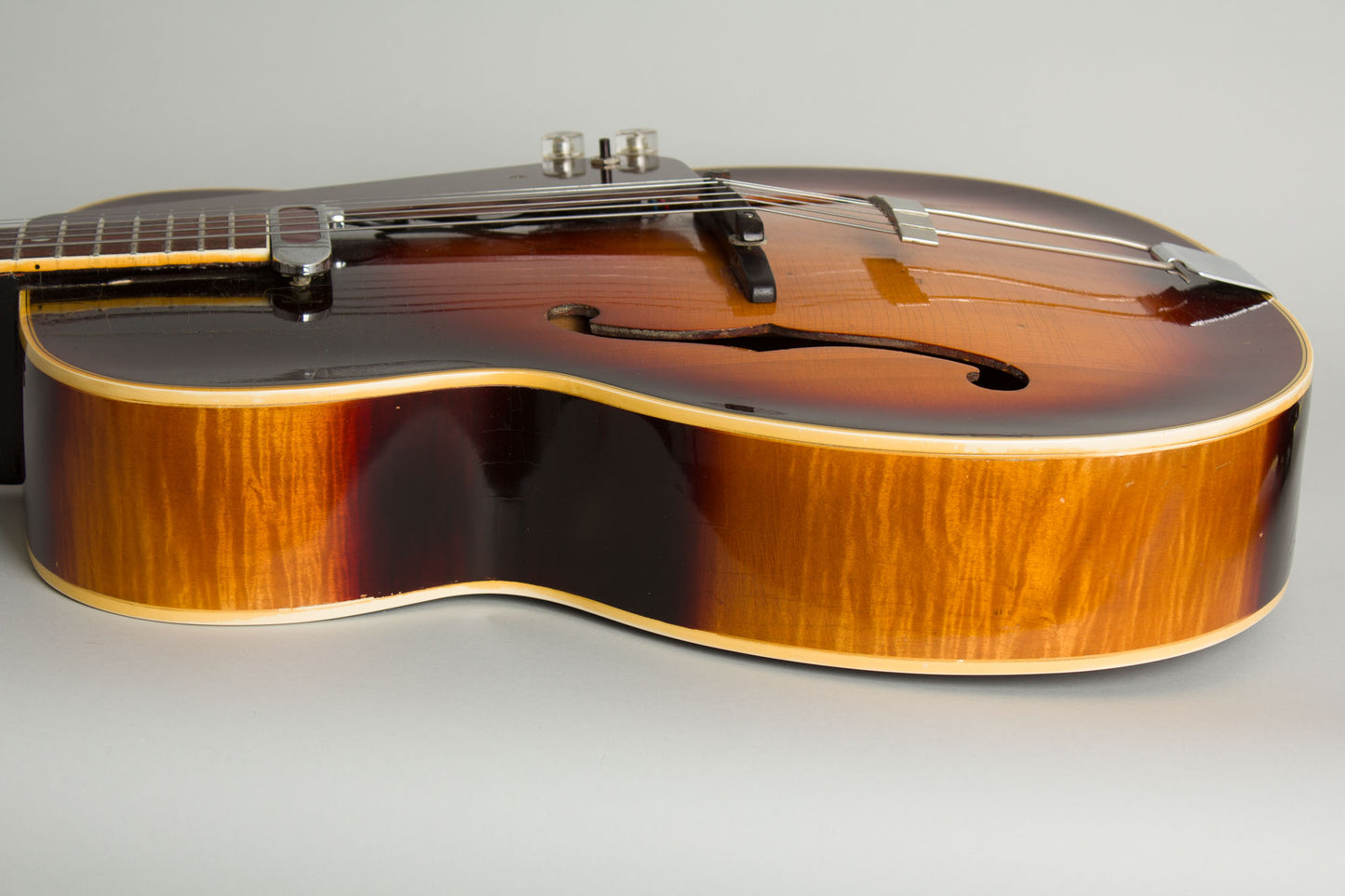
Vega C-56 Special w/DeArmond Rhythm Chief Pickup Model Arch Top Acoustic Guitar (late 1940s), made in Boston, Mass., serial # 5370, sunburst lacquer finish, maple back and sides, spruce top; mahogany neck with ebony fingerboard, black hard shell case.
The finely built Vega archtops of the 1930's and '40s remain mostly under-appreciated; while the company is not well remembered in this market niche their instruments were always very well made. This one is a bit of an oddball, and has had something of a hard life over the last 75 or so years but survives as a fine player's instrument.
This guitar is labeled "Special" on the label with the C-56 model designation hand written in fountain pen. It appears to date from the end of the 1940s, when Vega archtops still resembled their pre-war ancestors but with the useful addition of an adjustable truss rod. This is a carved-top 17" wide guitar, roughly the equivalent to the Gibson L-7 and in some ways even a bit classier. The spruce top is parallel braced and carved fairly thick (from a block made up of 4 pieces of wood!), giving a mellower but still powerful sound. The back and sides are flame maple, it appears the back is pressed not carved.
This "Special" C-56 is ornamented with a triple bound top and single bound back, fingerboard and headstock. The neck is slim and modern feeling with a but of a "U" profile. The bound rosewood fingerboard has pearloid block diamond inlay with a single dot at the treble end and the wide-bound headstock has a "Vega" and star logo inlaid in celluloid.
The guitar has an old DeArmond Rhythm chief pickup fitted, generally considered the best unit of its type and still a world standard. This is solidly mounted to the pickguard, as is the control box and wired to an endpin output jack for more convenient use than the old Amphenol connector on the box. With this addition the amplified sound is excellent and this is a fine player's guitar as well as an interesting piece of archtop guitar history.
Overall length is 41 1/2 in. (105.4 cm.), 17 in. (43.2 cm.) wide at lower bout, and 3 3/8 in. (8.6 cm.) in depth, measured at side of rim. Scale length is 25 in. (635 mm.). Width of nut is 1 5/8 in. (41 mm.).
This guitar shows some wear and repair but remains an excellent gigging amplified archtop, sounding great both plugged-in and unplugged. The finish on the body remains original with some moderately heavy checking and scattered dings, dents and scrapes overall. The back of the neck has been refinished from the bottom of the heel to the base of the headstock, with an old heel repair as the apparent reason. This repair spot is higher than most, situated where the heel meets the neck and was solidly done, not an ongoing issue but noticeable. The carved top has a crack running back from the tail of the treble side F-hole to the rim; this is solidly sealed with no finish added so quite visible. A spruce grain split on the upper bass bout shows evidence of some glue added but does not go through to the inside.
The guitar was refretted some time ago with larger wire than stock; the job is neat and the frets show little subsequent wear. The large bone nut is original but was reseated. There is some cracking to the fingerboard binding but it has been securely glued and is not crumbling off; the body and headstock binding are fully solid. The fingerboard has some noticeable divoting; this guitar was played a lot at some point.
The tuners are older Kluson openback strips but not original to the guitar; several sets of tuners have likely been on this in the past. The heavy composite pickguard is quite old but not original; the DeArmond dates to the 1950s and these were likely added at the same time. The pickup is wired to an endpin jack that is a later addition. The trapeze tailpiece appears original but the baseplate is a bit of a mystery, it is likely an old replacement. The carved adjustable bridge is original.
The Rhythm Chief pickup sounds fantastic as they all do, but this carved-top Vega has fine chunky acoustic sound as well. While having a bit of a checkered past, this post-war Vega has survived well into the 21st century as a fine player's instrument, housed in a later HSC. Overall Very Good + Condition.