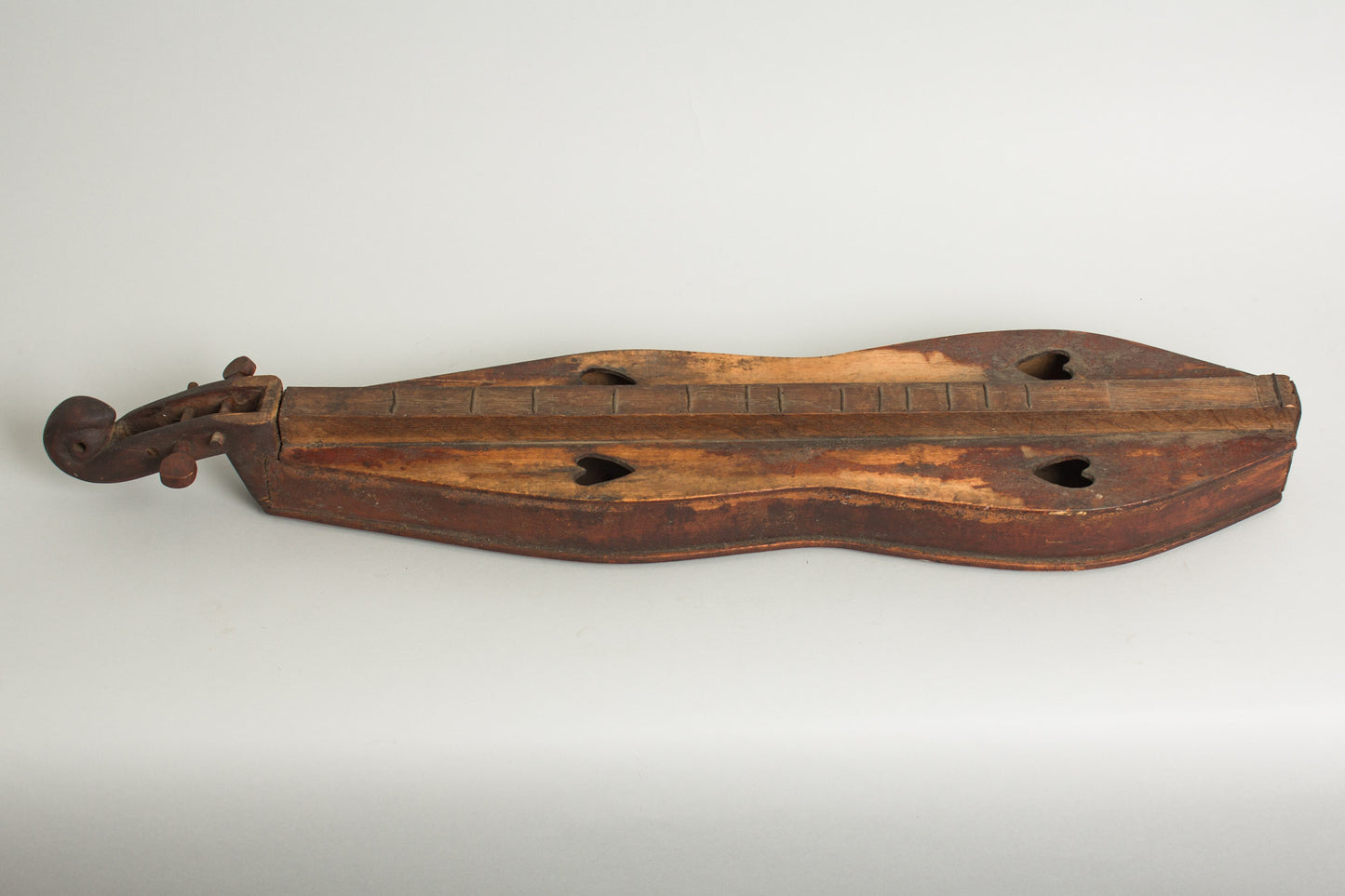
unlabelled 3-String Appalachian Dulcimer (Early 1900's)
1
/
of
9
Regular price
$350.00
Regular price
$350.00
Sale price
$350.00
Unit price
/
per
Item #13502
3-String Model Appalachian Dulcimer (unlabelled) (Early 1900's), made in Watauga County, North Carolina, likely cherry.
This is a non-functioning but beautiful example of an early hourglass Nathan Hicks pattern Appalachian dulcimer meant for three strings. While we do not usually deal in non-functioning or as-is instruments, a couple of these primitive dulcimers came as part of a larger collection from a dulcimer aficionado and we share a historical appreciation for even cruder artifacts of early American musicmaking. Traces of age and hardware imply that this dulcimer is likely not far off from around the turn of the century; the shape of this kind of dulcimer only began circulating more widely in the late 1800's through Appalachia after Eli Presnell allegedly traced the pattern of what would come to be the most iconic silhouette of these instruments from the dulcimer carried by a "stranger from out west" he met.
This one appears to be made of perhaps a cherry wood that has faded and aged with time; this would have been a commonly sourced wood in the region. Despite its flaws and the degradation of time, it is not an unimpressively built piece. Sincere effort was made here with regards to the body's construction, the bent nail frets and hand-carved scroll headstock and friction pegs. The instrument was even crudely finished, though the finish has only held up in patches over the years.
This one comes from around Watauga County, North Carolina or near the border with West Virginia. This region has a reputation for its tremendous contributions to American folk lutherie, being home to many historically prevalent family builder dynasties like the Hicks, Presnells, and Glenns. The work is older and more amateur, but overall beautiful even more so as a triumph over circumstance. This was almost certainly built by a quite poor (financially, but not spiritually) musician using what little they had to participate in storytelling and ballad-singing which was a major part of not only everyday life and merriment 19th-20th century Appalachia but how many of these families and communities kept a historical record.
Length is 34 in. (86.4 cm.), 7 3/8 in. (18.7 cm.) wide at lower bout, and 3 1/2 in. (8.9 cm.) in depth at deepest point.
This is a non-functioning, unrestored instrument sold as a historical artifact and decorative, musicological piece. If desired by a curious and experienced luthier; the nut is missing and the rudimentary nature of the construction would require significant reworking of the bridge and tailpiece to be playable again. There are a couple small grain cracks in the wood as well. Some of the outer lacquer through the years appears to have been affected by a bit of bubbling and aging from heat and there is an overall rustic patina to all wood and metal accents.
All that said, we think it is best kept as a truly beautifully piece of Americana to be admired rather than a piece to be restored. Unrestored. Overall Excellent Historic Condition.
View full details
This is a non-functioning but beautiful example of an early hourglass Nathan Hicks pattern Appalachian dulcimer meant for three strings. While we do not usually deal in non-functioning or as-is instruments, a couple of these primitive dulcimers came as part of a larger collection from a dulcimer aficionado and we share a historical appreciation for even cruder artifacts of early American musicmaking. Traces of age and hardware imply that this dulcimer is likely not far off from around the turn of the century; the shape of this kind of dulcimer only began circulating more widely in the late 1800's through Appalachia after Eli Presnell allegedly traced the pattern of what would come to be the most iconic silhouette of these instruments from the dulcimer carried by a "stranger from out west" he met.
This one appears to be made of perhaps a cherry wood that has faded and aged with time; this would have been a commonly sourced wood in the region. Despite its flaws and the degradation of time, it is not an unimpressively built piece. Sincere effort was made here with regards to the body's construction, the bent nail frets and hand-carved scroll headstock and friction pegs. The instrument was even crudely finished, though the finish has only held up in patches over the years.
This one comes from around Watauga County, North Carolina or near the border with West Virginia. This region has a reputation for its tremendous contributions to American folk lutherie, being home to many historically prevalent family builder dynasties like the Hicks, Presnells, and Glenns. The work is older and more amateur, but overall beautiful even more so as a triumph over circumstance. This was almost certainly built by a quite poor (financially, but not spiritually) musician using what little they had to participate in storytelling and ballad-singing which was a major part of not only everyday life and merriment 19th-20th century Appalachia but how many of these families and communities kept a historical record.
Length is 34 in. (86.4 cm.), 7 3/8 in. (18.7 cm.) wide at lower bout, and 3 1/2 in. (8.9 cm.) in depth at deepest point.
This is a non-functioning, unrestored instrument sold as a historical artifact and decorative, musicological piece. If desired by a curious and experienced luthier; the nut is missing and the rudimentary nature of the construction would require significant reworking of the bridge and tailpiece to be playable again. There are a couple small grain cracks in the wood as well. Some of the outer lacquer through the years appears to have been affected by a bit of bubbling and aging from heat and there is an overall rustic patina to all wood and metal accents.
All that said, we think it is best kept as a truly beautifully piece of Americana to be admired rather than a piece to be restored. Unrestored. Overall Excellent Historic Condition.