


Travis Bean TB-1000A Artist Solid Body Electric Guitar (1978)


1
/
of
15
Couldn't load pickup availability
Item #10580
Travis Bean TB-1000A Artist Model Solid Body Electric Guitar (1978), made in Sun Valley, CA, serial # 1315, black lacquer finish, aluminum neck and centerpiece, hardwood body, rosewood fingetboard, original black hard shell case.
This striking 1970's classic is a very rare black example of the Travis Bean TB1000A "Artist", the high-end model in the company's innovative but short-lived guitar line. It mates their patented raison d'etre aluminum neck/centerpiece with a carved solid body and pearl block inlaid rosewood fingerboard. The company also offered the "Standard" TB1000S Bean model, similar in design but less deluxe, the budget TB-500 and the very eccentrically shaped "Wedge" models. Of all of these the TB-1000A is considered the "classic" Bean, the most widely recognized and fondly remembered signature model of the bunch. The gleaming black-and-shining-metal example is a fairly rare custom finish guitar, as most Artists were finished in natural.
Former motocross racer and lifelong tinkerer Clifford Travis Bean had two partners initially in the instrument business; guitar tech Marc McElwee and Gary Kramer, who would split off to found his own (for a time) hugely successful guitar operation. The ads claimed their aluminum-necked designs were "the first new development in the electric guitar since the 1930s" although whether they were considering the early cast aluminum Rickenbacker steels is not addressed! The catalog continued "The...lightweight neck and receiver system forms a rigid link between the tuning machines and the bridge. When the strings are attached, a complete vibration connection is achieved. It is this patented chassis that makes the Travis Bean guitar what it is: an instrument that has become the most dramatic breakthrough in electric guitar technology in 50 years."
Bean's patented concept was a through-neck/central body core milled from T6061 aircraft aluminum, extending from headstock to the through-the-body strung six-saddle bridge. Narrow chambers running its length improved resonance and reduced weight, if only slightly. This metal centerpiece is mounted into a slim solid wood body finished in jet black, a catalog option but rarely seen in practice. The Standard, Artist, and Wedge models mounted the company's proprietary Alnico magnet humbucking pickups with "Travis Bean" engraved on their covers - the only branding on the instrument besides the subtle "T" cut out of the headstock. These in-house pickups offer exceptional power and clarity and have a stellar reputation on their own; they were never used on any other instruments.
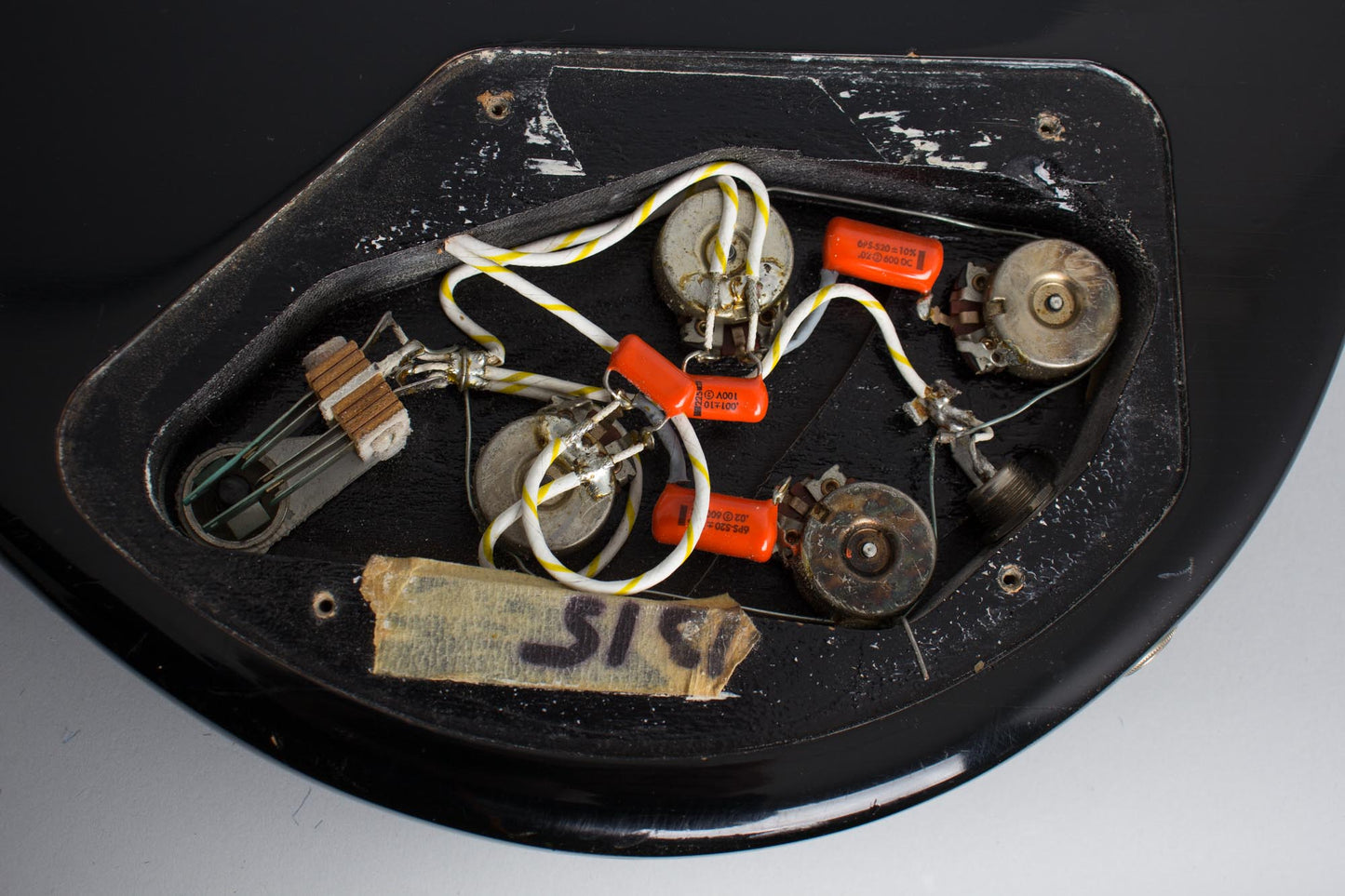
This Artist carries serial number #1315 stamped into the headstock which would suggest manufacture around early 1978. The body is slimmer than previous artists, likely a (successful) effort to reduce weight. This is an early example of this design revision, and also of the slimmer fingerboard with an extra aluminum underlay. The electronics rig uses a matched set of pots with a visible date from the third week of 1977.
This model retailed originally at $1,395, making it one of the most expensive solidbody guitars on the market. While not a huge commercial success they were featured by some major artists. At various times Keith Richards, Ron Wood, and Bill Wyman played them with the Rolling Stones in the mid '70s, Wyman having custom short-scale basses made for him. Jerry Garcia played both a TB 1000 and a TB 500 for a time, models which many deadheads still revere to this day. The guitars garnered a reputation for very high quality, but many players felt the bare aluminum neck had a cold and clinical feel. This later model is lighter and somewhat handier than the earlier examples, and a very fine player.
More recently, Travis Beans have been gainfully employed by a number of noise-rock players along with many denizens of myriad heavy sub-genres like doom and stoner metal. The Bean sound is powerful and articulate at lover volumes, but winds up magnificently to a shuddering crunch when pushed. This starkly industrial looking ebony Bean would be a spectacular instrument in this context, both in looks and sound! Travis Bean knew he had something great in the mid-1970s; while his vision did not lead to major commercial success at the time he would no doubt be well satisfied by the lasting appeal to players and highly collectible status his creations have earned 45+ years on.
Overall length is 39 1/2 in. (100.3 cm.), 14 1/8 in. (35.9 cm.) wide at lower bout, and 1 3/8 in. (3.5 cm.) in depth, measured at side of rim. Scale length is 24 1/2 in. (622 mm.). Width of nut is 1 11/16 in. (43 mm.).
This guitar remains completely original, showing some light play wear but no abuse or alterations. The black lacquer body finish shows some small scuffs, dings, dents and a wear spot on the upper edge but no large areas of wear through to the wood. The back has some belt buckle wear into but not through the finish, with light scuffing to that part of the aluminum center, which for the most part is still quite shiny.
The rest of the metal surfaces show some fairly light wear, most notably scuffing to the pickguard. The back of the neck is very clean with no notable dings or dents into the metal. The original fairly large frets have been crowned down flatter than the original profile a bit but still have plenty of meat on them. The fingerboard shows some minor wear in the lower positions. Some of the numbering has rubbed off the control knobs; a couple of solder joints may have been redone but on the whole the electronics appear original. There is an old 1994 repair sticker on the reverse of the cavity plate.
This metal-neck marvel plays excellent and sounds truly fantastic, even unplugged. And with its black-and-metal livery this is a visual stunner, about as badass a 1970s vibe as you can get while still appearing absolutely contemporary. While it has been played somewhat the gleaming aluminum neck still looks almost new and feels timelessly modern. The guitar is housed in the original HSC, somewhat beat up (the ends are heavily worn and the plastic handle piece is missing) but still fully solid and functional. Excellent Condition.
View full details
This striking 1970's classic is a very rare black example of the Travis Bean TB1000A "Artist", the high-end model in the company's innovative but short-lived guitar line. It mates their patented raison d'etre aluminum neck/centerpiece with a carved solid body and pearl block inlaid rosewood fingerboard. The company also offered the "Standard" TB1000S Bean model, similar in design but less deluxe, the budget TB-500 and the very eccentrically shaped "Wedge" models. Of all of these the TB-1000A is considered the "classic" Bean, the most widely recognized and fondly remembered signature model of the bunch. The gleaming black-and-shining-metal example is a fairly rare custom finish guitar, as most Artists were finished in natural.
Former motocross racer and lifelong tinkerer Clifford Travis Bean had two partners initially in the instrument business; guitar tech Marc McElwee and Gary Kramer, who would split off to found his own (for a time) hugely successful guitar operation. The ads claimed their aluminum-necked designs were "the first new development in the electric guitar since the 1930s" although whether they were considering the early cast aluminum Rickenbacker steels is not addressed! The catalog continued "The...lightweight neck and receiver system forms a rigid link between the tuning machines and the bridge. When the strings are attached, a complete vibration connection is achieved. It is this patented chassis that makes the Travis Bean guitar what it is: an instrument that has become the most dramatic breakthrough in electric guitar technology in 50 years."
Bean's patented concept was a through-neck/central body core milled from T6061 aircraft aluminum, extending from headstock to the through-the-body strung six-saddle bridge. Narrow chambers running its length improved resonance and reduced weight, if only slightly. This metal centerpiece is mounted into a slim solid wood body finished in jet black, a catalog option but rarely seen in practice. The Standard, Artist, and Wedge models mounted the company's proprietary Alnico magnet humbucking pickups with "Travis Bean" engraved on their covers - the only branding on the instrument besides the subtle "T" cut out of the headstock. These in-house pickups offer exceptional power and clarity and have a stellar reputation on their own; they were never used on any other instruments.
This Artist carries serial number #1315 stamped into the headstock which would suggest manufacture around early 1978. The body is slimmer than previous artists, likely a (successful) effort to reduce weight. This is an early example of this design revision, and also of the slimmer fingerboard with an extra aluminum underlay. The electronics rig uses a matched set of pots with a visible date from the third week of 1977.
This model retailed originally at $1,395, making it one of the most expensive solidbody guitars on the market. While not a huge commercial success they were featured by some major artists. At various times Keith Richards, Ron Wood, and Bill Wyman played them with the Rolling Stones in the mid '70s, Wyman having custom short-scale basses made for him. Jerry Garcia played both a TB 1000 and a TB 500 for a time, models which many deadheads still revere to this day. The guitars garnered a reputation for very high quality, but many players felt the bare aluminum neck had a cold and clinical feel. This later model is lighter and somewhat handier than the earlier examples, and a very fine player.
More recently, Travis Beans have been gainfully employed by a number of noise-rock players along with many denizens of myriad heavy sub-genres like doom and stoner metal. The Bean sound is powerful and articulate at lover volumes, but winds up magnificently to a shuddering crunch when pushed. This starkly industrial looking ebony Bean would be a spectacular instrument in this context, both in looks and sound! Travis Bean knew he had something great in the mid-1970s; while his vision did not lead to major commercial success at the time he would no doubt be well satisfied by the lasting appeal to players and highly collectible status his creations have earned 45+ years on.
Overall length is 39 1/2 in. (100.3 cm.), 14 1/8 in. (35.9 cm.) wide at lower bout, and 1 3/8 in. (3.5 cm.) in depth, measured at side of rim. Scale length is 24 1/2 in. (622 mm.). Width of nut is 1 11/16 in. (43 mm.).
This guitar remains completely original, showing some light play wear but no abuse or alterations. The black lacquer body finish shows some small scuffs, dings, dents and a wear spot on the upper edge but no large areas of wear through to the wood. The back has some belt buckle wear into but not through the finish, with light scuffing to that part of the aluminum center, which for the most part is still quite shiny.
The rest of the metal surfaces show some fairly light wear, most notably scuffing to the pickguard. The back of the neck is very clean with no notable dings or dents into the metal. The original fairly large frets have been crowned down flatter than the original profile a bit but still have plenty of meat on them. The fingerboard shows some minor wear in the lower positions. Some of the numbering has rubbed off the control knobs; a couple of solder joints may have been redone but on the whole the electronics appear original. There is an old 1994 repair sticker on the reverse of the cavity plate.
This metal-neck marvel plays excellent and sounds truly fantastic, even unplugged. And with its black-and-metal livery this is a visual stunner, about as badass a 1970s vibe as you can get while still appearing absolutely contemporary. While it has been played somewhat the gleaming aluminum neck still looks almost new and feels timelessly modern. The guitar is housed in the original HSC, somewhat beat up (the ends are heavily worn and the plastic handle piece is missing) but still fully solid and functional. Excellent Condition.


Loading...
Just arrived!
Item #