


Stratosphere Single Neck Standard Solid Body Electric Guitar (1956)


1
/
of
15
Couldn't load pickup availability
Item #12645
Stratosphere Single Neck Standard Model Solid Body Electric Guitar, c. 1956, made in Springfield, MO, serial # 67, red/black sunburst finish, hardwood body, maple neck and fingerboard, black hard shell case.
"Without doubt the finest electric standard guitar you can buy at any price"
That's what the Stratosphere catalog claimed, anyway, although both Leo Fender and Ted McCarty at Gibson would have begged to differ! This amazingly eccentric alien-looking guitar arrived not from the Stratosphere but from Springfield, Missouri, home to the Stratosphere Guitar Manufacturing Co. This was founded brothers Russell and Claude Deaver, their factory located at 341 Boonville Avenue in Springfield, a manufacturing block just north of the city center. The guitars were in at least limited production by mid-1954 at the latest, but the operation lasted only a few years into the mid-1950s.
Russell Deaver was the designer; his brother Claude assisted in production and legend has it their short-lived venture manufactured something like 200 instruments. What put them on the map was the truly astounding Stratosphere Twin double-neck, "The Guitar of Tomorrow-Today!". This massive, imposing double neck creation was made (briefly) famous by Jimmy Bryant when he and Speedy West recorded the song "Stratosphere Boogie" on September 2, 1954. This was done using the 12-string neck in a special harmonized tuning which the Deavers developed and promoted in their catalog. Russel Deaver had been friends with Bryant's musical partner Speedy West, who originally hailed from Springfield. Supposedly West got one to Bryant and another the Glenn Strange, their rhythm player.
The Stratosphere Twin was designed for country musicians, specifically to make the popular twin-guitar harmonies of the day accessible to a single guitarist. The brothers had a convenient opportunity to get them into players' hands as Springfield hosted the "Ozark Jubilee" a groundbreaking weekly live radio then television show that ran from 1954 up into 1960. The broadcast was hosted by Red Foley and many top country performers guested there including Chet Atkins, Eddy Arnold, Merle Travis, Johnny Cash and Patsy Cline. As country music stars came through Springfield, Russell Deaver was there demonstrating his Stratosphere guitar to the hot pickers in the band. Chet Atkins took one and the catalog listed Pete Wade and Bill Woods as endorsers, alongside Jimmy Bryant.
While the "Twin" was the brother's signature raison d'etre, they diversified by also offering single neck versions. These are exceptionally rare; only a few "single sixes" are known to exist and as far as we know no single neck 12 has ever surfaced. This "Stratosphere Single Neck Standard" is not only one of the rarer guitars we have ever handled, it is practically unique. The Deavers' design is absolutely their own, and they used local woods and handmade hardware cast in aluminum including the bridges, tailpieces and pickups. The only outside-sourced parts on this guitar are the Kluson Deluxe tuners, pots and switch, and a unique locally made tailpiece.
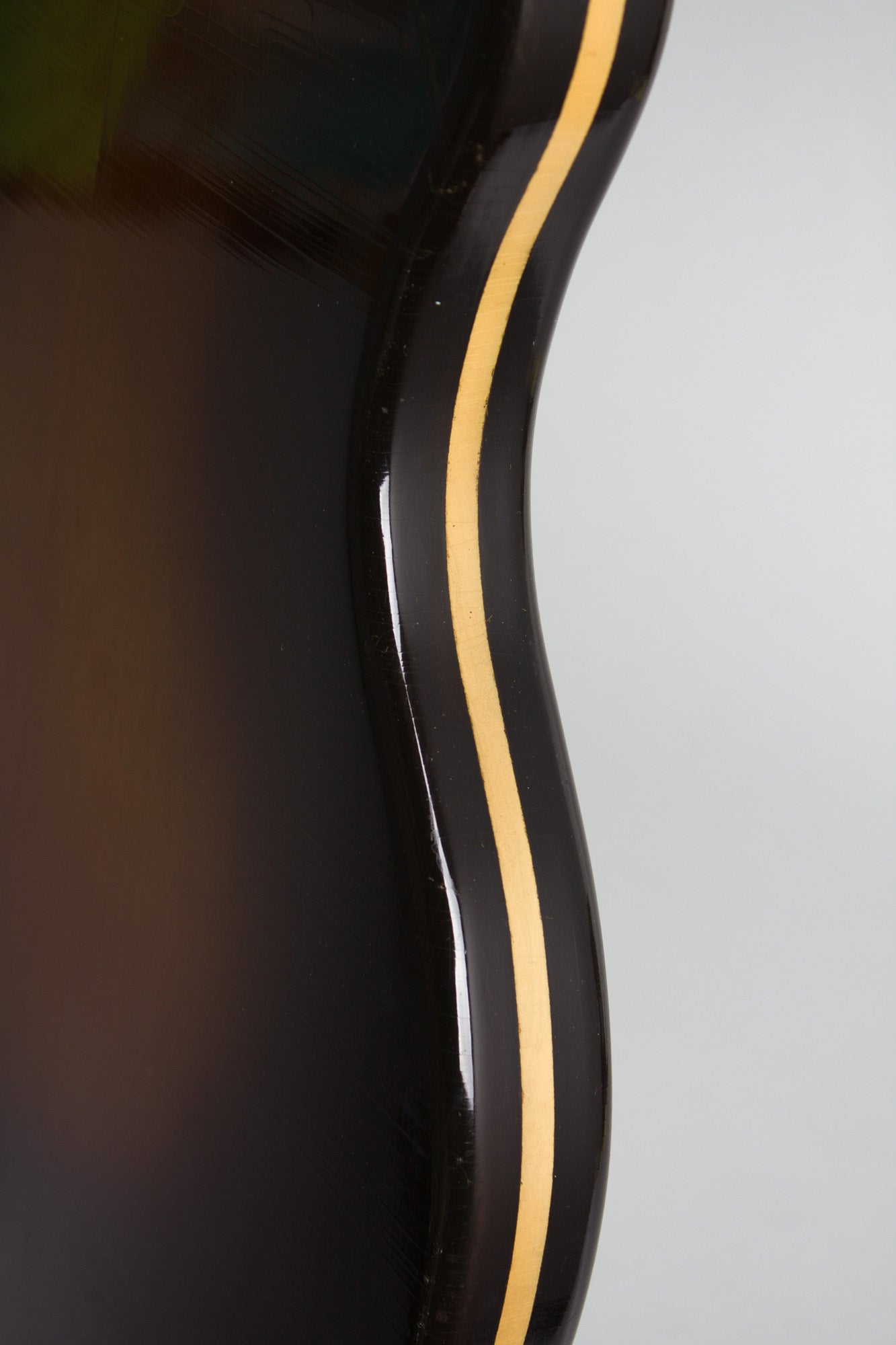
The Stratosphere guitar looks like nothing else, love it or hate it and is brimming with bespoke features. The body is a fluid single cutaway shape made up of "pancaked" slabs of wood with the contrasting center section left as a decorative stripe along the sides. This guitar's red/black sunburst top is unusual; most Stratospheres were finished natural. Even odder, the back (and back of the neck) are sprayed in a surprisingly close match to Fender's two-tone Stratocaster scheme. Fittings include a Mosrite-esque raised white plastic lower pickguard (BEFORE Semie Moseley was in business!) mounting the selector switch with the same "top hat" tip Telecasters used. Another flush lower plate carried the tone and volume knobs, while a purely ornamental upper plate completes the "look". These are held in place by grommeted flat-head wood screws, as the holes in the plates were not countersunk!
The reverse-angled twin pickups are powerful single coils wound around magnet poles (a somewhat Fender like design) mounted inside unique slotted metal covers that look like period Buick grills; the bridge pickup is adjustable for height. Another amazing piece of hardware is the completely hand-tooled adjustable floating bridge with individual triangular saddles neatly slotted into the base, held in place by string tension.
An unusual feature of this particular Standard is the cast aluminum "Maur-ite" vibrato tailpiece, a rarely seen fitting. This was made in Springfield by "Doc" Martin, a steel guitarist on the Ozark Jubilee (thanks to Deke Dickerson for this tidbit of info). This unit uses long sprung metal rods for tension but as it has no arm affixed currently functions as an elaborate stoptail.
The maple neck is long and slim, the maple fingerboard ornamented with contrasting wood stripe inlay. The entire neck (especially the truss rod system) is slim and Fender-like down to the "skunk stripe" on the back and plug on the headstock just above the nut. The nut is aluminum, an early appearance of this idea. The Deavers were some of the very first builders directly inspired by Leo Fender; when they began operation the Telecaster was only a few years old the Stratocaster (great minds thinking alike on the names?) still in the prototype stage.
The Deavers departed from the Fender playbook in using a double-sided pointy headstock, with a "Stratosphere" logo printed on metallic tape (cut out by hand) on the dark-finished face. It mounts the same tulip-button Kluson Deluxe machines used by Gibson; amazingly nobody ever stole these for a Les Paul! They are the 1953-6 "No logo" version pinpointing when the Deavers bought them, at least.
Normally we would be able to (roughly) date this guitar from the pots but when we opened the cavity up we found what look like oversized older surplus radio pots with no date encoded. The serial number 67 is stamped on the body just below the neck heel, for what that's worth. With the sunburst finish and vibrato, we think this is a slightly later model, likely built in 1955-6.
The Stratosphere catalog priced this model at $170, plus case while the Twin was a whopping $330. A single neck 12-string was pictured at $180, but as far as we know none are known "in the wood". While admittedly not a stylistic match for a Fender Stratocaster (which, remember the appeared around the same time, mid/late 1954) we do find the Stratosphere standard a compellingly idiosyncratic guitar, homely perhaps but beautiful in its own way. As a testament to that old go-getter American hand-made mojo it's pretty hard to beat, and after some careful setup tweaks a decent playing but great sounding guitar. We salute the Deaver Brothers gung-ho spirit, and are proud to have their endlessly quirky but fabulously individual creation in out showroom.
Overall length is 41 7/8 in. (106.4 cm.), 14 5/8 in. (37.1 cm.) wide at lower bout, and 1 3/8 in. (3.5 cm.) in depth, measured at side of rim. Scale length is 25 1/2 in. (648 mm.). Width of nut is 1 9/16 in. (40 mm.).
This insanely rare Stratosphere single-neck Standard remains original (as far as we can tell) and complete except whatever arm was provided for the vibrato is long gone. It's just as well as we have discovered the guitar works better with the strings wrapped under the bar, increasing the angle over the floating bridge and improves the sound noticeably. The original finish has checking, dings and dents overall but no really serious wear.
The original fret work (and in some cases fret spacing up the neck) are not to a modern professional standard but the guitar is playable; the very small brass wire is not ideal to modern tastes and the guitar could play to a higher standard if refretted. Due to the extreme rarity and veritable museum piece character we did successfully straighten the neck leave the fret question up to the next owner. The guitar does sound great, the pickups have a honking "Hillbilly deluxe" feel and the neck itself is fast and comfortable. This is definitely a special piece, a real slice of old fretted Americana, heartland moxie and just plain whimsey. It lives in an old but not original HSC, ready to twang again in the home of the brave. Excellent - Condition.
View full details
"Without doubt the finest electric standard guitar you can buy at any price"
That's what the Stratosphere catalog claimed, anyway, although both Leo Fender and Ted McCarty at Gibson would have begged to differ! This amazingly eccentric alien-looking guitar arrived not from the Stratosphere but from Springfield, Missouri, home to the Stratosphere Guitar Manufacturing Co. This was founded brothers Russell and Claude Deaver, their factory located at 341 Boonville Avenue in Springfield, a manufacturing block just north of the city center. The guitars were in at least limited production by mid-1954 at the latest, but the operation lasted only a few years into the mid-1950s.
Russell Deaver was the designer; his brother Claude assisted in production and legend has it their short-lived venture manufactured something like 200 instruments. What put them on the map was the truly astounding Stratosphere Twin double-neck, "The Guitar of Tomorrow-Today!". This massive, imposing double neck creation was made (briefly) famous by Jimmy Bryant when he and Speedy West recorded the song "Stratosphere Boogie" on September 2, 1954. This was done using the 12-string neck in a special harmonized tuning which the Deavers developed and promoted in their catalog. Russel Deaver had been friends with Bryant's musical partner Speedy West, who originally hailed from Springfield. Supposedly West got one to Bryant and another the Glenn Strange, their rhythm player.
The Stratosphere Twin was designed for country musicians, specifically to make the popular twin-guitar harmonies of the day accessible to a single guitarist. The brothers had a convenient opportunity to get them into players' hands as Springfield hosted the "Ozark Jubilee" a groundbreaking weekly live radio then television show that ran from 1954 up into 1960. The broadcast was hosted by Red Foley and many top country performers guested there including Chet Atkins, Eddy Arnold, Merle Travis, Johnny Cash and Patsy Cline. As country music stars came through Springfield, Russell Deaver was there demonstrating his Stratosphere guitar to the hot pickers in the band. Chet Atkins took one and the catalog listed Pete Wade and Bill Woods as endorsers, alongside Jimmy Bryant.
While the "Twin" was the brother's signature raison d'etre, they diversified by also offering single neck versions. These are exceptionally rare; only a few "single sixes" are known to exist and as far as we know no single neck 12 has ever surfaced. This "Stratosphere Single Neck Standard" is not only one of the rarer guitars we have ever handled, it is practically unique. The Deavers' design is absolutely their own, and they used local woods and handmade hardware cast in aluminum including the bridges, tailpieces and pickups. The only outside-sourced parts on this guitar are the Kluson Deluxe tuners, pots and switch, and a unique locally made tailpiece.
The Stratosphere guitar looks like nothing else, love it or hate it and is brimming with bespoke features. The body is a fluid single cutaway shape made up of "pancaked" slabs of wood with the contrasting center section left as a decorative stripe along the sides. This guitar's red/black sunburst top is unusual; most Stratospheres were finished natural. Even odder, the back (and back of the neck) are sprayed in a surprisingly close match to Fender's two-tone Stratocaster scheme. Fittings include a Mosrite-esque raised white plastic lower pickguard (BEFORE Semie Moseley was in business!) mounting the selector switch with the same "top hat" tip Telecasters used. Another flush lower plate carried the tone and volume knobs, while a purely ornamental upper plate completes the "look". These are held in place by grommeted flat-head wood screws, as the holes in the plates were not countersunk!
The reverse-angled twin pickups are powerful single coils wound around magnet poles (a somewhat Fender like design) mounted inside unique slotted metal covers that look like period Buick grills; the bridge pickup is adjustable for height. Another amazing piece of hardware is the completely hand-tooled adjustable floating bridge with individual triangular saddles neatly slotted into the base, held in place by string tension.
An unusual feature of this particular Standard is the cast aluminum "Maur-ite" vibrato tailpiece, a rarely seen fitting. This was made in Springfield by "Doc" Martin, a steel guitarist on the Ozark Jubilee (thanks to Deke Dickerson for this tidbit of info). This unit uses long sprung metal rods for tension but as it has no arm affixed currently functions as an elaborate stoptail.
The maple neck is long and slim, the maple fingerboard ornamented with contrasting wood stripe inlay. The entire neck (especially the truss rod system) is slim and Fender-like down to the "skunk stripe" on the back and plug on the headstock just above the nut. The nut is aluminum, an early appearance of this idea. The Deavers were some of the very first builders directly inspired by Leo Fender; when they began operation the Telecaster was only a few years old the Stratocaster (great minds thinking alike on the names?) still in the prototype stage.
The Deavers departed from the Fender playbook in using a double-sided pointy headstock, with a "Stratosphere" logo printed on metallic tape (cut out by hand) on the dark-finished face. It mounts the same tulip-button Kluson Deluxe machines used by Gibson; amazingly nobody ever stole these for a Les Paul! They are the 1953-6 "No logo" version pinpointing when the Deavers bought them, at least.
Normally we would be able to (roughly) date this guitar from the pots but when we opened the cavity up we found what look like oversized older surplus radio pots with no date encoded. The serial number 67 is stamped on the body just below the neck heel, for what that's worth. With the sunburst finish and vibrato, we think this is a slightly later model, likely built in 1955-6.
The Stratosphere catalog priced this model at $170, plus case while the Twin was a whopping $330. A single neck 12-string was pictured at $180, but as far as we know none are known "in the wood". While admittedly not a stylistic match for a Fender Stratocaster (which, remember the appeared around the same time, mid/late 1954) we do find the Stratosphere standard a compellingly idiosyncratic guitar, homely perhaps but beautiful in its own way. As a testament to that old go-getter American hand-made mojo it's pretty hard to beat, and after some careful setup tweaks a decent playing but great sounding guitar. We salute the Deaver Brothers gung-ho spirit, and are proud to have their endlessly quirky but fabulously individual creation in out showroom.
Overall length is 41 7/8 in. (106.4 cm.), 14 5/8 in. (37.1 cm.) wide at lower bout, and 1 3/8 in. (3.5 cm.) in depth, measured at side of rim. Scale length is 25 1/2 in. (648 mm.). Width of nut is 1 9/16 in. (40 mm.).
This insanely rare Stratosphere single-neck Standard remains original (as far as we can tell) and complete except whatever arm was provided for the vibrato is long gone. It's just as well as we have discovered the guitar works better with the strings wrapped under the bar, increasing the angle over the floating bridge and improves the sound noticeably. The original finish has checking, dings and dents overall but no really serious wear.
The original fret work (and in some cases fret spacing up the neck) are not to a modern professional standard but the guitar is playable; the very small brass wire is not ideal to modern tastes and the guitar could play to a higher standard if refretted. Due to the extreme rarity and veritable museum piece character we did successfully straighten the neck leave the fret question up to the next owner. The guitar does sound great, the pickups have a honking "Hillbilly deluxe" feel and the neck itself is fast and comfortable. This is definitely a special piece, a real slice of old fretted Americana, heartland moxie and just plain whimsey. It lives in an old but not original HSC, ready to twang again in the home of the brave. Excellent - Condition.


Loading...
Just arrived!
Item #