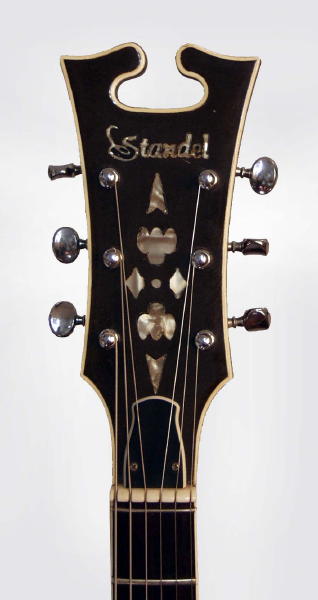
Standel Model 410-C Model Thinline Hollow Body Electric Guitar (1968), made in New Jersey, cherry lacquer finish, laminated mahogany body, lmahogany neck with rosewood fingerboard, original black hard shell case.
A beautifully made and rare example of 1960's American guitar design, this Standel 410 can be considered a cool lost instruments of the era. The somewhat convoluted history behind this guitar binds the names Standel, Harptone and Koontz together, with nods to DeArmond and Guild as well! In the late 1960's Standel, based in California, was an amplifier manufacturer that had made several half-hearted attempts to get into guitar production. Somehow they hooked up with the Harptone company of Newark, New Jersey which was a well-known case manufacturer with some background in guitar production. Harptone comissioned New Jersey luthier Sam Koontz, known for his original archtop creations, to design a line of hollowbody instruments and set up the production line. The guitars were offered in a range of models branded Standel, and distributed out of California.
Soon enough, the Standel company ran into financial trouble (due to faults in their early solid-state amps) and failed; the guitars were re-branded Harptone, and sold for another few years out of New Jersey. Although the Harptone line lasted into the early '70's the company soon focused on acoustic guitars and the electrics were discontinued.
These instruments feature very high-grade workmanship throughout, with a vibrant finishes and high quality hardware. The line was fairly extensive, all instruments being hollow body electrics ranging from full-depth carved top 17" to 16" thinlines with several different cutaway options. The most distinctive common feature was the unique Koontz-designed headstock with the large center scoop. This model, the 410-C is closest in design to the equally rare Guild Studio series with a thin, double Florentine cutaway body and two unusual style DeArmond pickups with a standard Gibson style wiring rig. The neck is thin and comfortable and overall this rates as a very good-playing guitar. These guitars were introduced in the late 1960's at the point where solidbodies were resurgant; had they been introduced a few years earlier, they would no doubt be much better known today. A very fine 1960's American-made instrument at a reasonable price.
Overall length is 42 1/4 in. (107.3 cm.), 16 1/8 in. (41 cm.) wide at lower bout, and 1 5/8 in. (4.1 cm.) in depth, measured at side of rim. Scale length is 24 1/2 in. (622 mm.). Width of nut is 1 5/8 in. (41 mm.). Super clean, all original-a truly exceptional example of a rare American guitar! Excellent + Condition.