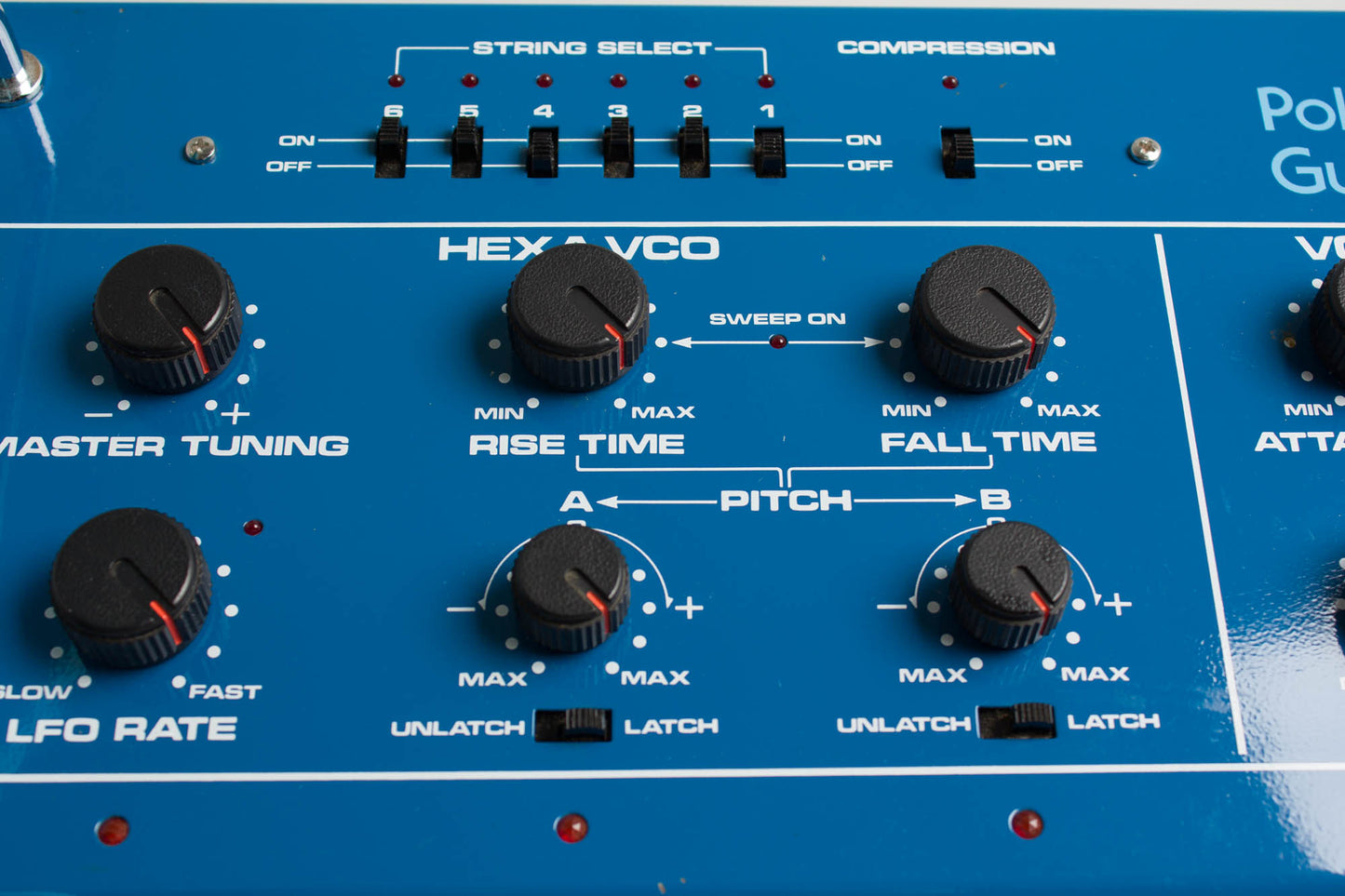
Roland GR-300 Polyphonic Guitar Synthesizer with G-505 Model Solid Body Electric Guitar (1982), made in Japan, serial # B823723, metallic blue finish, ash body,maple neck, original black tolex hard shell case.
At the end of the 70s the music industry was abuzz with the concept that guitars were on the way out and synthesis the wave of the future. Riding this wave Roland introduced the GR-300 analog polyphonic guitar synthesizer and its accompanying controller instruments, following earlier efforts including the Arp Avatar. While there have been plenty technological advancements in the music world since the 80s, this particular little unit still very much reigns as the pinnacle of analog guitar synthesis.
Although by conventional synthesizer standards the GR-300 has a simple tonal palette the unit offers, to this day, the most accurate and musical tracking ever achieved in a guitar synth. It certainly has the artist roster to speak for itself, most notably including Pat Metheny, Robert Fripp, Adrian Belew and Andy Summers.
Unlike today's more common pitch-to-MIDI pickups, the GR-300 guitar synthesizer uses all analog tracking with no latency. Additionally, many of the guitars natural artifacts, like the initial "atonal" pick attack are translated to be musical and natural sounding, where MIDI pickups can often output wildly inaccurate notes or strange glitches. Because of this, the GR-300 synth requires minimal player adaptation and is reliably easy to play. A fairly unique approach to the pitch detection treats lower fretted notes differently from higher fretted notes on each string, true to the nature of the instrument. The analog technology is not without its own quirks, but they are generally endearing and musically usable: for instance, the aforementioned pick attack is translated into a sound very reminiscent of the "spit" sound heard at the beginning of a trumpet phrase.
The synthesizer has two selectable oscillators, each tunable to +/- one octave and the "duet" option to use them simultaneously, in unison, octaves or any interval in-between. The two foot-selectable pitch settings have dedicated rise and fall controls and can be switched as latching or momentary. The synth also features a pitch-modulating LFO and an envelope filter, each with their respective depth control (LFO) and frequency cut-off control (envelope filter) residing on the guitar itself. On the instrument there's also a resonance control and the ability to select and/or blend the synthesized signal and the output of the two magnetic humbuckers - and, finally, a master volume control for it all. There's also a "touch" strip on the bridge pickup which turns the LFO (vibrato) on and off. Lastly, the GR-300 has the ability to select any specific strings to be synthesized, offering virtually endless possibilities in augmenting or complimenting the raw guitar sound.
In many ways a continuation of the earlier GS-500 and GR-500, the Roland GR-300 and Greco-made G-808/G-303/G-505 guitar controller pairings were a real flagship of Roland's guitar synths of the early 1980s and prominently advertised as such. While most people are likely more familiar with the G-303 guitar made famous by Pat Metheny, the G-505 was a more affordable offering of the line-up, embracing more Fender-like aesthetics (something the Fujijen Gakki factory were well-poised for, considering their expertise in Fender clones at the time!). The Strat-inspired guitar features a bolt on maple neck with, with a choice of maple or rosewood fretboard, finished in blue, red or sunburst. The guitar interestingly inherited the same electronics as the G-808 and G-303 controllers, including the less common pairing of 500k pots with its single coil pickups.
Overall length is 39 3/8 in. (100 cm.), 13 5/8 in. (34.6 cm.) wide at lower bout, and 1 1/2 in. (3.8 cm.) in depth, measured at side of rim. Scale length is 24 3/4 in. (629 mm.). Width of nut is 1 11/16 in. (43 mm.).
This iconic synth guitar setup is in fabulous condition, appearing only lightly used. The GR-300 floor unit is beautifully clean and only shows very light wear; some occasional scuffs and scratches. All knobs and footswitches are intact and present and all the graphics and lettering remain perfectly intact. The G-505 guitar controller likewise is in wonderful shape overall, with a couple of dings near the output jack and one bit of finish missing on the tip of the headstock; otherwise only minor wear to the original jumbo frets. The floor unit comes with a non-original carrying case.
Electrically, both the floor unit and guitar controller are all original and operate perfectly with all functions behaving as they should. The GR-300 floor unit has seen recent service, where two capacitors were replaced. All connectors and pots have been cleaned and the set comes with the original (and virtually irreplaceable) 24-pin connector cable, still in exquisite shape. The guitar bears one interesting modification: the addition of two mini-toggles near the pickup selector. One flips the phase of the middle pickup, and the three way switch adds the neck pickup across the five pickup selector positions.
One of the wildest additions to our showroom as of late, this is a truly phenomenal sounding and playing example of the best analog guitar synth ever made in superb condition. Overall Excellent - Condition.