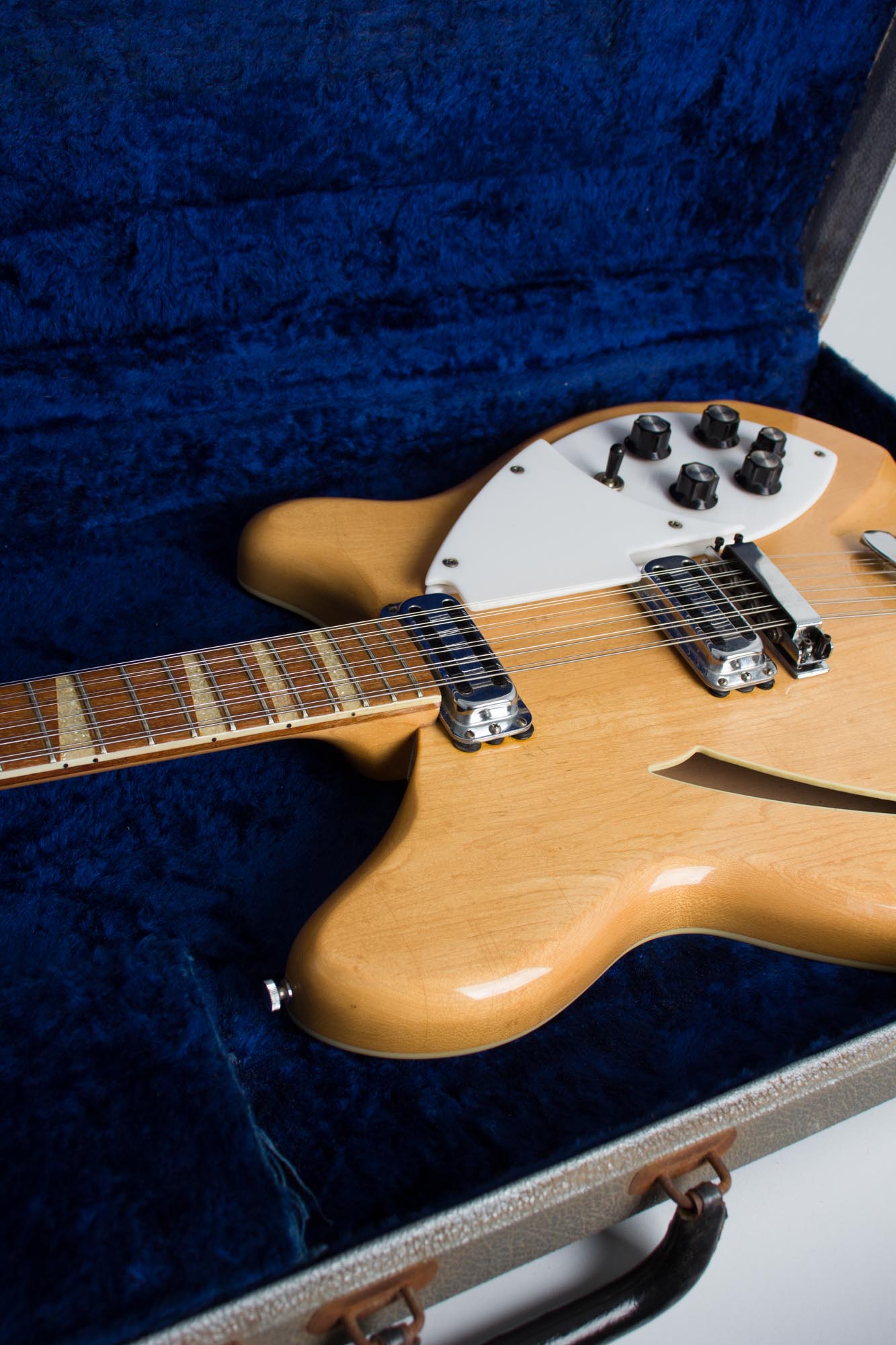
Rickenbacker Model 360/12 Model Thinline Hollow Body Electric Guitar (1966), made in Santa Ana, CA, serial # FH-2842, mapleglo natural lacquer finish, maple body, laminated maple neck with padouk fingerboard, original silver tolex hard shell case.
This is a lovely example of the Byrds-approved Mapleglo Rickenbacker Model 360-12, one of the absolute classic 1960s American guitars. In the middle of that decade the unique "Folk Rock" sound of an entire style of music centered around this one model A mainstay of the California company's line from 1964 right up through to the present, the 360/12 is the instrument that really put Rickenbacker on the map as a modern guitar maker.
The Rickenbacker 360 in general is one of the sharpest-looking and most distinctive-sounding of all American guitar designs. The Model 360-12 is the "Deluxe" style Rickenbacker 12-string, with triangle crushed pearl inlay on the bound fingerboard, a round-top body bound on the back in checkerboard trim and a bound sound hole. This model remains an icon of the '60s, synonymous with the sounds of that Folk-Rock era as well as more recent "jangle" styles. The less fancy flat-topped models 330/12 offer much of the same sound but lack some of the iconic visual appeal of the 360/12.
The Rickenbacker 12-string in the hands of Beatle George Harrison kicked off a wave of popularity for the electric 12s in 1964-6 that left every other maker trying to catch up. This guitar has a serial number indicating it was made in August 1966, with pots from the 17th week of that year. It is a second generation 360/12 with the rounded top body design introduced in spring 1964, which is the most recognizable version. The body and neck carry the natural "Mapleglo" finish most associated with the Byrds' Roger McGuinn, who played an identical guitar in 1965-6 before having the factory modify it to three pickups. While exact production totals are not known, this finish is considerably rarer than the Fireglo sunburst.
At the time this 360/12 was made there was a 6 month to one year dealer waiting list for this model, which the fairly small Rickenbacker factory struggled to keep up with. While for the most part instruments of this period are very consistent but one production alteration is significant. Beginning in the summer of 1966, Rickenbacker no longer routed a channel for pole magnets under the neck pickup, so guitars like this from that point on have a much solider neck/body joint. As a result they usually maintain their original neck angle better than earlier examples, making for a better playing instrument.
Besides the Byrds this model saw extensive use by George Harrison (who adopted a round-top model in 1965), Brian Jones of the Rolling Stones, Al Nichol of the Turtles, Tony Hicks of the Hollies and countless others in the 1964-70 period. The instrument maintains a timeless "60s cool" factor to this day. Despite all the other electric 12-strings made since, the Rickenbacker 360/12 has remained the single dominant instrument of this type for well over 55 years. This is one of the nicer examples we have had and a must for anyone who desires the unmistakable sound and look only the original 360/12 can provide.
Overall length is 40 in. (101.6 cm.), 15 1/4 in. (38.7 cm.) wide at lower bout, and 1 1/2 in. (3.8 cm.) deep. Scale length is 24 3/4 in. (629 mm.). Width of nut is 1 5/8 in. (41 mm.). This 360/12 has seen some use but is still a nicely clean guitar overall, all original and showing only some light general wear. The finish on the body shows small scuffs and dings overall but maintains a nice amber natural patina with no really notable areas of loss. The back has some typical belt-buckle wear into but not through the lacquer. There are a few dings and scuffs on tip of the headstock but the back of the neck has just a few small dinks and chips.
All hardware appears original, even the usually missing bridge cover is intact. A couple of the rubber grommets have gone missing from under the neck pickup. The neck is quite straight and the truss rods are working correctly, and the fingerboard has not been popped up by the nut from over-adjustment of the rods as many have. The frets show very little wear, the fingerboard has a few spots worn through the lacquer in the first position. The neck angle is good (unlike many from 1964-mid '66) and this is an excellent playing example with the classic sound heard on countless recordings. It is complete in the original silver HSC with the (we assume) band name "Apocalypse" stenciled in black on the lid; this must have been the doomiest jangle band ever, or the jangliest doom band! Overall Excellent - Condition.