Premier Ruby Special E-722 Owned and Used by Elliott Sharp Model Solid Body Electric Guitar (1959), made in New York, NY, cherry lacquer finish, mahogany body, Brazilian rosewood neck, black hard shell case.
This 1959 scroll-body Premier guitar is one of the coolest and quirkiest 6-strings to come out of the New York area, and also one of the very earliest solid-body designs from the East Coast. This one has been in the arsenal of New York guitarist/composer Elliott sharp for some time, and is even more vibey for it! He tells us it was used on the upcoming Terraplane album "Livin Here" and upcoming solo album "The Collapsed Wave" as well as on miscellaneous sessions.
The Peter Sorkin company was a well-established jobber in New York City with several house brands, the flagship of which was Premier. Premier-branded amplifiers came in a variety of sizes and often eye-catching styles, built by Sorkin's satellite company named Multivox; the guitars carry this name on the stamped plaque on the back of the headstock. 1950s Premier guitars were built by United Guitars in Jersey City, both full-body electric archtops and small "Bantam" models. Sorkin fitted them with eye-catching sparkle plastic pickguards and knobs and high quality hardware including pickups sourced from DeArmond and Fransch Electronics in Queens, NY.
The 1958 Sorkin catalog was the first to feature a new line of Premier solid-body guitars, quirky and original with a unique look and feel. Premier's trademark glitter look was retained and most had gold-plated hardware. Still, the body was the most interesting element with Gibson-mandolinesque scroll carved into the upper bout, the cutaway below curing downward in a gentle arc. The top is bound into the scroll area with a celluloid dot in the center. The back is dressed away somewhat like a Stratocaster, making the guitar more comfortable to play. They were offered in four finish options equipped with one, two, or three pickups.
The very first had set-in necks, but they almost immediately went to a bolt-on design. Another unique feature is the neck itself, carved from SOLID Brazilian rosewood, which for this often penny-pinching company was quite the luxury. The earliest 2-on-a-side headstocks had a backwards pitch; by the time this guitar was made, it had been changed to a flat-cut Fender style with a prominent flat-plate string retainer. The neck has a chunky round-backed profile, substantial but still quite playable; there is no truss rod so the relative thickness was a good idea. The headstock is adorned with an engraved and painted Premier logo and torch emblem.
These were not cheap guitars; prices originally ranged from $145.50 to $230.00, in the same league as many Fender and Gibson models. This Model E722 with two gold-plated pickups and the "Ruby Special" Cherry mahogany finish listed at $184.50 in 1959, plus case. Pickup selection is via a 3-way rotary lever switch. The pots have ink codes dating to the 48th week of 1958, so this guitar was likely assembled and sold in early 1959.
Despite their local origins, we rarely see early Premier solid-bodies. It is not sure exactly where they were actually made. Some claim they were also the product of United Guitar in Jersey City, while others remember the old Strad-O-line workshop around 17th street and 7th avenue in Manhattan, then run by Sorkin. Wherever it was birthed, this is a nice example of an early "scroll guitar". They were built into the mid-'60s, but later examples were assembled from imported parts and have neither the quality nor class of the first models.
Overall length is 37 9/16 in. (95.4 cm.), 12 5/8 in. (32.1 cm.) wide at lower bout. Scale length is 24 1/2 in. (622 mm.). Width of nut is 1 11/16 in. (43 mm.).
This Premier is a nice original example; it has been played over the years and shows a decent amount of wear but nothing too distressing. The all-original finish has faded somewhat and shows checking, scuffing, dings, scratches and dents overall. There are several worn away areas mostly to the unbound back body edges, with some deeper scratches on the back. The back of the neck down by the nut has a couple of larger chips to the wood. The only repair is that the sides of the headstock have been re-bound; binding issues are common with New York-made guitars of this period. The rest of the binding is intact with a couple of small cracks and some minor shrinkage but no deterioration.
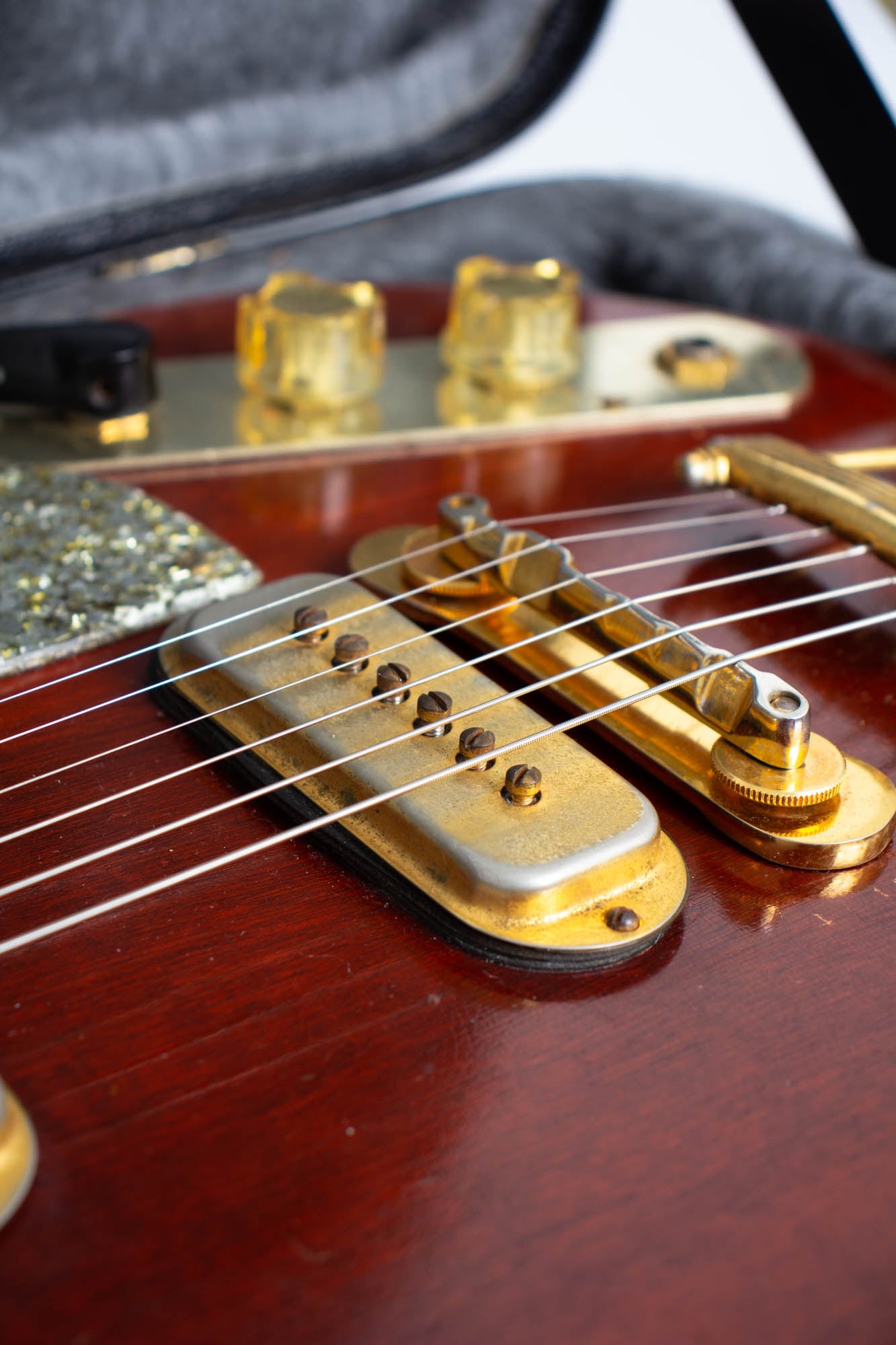
The hardware is all period appropriate, if not all original. The gold trapeze tailpiece is original; the bridge is a later Bigsby "dogbone" piece appropriate to but not original on this guitar. These DID come with a Bigsby bridge if ordered with the matching vibrato tailpiece. The tuners (gold plated, metal button Waverlys) are period appropriate but not original to the guitar; one of them is nickel. The elaborate amber plastic knobs are unusual but appear original. The upper strap button is original; the lower one is later and there is an extra hole in the lower rim from a third. The gold plating overall shows some wear but is better quality than, say, Gretsch would have used!
This guitar is a better player than most; the rosewood neck has stayed straighter than many and the frets show only light wear. The pickups and wiring are all original except for an external ground wire added to the bridge base. The twin Franz pickups have a distinct character not unlike a brighter P-90; combined with the big solid rosewood neck, they produce a rip-roaring growl when cranked. Most of these Premiers have a simple wooden bridge; while not original the metal Bigsby unit is definitely a sonic advantage to this guitar. This is not the cleanest of these we have seen, but a very good player with a cool provenance. Elliott tells us it has served him well and is ready for a new home. Overall Very Good + Condition.