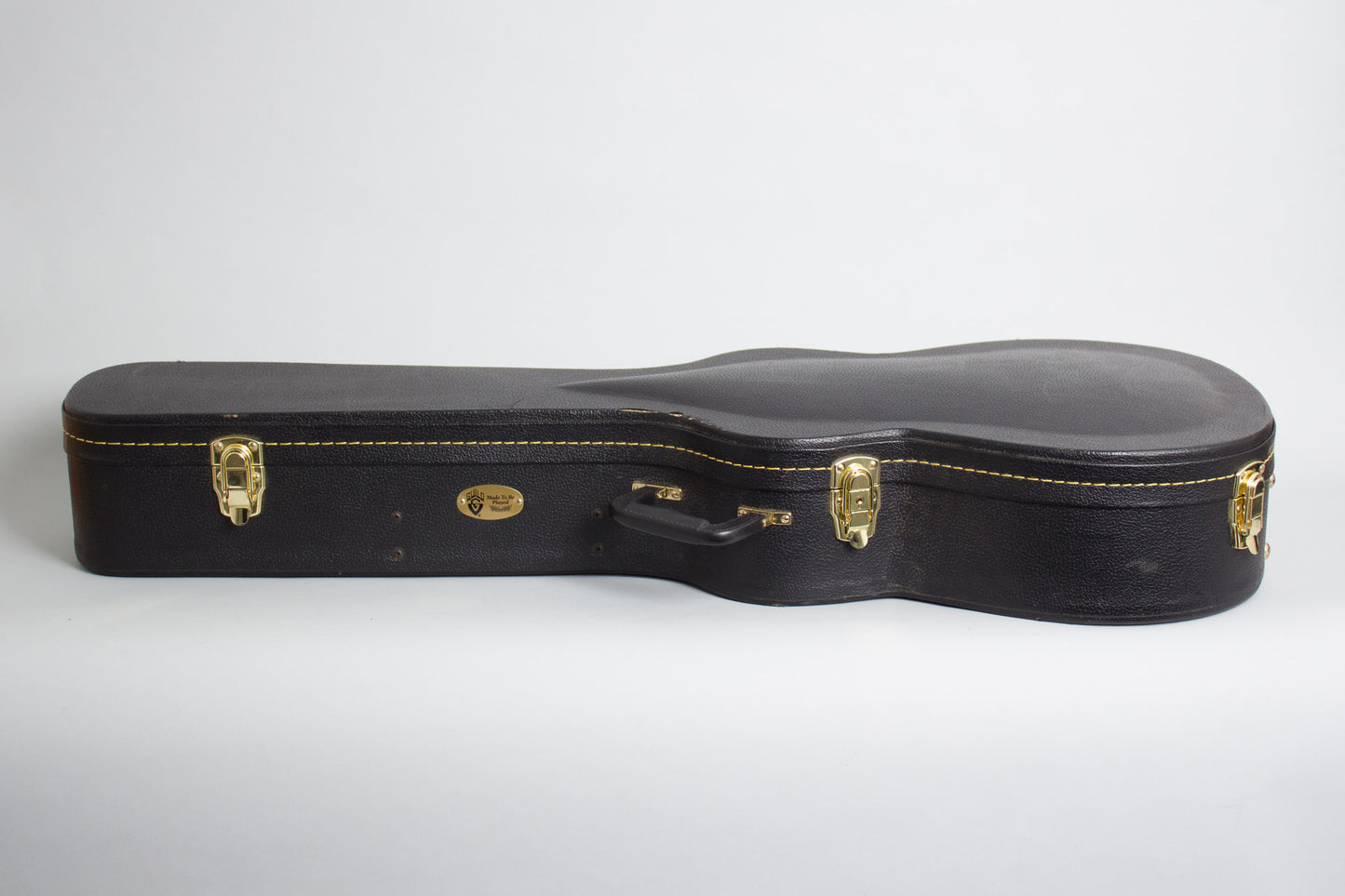
Premier Bantam Deluxe E-704 Model Arch Top Hollow Body Electric Guitar (1958), made in Jersey City, NJ, serial # 1422, sunburst lacquer finish, laminated maple body, mahobany neck with rosewood, black tolex hard shell case.
This is by far the finest example we have ever seen of a Premier Bantam Deluxe, a very interesting but mostly forgotten electric from the late the 1950s. A product of the New York-based Sorkin/Multivox organization, the Premier brand name was used from the late '40s for amplifiers and from the early 1950s on guitars. The company offered many interesting designs, including some quite original amplifiers like the split-cabinet Premier 88.
The Bantam guitar is their version of an idea that was kicking around several New York-area makers in the mid-'50s: a small-body archtop hollow or semi-hollow electric guitar to compete with that new-fangled solid-body Les Paul from Gibson. Around the same time, Gretsch came out with the Duo-Jet and Guild the M-75 Aristocrat, which were both more of a semi-solid design. Sorkin's Bantam series were actually the most traditional of the bunch built on a deeper, fully hollow body only 13 1/2" wide.
There seemed to be more resistance to the solid-body concept in New York (where many studio and broadcast performers worked) than out in the wilds of southern California! The archtop guitar was the preferred tool of most East Coast professionals, and NY-based builders -- Gretsch, Epiphone, Guild, and Sorkin -- generally eschewed solid-bodies well up into the end of the decade. Sorkin offered an extensive line of full-sized Premier-branded archtop electrics, with the Bantam as the runt of the litter!
This particular Bantam Deluxe is an early example from around 1958-9. The small fully hollow-body and neck unit was made by the United Guitars factory in Jersey City, who supplied components to a number of re-sellers -- including, on occasion, John D'Angelico. This one is unusual in having no F-holes, a more common trait on similar models United built for the Orpheum brand. It is bound top and back and finished overall in a reddish-orange sunburst lacquer. The bound rosewood fingerboard has pearl dot inlay (larger than most) and the headstock carries the Premier logo and torch emblem engraved into a plastic overlay.
The unique dazzling silver-sparkle pickguard and knobs are a Premier trademark that appeared on many of their creations. The pickups are the same rare single-pole white-top DeArmonds used on some Guilds at the time and sound great; they were the "Deluxe" fitting and added $35 to the list price. The unusual large rotary pickup selector lever is another Premier trademark. The heavy tailpiece has a sort of "D'Angelico junior' flavor. In the late 1950s this "Shaded Deluxe " twin-pickup model sold for $230 (plus case) so it was not really a particularly cheap guitar. This is a superbly cool-looking, good-playing, great-sounding little guitar, a standout example of one of Premier's best, most unique offerings.
Overall length is 38 1/4 in. (97.2 cm.), 13 1/2 in. (34.3 cm.) wide at lower bout, and 2 11/16 in. (6.8 cm.) in depth, measured at side of rim. Scale length is 25 in. (635 mm.). Width of nut is 1 11/16 in. (43 mm.).
We have simply never seen one of these little marvels in anything like this kind of condition! While not absolutely pristine is cleaner than most New York guitars from this period and has not suffered the typical decay most have. The original cream celluloid body and neck binding remains in excellent shape with NONE of the common deterioration; this is VERY rare on these 1950s NYC made guitars nearly all of which have experienced serious binding rot either having been or needing to be rebound completely. The engraved plastic headstock veneer has some small chips and marks but has not shrunken up appreciably.
The vibrant sunburst lacquer finish remains nicely original with minimal fade and very little play wear, just light checking and a few random dings, dents and overall (mostly on the back) with a little flaking on the treble side of the neck heel. The back of the neck has light checking and two feelable dinks on the treble side in the second-to-third fret area, otherwise is quite clean.
The hardware is original, most importantly the massive selector head and sparkle pickguard and knobs, which are almost impossible to find if they have gone missing. A couple of reversible parts substitutions have been made for the sake of improved playability: The original carved ebony bridge is stored in the case; the guitar is set up with a later Tune-O-Matic which actually looks correct as Premier offered these (bought from CMI/Gibson) as a catalog option at the time. The plastic risers under the pickups are replacements (again the felt originals are in the case) built taller to bring the coils closer to the strings for improved output.
The fingerboard has been very neatly refretted with larger wire than the thin 1950s spec and playability is excellent. This DeArmond-equipped Premier is a lot of fun to play and visually a stunner with its sparkle accents flashing. This Funky-but-Chic New York classic sounds great as well with a cool, spanky tone, and lives in a well-fitted modern hard shell case. Overall Excellent Condition.