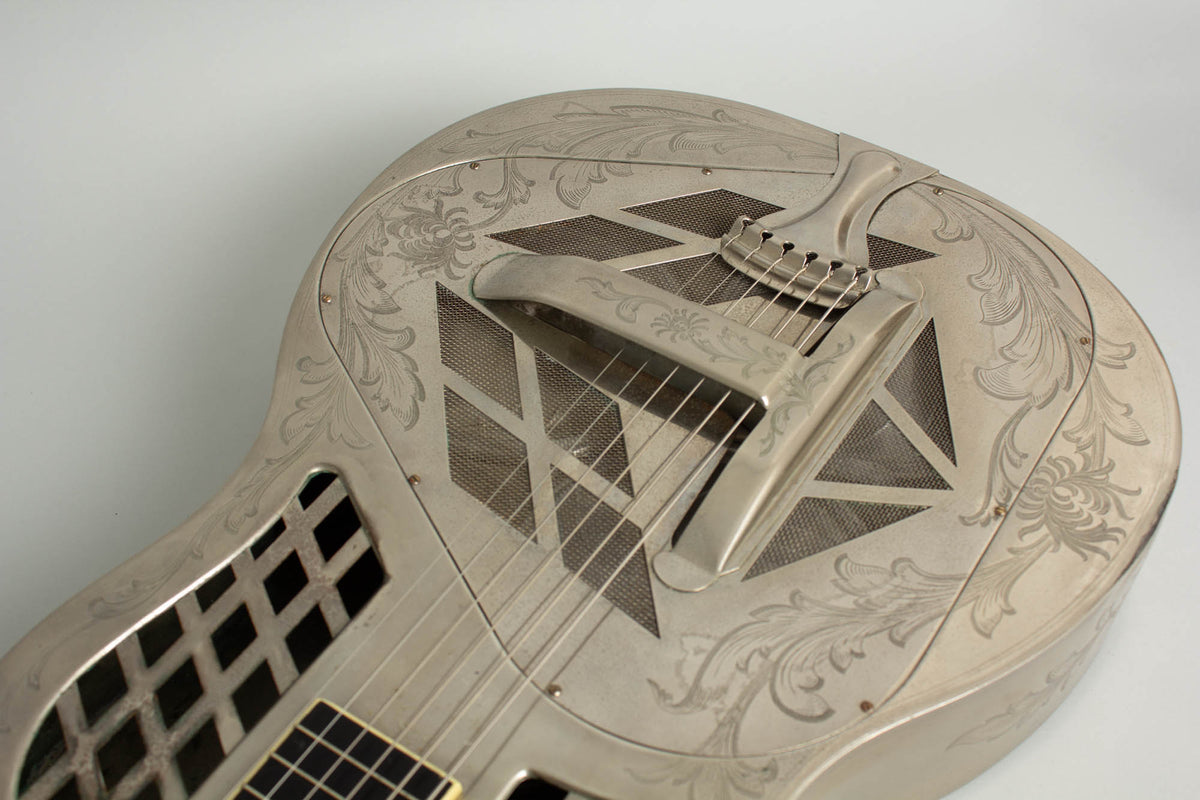
National Style 4 Tricone Squareneck Model Resophonic Guitar (1928), made in Los Angeles, California, serial # 1006, nickel plated finish, German silver body, ebony fingerboard, black tolex hard shell case.
This Style 4 Tricone is an early example of the finest instrument of its type made in 1928; some would say ever! This one has some general wear but a special provenance as well: it was carried shipboard by a US Navy sailor in WWII who etched his name and the names of ships he served on daintily into the side of the neck, including the USS Hancock (an Essex-class aircraft carrier) and the USS Biloxi (A Cleveland class light cruiser). His name and the name "Elaine" are also delicately etched in (presumable the sweetheart left at home) along with the Biblical message "Reap What You Sow".
We don't know what sort of music this sailor played in the mid-1940s but the National Tricone is generally considered the best sounding of all acoustic Hawaiian guitars. Built just as the 1920's Jazz Age party was about to come crashing down, this is a wonderful representative of the "state of the art" acoustic steel from the time before electrification changed the game. The company's early publicity proclaimed the National Silver Guitars "The Greatest Musical Sensation of the Age" and before electricity took over they were not far wrong!
The Style 4 Tricone was the most superlative resonator instrument made by National, the top of the line from 1928-1940. Much rarer than the plain Style 1, the Style 4 with its extremely elaborate "chrysanthemum" engraving is the fanciest and to many the most aesthetically pleasing of all Nationals. It cost $195 in 1928, a considerable sum at the time. These ultra-modern fancy resophonic guitars would continue to be built up until WWII, but only in ever-decreasing numbers as the great bulk of National's production from 1930 on would be the cheaper single cone instruments, and eventually those new-fangled electrics by the end of the decade.
The Style 4 features a bound ebony fingerboard inlayed with pearl diamonds mounted to the integral square metal-sheathed neck. The headstock is faced in ebony with an inlaid pearl engraved National shield logo at the top. The flowing floral engraving pattern was supposedly designed by George Beauchamp himself and is extremely finely executed; this version has fronds running through the coverplate as was standard after mid-1928. The engraver's name is only recorded as Mr. Williams; his work adorns all the early engraved Tricones and is beautifully executed. This early model is stamped PatPend. on the top just below the fingerboard.
The guitar has the smooth deep Tricone sound, fabulous for both the original Hawaiian style or other 6-string steel guitar playing. "The Tricone guitar flowed like a river" is how inventor John Dopyera described it decades later, and no one has said it better since.
Overall length is 38 7/8 in. (98.7 cm.), 14 1/8 in. (35.9 cm.) wide at lower bout, and 3 1/8 in. (7.9 cm.) in depth at side, taken at the end block. Scale length is 25 in. (635 mm.). Width of nut is 2 in. (51 mm.).
This Style 4 shows some general wear overall, likely at least in part from exposure to the salt air of the Western Pacific! Despite this it remains nicely original and lovely player. The nickel plated finish has occlusion overall from moisture and there is some heavier scuffing, spotting and scratching to the back. The most notable areas of wear are to the upper screen holes, where corrosion from the unplated edges has leeched into the plating on the top surface. There is no major plating loss to the rest of the body; The elevated handrest on the coverplate shows less plating loss than many where the player's hand rests.
There are various dents along the body edges but no open seams. There are some small dings and dents to the top and back. The neatly done shallow engravings done by the previous U.S. Navy owner are visible on the back and sides of the neck. The lacquer finish on the wooden headstock is heavily chipped and worn away but the engraved pearl National Shield logo still looks great. A small "$300" is etched into the back of the headstock, reason unknown. The original Waverly strip tuners have some noticeable corrosion but still work fine.
All hardware is original including the cones, tri-bar, nut and tailpiece. The treble side cone has a small dimple visible at the base but is still fully functional. The original maple saddle is in fine condition and the instrument still produce the lush warm sound these are prized for. This beautiful instrument has some real history to it and is a lovely reminder of the golden age of Hawaiian Music and likely provided some welcome entertainment 80+ years ago for some sailors serving far from home. Overall Very Good + Condition.