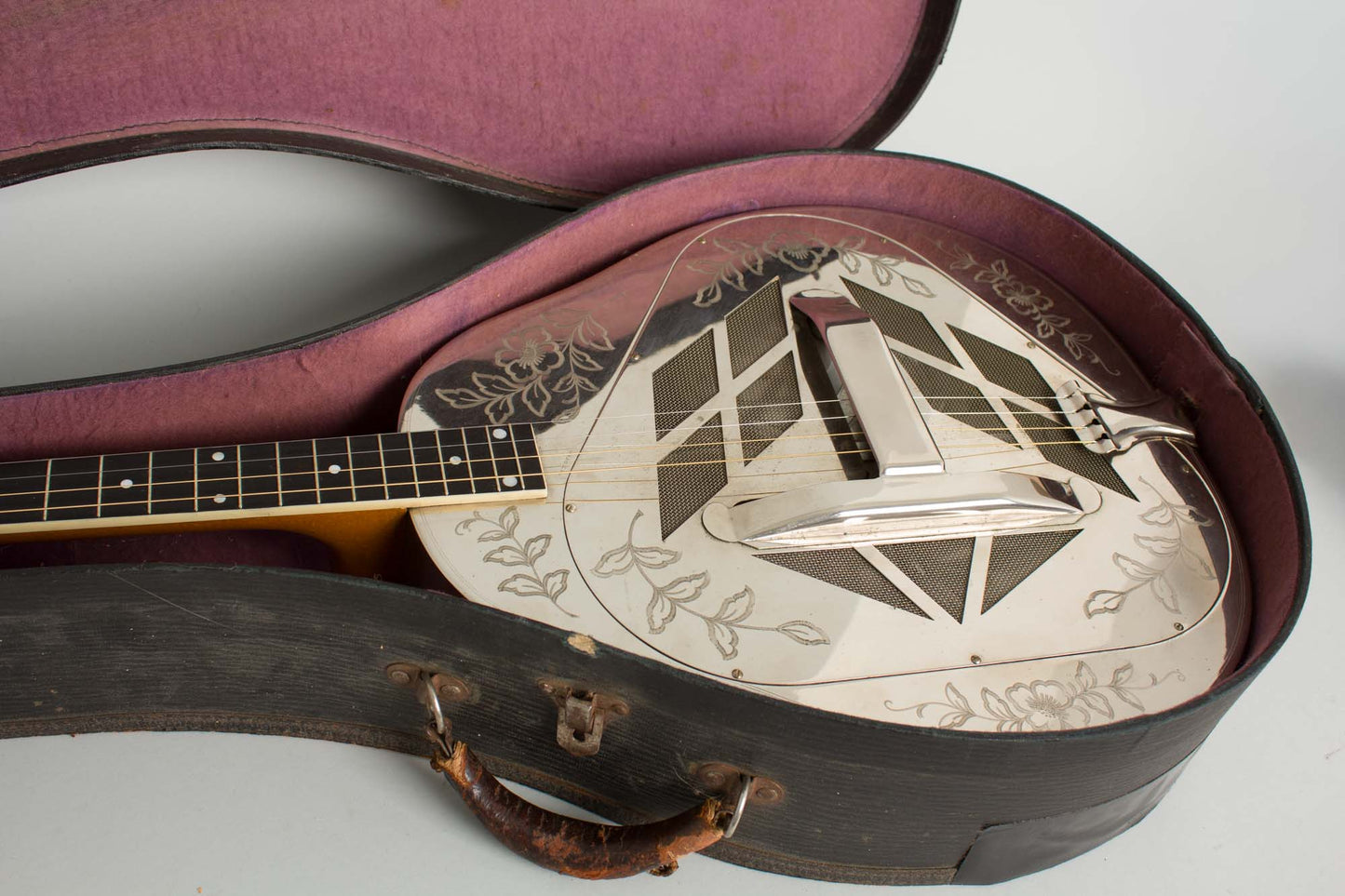
National Style 2 Model Resophonic Tenor Guitar (1928), Los Angeles, serial # 23.
This is a lovely example of a rare and somewhat forgotten National instrument, a first-generation Style 2 Tricone Tenor guitar. The National String Instrument Corporation's first products, released in 1927, were German silver bodied Tricone Spanish and Hawaiian 6-string guitars. As the name implies the Tricone design uses 3 small spun aluminum cones to amplify the strings, set inside a hollow metal body of "German silver" alloy. A collaborative project between inventor John Dopyera and Hawaiian guitarist George Beauchamp The Tricone came out so well that in 1927 they attracted investors and went into production with four styles of "National Silver Guitars" ranging from a plain deco Style 1 through the elaborately engraved Style 4.
By 1928 these were successful enough National expanded the line to include mandolins, tenor and plectrum guitars and ukuleles all using the same triple-resonator system. The smaller dimensions of these uniquely pear-shaped 4-string bodies made fitting the three cones a fidgety and difficult procedure; around 5-600 serial numbers in, they were redesigned to use a single-cone resonator. Not long after that the tenor and plectrum design was changed to a more conventionally guitar shaped body.
This first-pattern Style 2 Tenor carries the very early serial #23, marking it as one of the very first ones built in 1928. The vaguely pear-shaped German silver body has three cones in the body well in a triangle pattern under the tri-armed bridge that activates them. This is topped by the same screen-hole coverplate used on the larger 6-string guitars, which likely dictated the somewhat eccentric body dimensions. The slim 22 3/4" maple neck has a bound ebony fingerboard with pearl dot inlay, and is topped by a somewhat bulbous banjo-style headstock fitting Grover patent "pancake" banjo tuners. The tailpiece is a smaller 4-string version of the one used on standard guitars.
The Style 2 is distinguished by a beautifully delicate rose pattern hand engraved on the top, back and sides of the nickel-plated body. "Pat Pend" is stamped to the top just below the fingerboard. The Style 2 Tenor originally retailed for $95.00, a considerable sum for a tenor guitar even in the roaring '20's but really an amazing bargain compared the elaborate professional banjos of the time. After 1930 all styles of these fancy German Silver instruments would only be produced in very small numbers compared to the plainer styles; most Depression era tenors are painted Triolian steel-bodied models.
In 1928 this was a uniquely viable instrument for orchestra banjoists looking for a more guitar like sound. It is one of the very few tenor guitars that can actually compete sonically with a banjo while offering the richer Tricone tone. It excels in either the traditional tenor fifths C-G-D-A tuning or the "Chicago" style of tuning to the four higher pitches of the 6-string guitar. These were not in production for very long and are a unique instrument both in feel and sound, a distinct delight for any four-string player.
Overall length is 35 1/4 in. (89.5 cm.), 14 in. (35.6 cm.) across at the widest point, and 2 15/16 in. (7.5 cm.) in depth, measured at side of rim. Scale length is 22 3/4 in. (578 mm.). Width of nut is 1 3/32 in. (28 mm.).
The instrument shows some old repair work but remains structurally very sound and an excellent player, surviving in unaltered original condition. The only visible repair is a pair of very old sealed vertical grain splits running down the down back of the neck, from the nut area to just above the 4th fret on the treble side and to the 2nd fret on the bass side. These appear to have been repaired long ago, with a thin spline added in a couple of spots on the treble side and the finish touched up and polished out above. While not the way it would have generally been done today this is a solid repair and not an ongoing structural issue. The neck was also reset and a small amount of glue residue visible around the heel.
The still-shiny nickel plated body finish has only light tarnish overall; the body shows some small dents, scratches and scuffing but no major wear. Apart from the repaired spits the neck finish is original with some checking overall and wear to the wood along the sides. The National decal on the headstock has darkened a bit but its fully intact. The original cones and T-bar appear fully intact and the original tailpiece has never sheared at the base as many have.
The ebony fingerboard retains the original frets, which have only very light wear. The instrument plays and sounds excellent with a very powerful tone and plenty of volume; in many ways the ideal bridge between guitar and tenor banjo. While it shows the one visible neck repair this is still a fine example of a very rare product of the original National company in Los Angeles. It is still in what appears to be the original chipboard case with some added tape along the edges but fully functional, at least for nearly century-old chipboard. Overall Very Good + Condition.