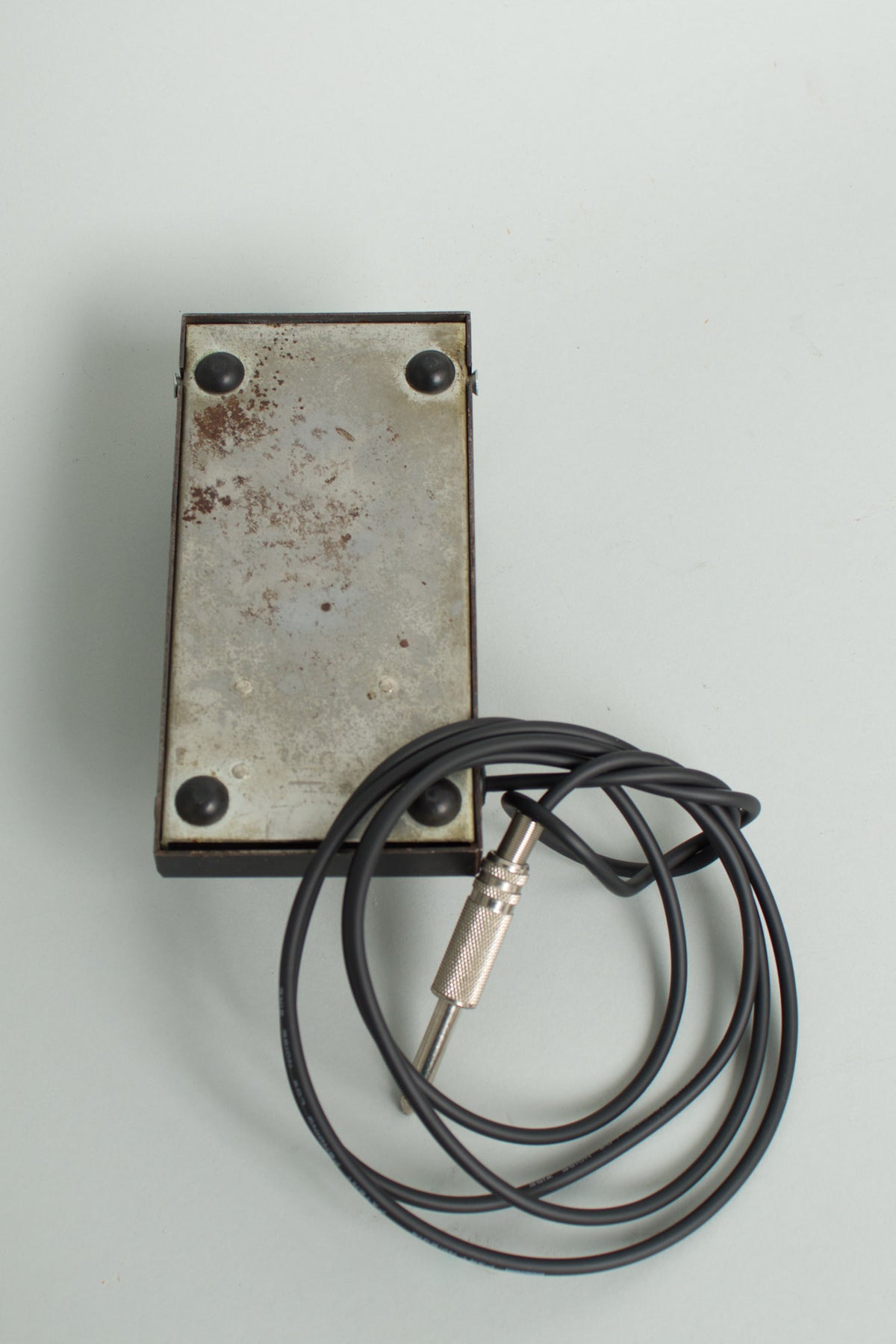
Maestro Fuzz-Tone Distortion Pedal Effect (1968)
1
/
of
5
Regular price
$450.00
Regular price
$450.00
Sale price
$450.00
Unit price
/
per
Item #14424
Fuzz-Tone Model Distortion Pedal Effect, made by Maestro, c. 1968, made in Kalamazoo, Michigan, black enamel finish, stamped metal housing.
It may be hard to think of a time without fuzz, but there was a time without fuzz. Eventually, guitarists and session players began to experiment with overdriving their tube amps to achieve a crunchier tone; history books can point to one noisy preamp in a Nashville studio accidentally leading to several singles like Grady Martin's "The Fuzz" that would jumpstart a trend among young guitarists. Unforuntately, the capricious (and mortal) nature of faulty equipment created the need for something compact, affordable, and intentional for this new generation of fuzz acolytes. Gibson was the first to capitalize on the moment, purchasing the design from recording engineer Glenn Snoddy and his engineer friend Revis Hobbs who had come up with a stompbox to serve their fuzz-seeking clientele. This is the FZ-1B, the silicone transistor based sibling of the the FZ-1: Maestro's simple stompbox that became the first commercially available fuzz effect pedal in 1962.
This particular FZ-1B is from around 1968 a few years after Gibson made revisions to the original FZ-1 circuit; it was this second variation that accounted for the use of the more standardized 9V battery and the circuit was further revised by Bob Moog. Unlike the pedals that came before it, this one relies on silicone rather than germanium transistors for a tighter, denser fuzz than the more warm and unwiedly germaniums. This pedal and its relatives can be heard on countless classic rock records, from the Stones to the Who and into psychedelic territories beyond.
Overall length is 6 in. (15.2 cm.), 3 in. (7.6 cm.) width, and 2 5/8 in. (6.7 cm.) high.
This classic box of fuzz is nicely original with just commensurate playwear from years of honest use; these Fuzz-tones in their sturdy aluminum wedge enclosures are typically workhorses. It was recently cleaned by us (some foam had really been left to the elements inside) and had the stomp replaced; it is healthy and original beyond this service except or the replaced 1/4" output cable. Excellent - Condition.
View full details
It may be hard to think of a time without fuzz, but there was a time without fuzz. Eventually, guitarists and session players began to experiment with overdriving their tube amps to achieve a crunchier tone; history books can point to one noisy preamp in a Nashville studio accidentally leading to several singles like Grady Martin's "The Fuzz" that would jumpstart a trend among young guitarists. Unforuntately, the capricious (and mortal) nature of faulty equipment created the need for something compact, affordable, and intentional for this new generation of fuzz acolytes. Gibson was the first to capitalize on the moment, purchasing the design from recording engineer Glenn Snoddy and his engineer friend Revis Hobbs who had come up with a stompbox to serve their fuzz-seeking clientele. This is the FZ-1B, the silicone transistor based sibling of the the FZ-1: Maestro's simple stompbox that became the first commercially available fuzz effect pedal in 1962.
This particular FZ-1B is from around 1968 a few years after Gibson made revisions to the original FZ-1 circuit; it was this second variation that accounted for the use of the more standardized 9V battery and the circuit was further revised by Bob Moog. Unlike the pedals that came before it, this one relies on silicone rather than germanium transistors for a tighter, denser fuzz than the more warm and unwiedly germaniums. This pedal and its relatives can be heard on countless classic rock records, from the Stones to the Who and into psychedelic territories beyond.
Overall length is 6 in. (15.2 cm.), 3 in. (7.6 cm.) width, and 2 5/8 in. (6.7 cm.) high.
This classic box of fuzz is nicely original with just commensurate playwear from years of honest use; these Fuzz-tones in their sturdy aluminum wedge enclosures are typically workhorses. It was recently cleaned by us (some foam had really been left to the elements inside) and had the stomp replaced; it is healthy and original beyond this service except or the replaced 1/4" output cable. Excellent - Condition.

Loading...
Just arrived!
Item #