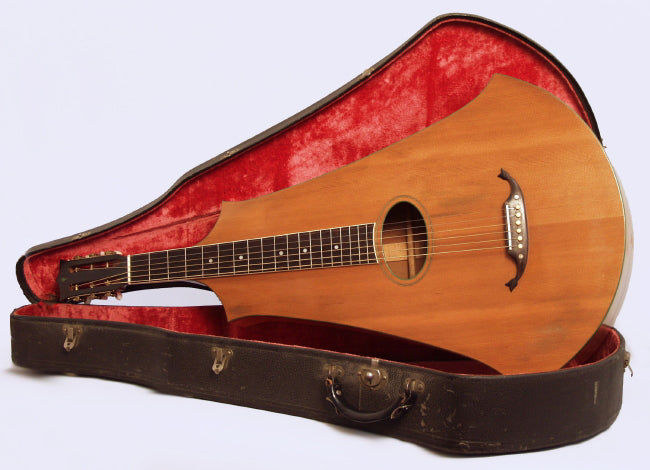
Lyon & Healy Bell Hawaiian Harp #5260 Hawaiian Acoustic Guitar (1926)


1
/
of
9
Couldn't load pickup availability
Item #3103
Lyon & Healy Bell Hawaiian Harp #5260 Model Hawaiian Acoustic Guitar, c. 1926, made in Chicago, natural lacquer finish, Flamed koa body, spruce top, laminared mahogany neck, ebony fingerboard, original black hard shell case.
One of the most original and unique of 1920's American fretted instruments (although it actually has no frets!), the Lyon & Healy Bell Hawaiian Guitar is an absolute showstopper, a truly original design that has never been equalled. While this sort of super-elaborate lap-style guitar may seem quixotic now, in the mid-1920's Hawaiian guitar was a major trend in showbiz, and the need for louder (and flashier) instruments for steel playing was a major concern of fretted instrument makers and players.
While the invention of the metal National resonator guitar proved to be the ultimate solution in the pre-electric era, several makers took a hint from the success of the Kona and Weissenborn non-traditional steel guitars and crafted ever grander wooden Hawaiian showboats, of which this is the grandest. When Lyon & Healy introduced this imposing monster around 1926, it must have seemed that the Hawaiian guitar had reached its peak.
The Bell Hawaiian is actually a somewhat strange creation. While it owes something in concept to the original Knutsen design that Herman Weissenborn popularized, it is not particularly similar to that or any other guitar. The "Bell" shape body was also used by L & H on a Spanish guitar produced at the same time, but that model had a much smaller body with a round upper bout and of course an actual 12-fret neck.
One of the odder features of the model #5260 is the vestigial neck�it is only three frets long, but still fully shaped and attached to the guitar in the conventional way. It would seem to have been far easier to simply fair the headstock into the body as Weissenborn did, but Lyon & Healy's designer thought otherwise! The early Knutsen and Kona guitars had a short fretted neck to allow for some adaptability to Spanish play, but the Bell Hawaiian's neck is purely decorative.
The very long spruce top is actually slightly arched and slopes gracefully down to meet the sides, most noticeably towards the front body points. The fingerboard is not fretted but has inlaid position markers and is bound in white celluloid, while the rest of the instrument's binding is a vibrant green peculiar to Lyon & Healy in this era. The back and sides are built of spectacular flamed koa wood of the highest grade, while the top is fine-grained spruce. The tuners are elaborately decorated gold-plated strips with solid pearl buttons.
The guitar's tone is far deeper than the average Hawaiian guitar, with a particularly dense rumble on the low notes. The top is ladder braced (unlike the X-braced Weissenborn-style instruments) and the bridge with its elaborate "fishtail" ends is quite thick. While Lyon & Healy often seemed to festoon their instruments with markings and numbers, this one carries no Washburn logo, serial, or model numbers, and only a very discreet "Lyon & Healy, Makers. Chicago" stamp on the inside back.
The Bell Hawaiian remains a fascinating example of American guitar ingenuity, so evolved it almost ceases to resemble a guitar. If not for the Dopyera Brother's collaboration with George Beauchamp in Los Angeles at around the same time creating the resonator guitar, it might have gone on to a better future, or at least seemed less like an obvious dead end! Still simply one of the most beautiful and distinctive Hawaiian guitars ever made, and a must for any high-end steel guitar collection.
Overall length is 39 in. (99.1 cm.), 19 15/16 in. (50.6 cm.) wide at lower bout, and 4 7/8 in. (12.4 cm.) in depth at side, taken at the end block. Scale length is 25 1/2 in. (648 mm.).
Very nice overall; one repaired top crack behind bridge and some overall light playwear. The bridge has pearl dots that appear to cover Gibson-style screws probably added during an early bridge reglue operation.
Otherwise completely original and spectacular looking and sounding, with the truly unique original shaped hard case. Excellent Condition.
View full details
One of the most original and unique of 1920's American fretted instruments (although it actually has no frets!), the Lyon & Healy Bell Hawaiian Guitar is an absolute showstopper, a truly original design that has never been equalled. While this sort of super-elaborate lap-style guitar may seem quixotic now, in the mid-1920's Hawaiian guitar was a major trend in showbiz, and the need for louder (and flashier) instruments for steel playing was a major concern of fretted instrument makers and players.
While the invention of the metal National resonator guitar proved to be the ultimate solution in the pre-electric era, several makers took a hint from the success of the Kona and Weissenborn non-traditional steel guitars and crafted ever grander wooden Hawaiian showboats, of which this is the grandest. When Lyon & Healy introduced this imposing monster around 1926, it must have seemed that the Hawaiian guitar had reached its peak.
The Bell Hawaiian is actually a somewhat strange creation. While it owes something in concept to the original Knutsen design that Herman Weissenborn popularized, it is not particularly similar to that or any other guitar. The "Bell" shape body was also used by L & H on a Spanish guitar produced at the same time, but that model had a much smaller body with a round upper bout and of course an actual 12-fret neck.
One of the odder features of the model #5260 is the vestigial neck�it is only three frets long, but still fully shaped and attached to the guitar in the conventional way. It would seem to have been far easier to simply fair the headstock into the body as Weissenborn did, but Lyon & Healy's designer thought otherwise! The early Knutsen and Kona guitars had a short fretted neck to allow for some adaptability to Spanish play, but the Bell Hawaiian's neck is purely decorative.
The very long spruce top is actually slightly arched and slopes gracefully down to meet the sides, most noticeably towards the front body points. The fingerboard is not fretted but has inlaid position markers and is bound in white celluloid, while the rest of the instrument's binding is a vibrant green peculiar to Lyon & Healy in this era. The back and sides are built of spectacular flamed koa wood of the highest grade, while the top is fine-grained spruce. The tuners are elaborately decorated gold-plated strips with solid pearl buttons.
The guitar's tone is far deeper than the average Hawaiian guitar, with a particularly dense rumble on the low notes. The top is ladder braced (unlike the X-braced Weissenborn-style instruments) and the bridge with its elaborate "fishtail" ends is quite thick. While Lyon & Healy often seemed to festoon their instruments with markings and numbers, this one carries no Washburn logo, serial, or model numbers, and only a very discreet "Lyon & Healy, Makers. Chicago" stamp on the inside back.
The Bell Hawaiian remains a fascinating example of American guitar ingenuity, so evolved it almost ceases to resemble a guitar. If not for the Dopyera Brother's collaboration with George Beauchamp in Los Angeles at around the same time creating the resonator guitar, it might have gone on to a better future, or at least seemed less like an obvious dead end! Still simply one of the most beautiful and distinctive Hawaiian guitars ever made, and a must for any high-end steel guitar collection.
Overall length is 39 in. (99.1 cm.), 19 15/16 in. (50.6 cm.) wide at lower bout, and 4 7/8 in. (12.4 cm.) in depth at side, taken at the end block. Scale length is 25 1/2 in. (648 mm.).
Very nice overall; one repaired top crack behind bridge and some overall light playwear. The bridge has pearl dots that appear to cover Gibson-style screws probably added during an early bridge reglue operation.
Otherwise completely original and spectacular looking and sounding, with the truly unique original shaped hard case. Excellent Condition.