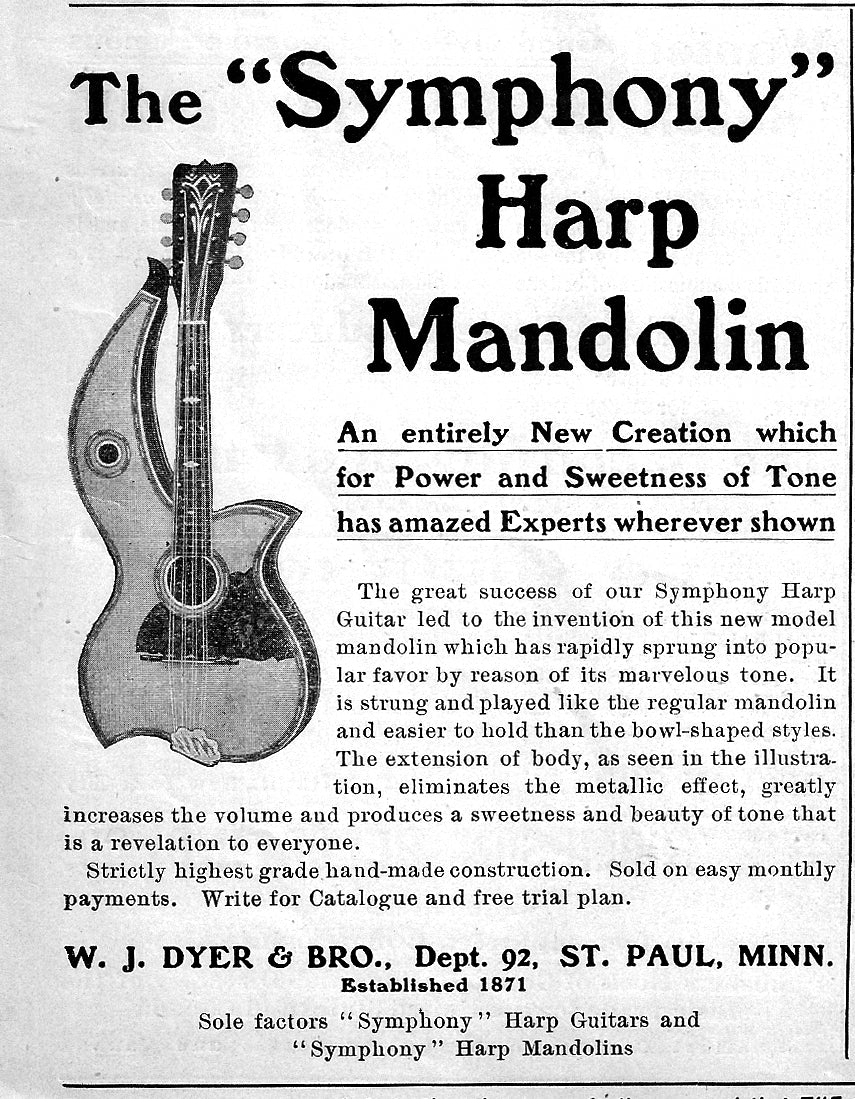
Dyer Symphony Harp Style 20 Model Flat Back Mandolin, made by Larson Brothers, c. 1908, made in Chicago, natural varnish finish, mahogany body and neck, spruce top, ebony fingerboard, hard shell case.
The Symphony Harp Mandolin is one of the rarer Larson Brothers creations, made for W.J. Dyer & Bro in the first decades of the 20th century. The Dyer Harp guitars are much better remembered, but a whole family of mandolin instruments were marketed alongside them. The mandolins have the upper body extension like the guitars, but do not have any sub-bass harp strings. The extended body definitely enhances toe tonal character, and this is a very fine-sounding instrument.
This is a very early example, with a Dyer label under the sound hole reading "Symphony Harp Mandolin Style 20 number #121". This mandolin shows subtle differences from most other known examples. The model was introduced in a 1908 ad in The Cadenza magazine, one of the fretted journals of the day, and this early version is virtually identical to the one illustrated there. By around 1910, later models have the point on the side of the back edge of the body in the lower treble side -- this one shows a similar point on the bass side instead.
There are only a limited number of Dyer Symphony Harp Mandolins in existence, and only a couple in this early pattern are known to survive. The Style 20 was fairly plain, with bound edges and wood purfling around the sound holes, but is still a most elegant and striking instrument, with a totally unique look and very fine sound.
Overall length is 24 1/2 in. (62.2 cm.), 9 3/16 in. (23.3 cm.) wide at lower bout, and 2 3/8 in. (6 cm.) in depth, measured at side of rim. Scale length is 13 in. (330 mm.). Width of nut is 1 1/8 in. (29 mm.).
This instrument shows wear all around but remains in remarkably good condition considering it is well over 100 years old. The top has some moderate pickwear through the finish, but no cracks to the spruce. There is one small grain crack to the mahogany back near the tailpiece; no other notable repairs. The finish shows some very fine varnish checking and a decent amount of wear overall, but no large areas of finish loss.
It is all original except for a very fine reproduction of the original style bridge. The sound is delightful, delicate but warm, and surprisingly loud. This is one of the most interesting mandolins we have had in a long time, both a wonderful historic piece and a lovely instrument to play. Includes a old lap-steel hard case modified internally to fit the mandolin. Overall Very Good + Condition.