


Kay K-775 Jazz II Thinline Hollow Body Electric Guitar (1961)


1
/
of
12
Regular price
$1,950.00
Regular price
$1,950.00
Sale price
$1,950.00
Unit price
/
per
Item #14242
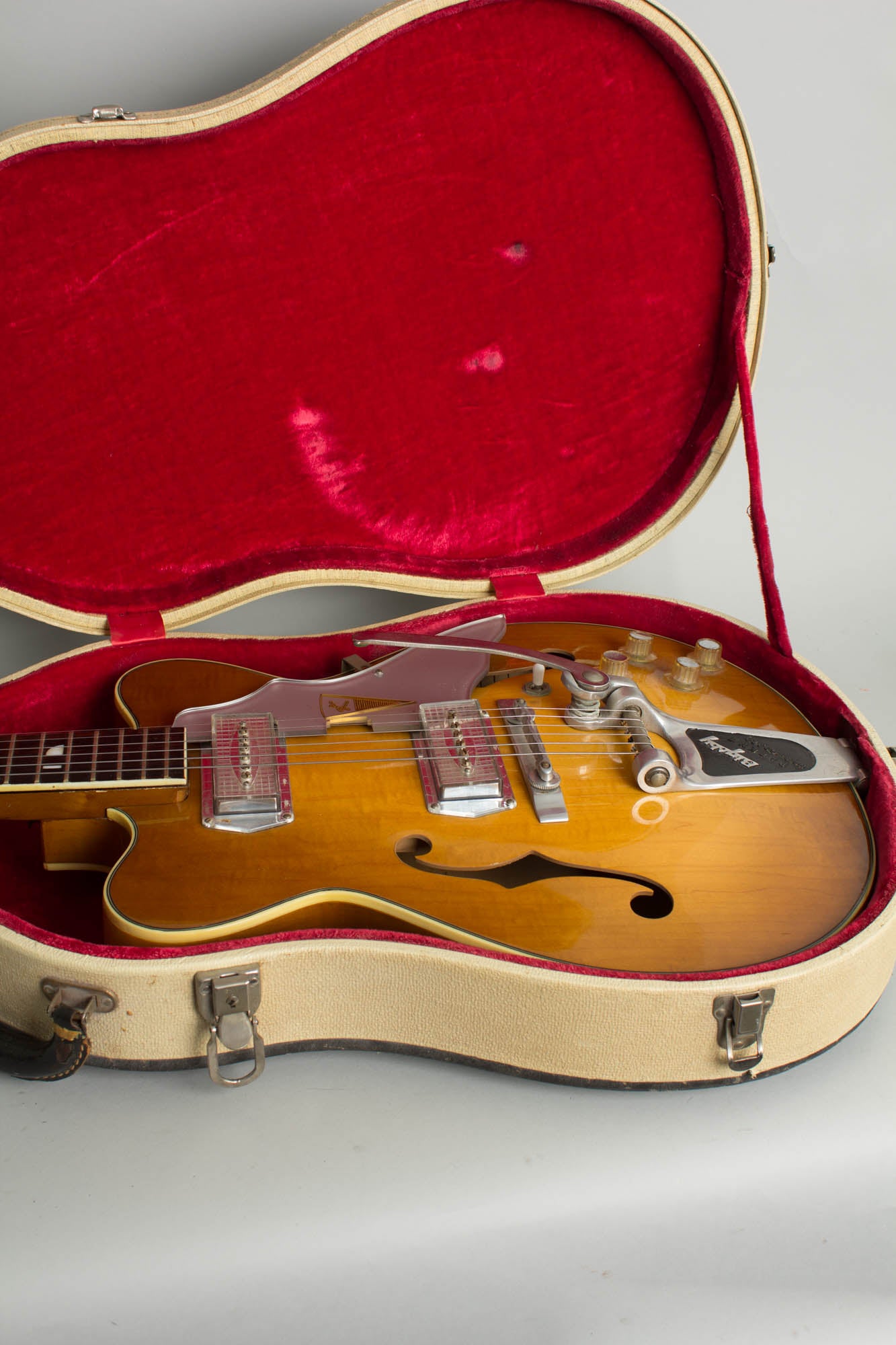
Kay K-775 Jazz II Model Thinline Hollow Body Electric Guitar (1961), made in Chicago, sunburst lacquer finish, laminated maple body, maple neck with rosewood fingerboard, original two-tone hard shell case.
After years of being mostly considered a "second tier" guitar builder, in 1957, Chicago's Kay under the new leadership of ex-Harmony man Sidney Katz jumped headlong into the professional electric guitar market. Their new "Gold K" line was designed to appeal to serious players instead of the pawnshop buyer! As Gibson had with Les Paul and Gretsch Chet Atkins, Kay secured an endorsement from poll-winning jazz man Barney Kessel and introduced a line of superbly flashy, well-made guitars bearing his signature.
Unfortunately the "Gold K" Kessel line was not a sales success and Barney Kessel let his endorsement deal expire after 3 years, moving (predictably) to Gibson. The Kessel signature line was gone by the 1961 catalog, but some of the features were retained on this simplified but still flashy model which graced the catalog cover that year. This K-775 Jazz II guitar was the top the new line, with a mid-sized thinline 15 1/4" body, fairly fancy cosmetics and a retail price of $249.50 (which was a lot for a Kay!) plus another $49.50 for the deluxe two-tone case. The Jazz II lasted for a couple of years (on the cover of the '62 catalog as well) but disappeared by the mid-60s as Kay focused more on budget product for the Beatle-fueled guitar boom.
The Jazz II retains some of the best features and "1950s Populuxe" trim of the Gold K line, notably the large headstock with the "Kelvinator" Lucite logo plate, silver back-painted Lucite K-logo pickguard and "Kleenex Box" single coil pickups encased in silver back-painted Lucite. The main difference was the neck was bolted on, which on a Kay (which often have questionable set neck joints) is reliably more functional. It carries pro-grade hardware including the then-new Grover Rotomatic tuners and a Bigsby True Vibrato tailpiece and aluminum bridge. The body is laminated maple, 4-ply bound on the back and single bound on the back finished in a subtly shaded amber sunburst. The neck is maple with a bound rosewood fingerboard inlaid with shaped plastic inserts. The "C" profile is slimmer than the 1950s Kay standard and fitted with a newly-adopted Gibson style truss rod that actually works.
The Jazz II is one of the best instruments Kay ever produced, at least from a practical playability standpoint. While largely forgotten now the model does have an historic connection to the seminal early 1960s British blues movement, being used by Eric Clapton in his pre-Yardbirds band The Roosters with Tom McGuinness. Clapton got his from Bell's Musical instruments, Ltd. in Surbiton, Surry, who actually imported them directly from Kay in Chicago. Bell's catalog listed the Jazz II at just over 117 pounds (plus another 21 for the case), but on hire-purchase (installment) plan one could be had at 12 Pounds down and just under a tenner a week.
This Surry area was "Ground Zero" for the South London music scene, and Bell's was a Mecca for guitar-besotted teenagers. Clapton's guitar was secured (with money from his grandmother) on the shop's HP plan. He played it through a Selmer Futurama III amplifier during The Roosters brief existence from January 1963 until they broke up in August. He recalled decades later:
"(it was) the same guitar I had seen Alexis Korner playing, a double-cutaway semi-acoustic Kay, which at the time was quite an advanced instrument, although essentially, as I later learned, it was still only a copy of the best guitar of the day, the Gibson ES-335. The Gibson would have cost over a hundred pounds then I think, well beyond our reach, while the Kay cost only ten pounds, but still seemed quite exotic. It captured my heart."
In 1962-3 London any American-made guitar was a status symbol, and Kay instruments had the additional cachet of being seen with several prominent Chicago blues artists. While the Jazz II is still not a replacement for a '62 ES-335 (not many things are!) taken on its own merits this a striking, well-made and quite playable instrument and cool piece of retro-guitar history.
Overall length is 41 5/8 in. (105.7 cm.), 15 1/4 in. (38.7 cm.) wide at lower bout, and 1 15/16 in. (4.9 cm.) in depth, measured at side of rim. Scale length is 25 5/8 in. (651 mm.). Width of nut is 1 11/16 in. (43 mm.).
This is a nicely original guitar, showing light wear overall and a very good player for this model. The all-original finish shows some small chips and dings, with a small area of flaking on the neck heel over the body where it looks like the binding was reglued. The "K" headplate logo has a small crack at one upper screw, and the silver pickup rings have some light staining in spots.
All hardware is original, the only alteration is an inexplicable cut to the original pickguard on the upper edge; perhaps someone tried to fit a DeArmond pickup there? This was very neatly done, it almost looks factory. At any rate all other hardware is intact showing some mostly minor wear. The original frets show almost no wear and this is a fine playing and sounding example of one of our favorite Kay models, complete in a very clean original two-tone HSC. Overall Excellent - Condition.
View full details
After years of being mostly considered a "second tier" guitar builder, in 1957, Chicago's Kay under the new leadership of ex-Harmony man Sidney Katz jumped headlong into the professional electric guitar market. Their new "Gold K" line was designed to appeal to serious players instead of the pawnshop buyer! As Gibson had with Les Paul and Gretsch Chet Atkins, Kay secured an endorsement from poll-winning jazz man Barney Kessel and introduced a line of superbly flashy, well-made guitars bearing his signature.
Unfortunately the "Gold K" Kessel line was not a sales success and Barney Kessel let his endorsement deal expire after 3 years, moving (predictably) to Gibson. The Kessel signature line was gone by the 1961 catalog, but some of the features were retained on this simplified but still flashy model which graced the catalog cover that year. This K-775 Jazz II guitar was the top the new line, with a mid-sized thinline 15 1/4" body, fairly fancy cosmetics and a retail price of $249.50 (which was a lot for a Kay!) plus another $49.50 for the deluxe two-tone case. The Jazz II lasted for a couple of years (on the cover of the '62 catalog as well) but disappeared by the mid-60s as Kay focused more on budget product for the Beatle-fueled guitar boom.
The Jazz II retains some of the best features and "1950s Populuxe" trim of the Gold K line, notably the large headstock with the "Kelvinator" Lucite logo plate, silver back-painted Lucite K-logo pickguard and "Kleenex Box" single coil pickups encased in silver back-painted Lucite. The main difference was the neck was bolted on, which on a Kay (which often have questionable set neck joints) is reliably more functional. It carries pro-grade hardware including the then-new Grover Rotomatic tuners and a Bigsby True Vibrato tailpiece and aluminum bridge. The body is laminated maple, 4-ply bound on the back and single bound on the back finished in a subtly shaded amber sunburst. The neck is maple with a bound rosewood fingerboard inlaid with shaped plastic inserts. The "C" profile is slimmer than the 1950s Kay standard and fitted with a newly-adopted Gibson style truss rod that actually works.
The Jazz II is one of the best instruments Kay ever produced, at least from a practical playability standpoint. While largely forgotten now the model does have an historic connection to the seminal early 1960s British blues movement, being used by Eric Clapton in his pre-Yardbirds band The Roosters with Tom McGuinness. Clapton got his from Bell's Musical instruments, Ltd. in Surbiton, Surry, who actually imported them directly from Kay in Chicago. Bell's catalog listed the Jazz II at just over 117 pounds (plus another 21 for the case), but on hire-purchase (installment) plan one could be had at 12 Pounds down and just under a tenner a week.
This Surry area was "Ground Zero" for the South London music scene, and Bell's was a Mecca for guitar-besotted teenagers. Clapton's guitar was secured (with money from his grandmother) on the shop's HP plan. He played it through a Selmer Futurama III amplifier during The Roosters brief existence from January 1963 until they broke up in August. He recalled decades later:
"(it was) the same guitar I had seen Alexis Korner playing, a double-cutaway semi-acoustic Kay, which at the time was quite an advanced instrument, although essentially, as I later learned, it was still only a copy of the best guitar of the day, the Gibson ES-335. The Gibson would have cost over a hundred pounds then I think, well beyond our reach, while the Kay cost only ten pounds, but still seemed quite exotic. It captured my heart."
In 1962-3 London any American-made guitar was a status symbol, and Kay instruments had the additional cachet of being seen with several prominent Chicago blues artists. While the Jazz II is still not a replacement for a '62 ES-335 (not many things are!) taken on its own merits this a striking, well-made and quite playable instrument and cool piece of retro-guitar history.
Overall length is 41 5/8 in. (105.7 cm.), 15 1/4 in. (38.7 cm.) wide at lower bout, and 1 15/16 in. (4.9 cm.) in depth, measured at side of rim. Scale length is 25 5/8 in. (651 mm.). Width of nut is 1 11/16 in. (43 mm.).
This is a nicely original guitar, showing light wear overall and a very good player for this model. The all-original finish shows some small chips and dings, with a small area of flaking on the neck heel over the body where it looks like the binding was reglued. The "K" headplate logo has a small crack at one upper screw, and the silver pickup rings have some light staining in spots.
All hardware is original, the only alteration is an inexplicable cut to the original pickguard on the upper edge; perhaps someone tried to fit a DeArmond pickup there? This was very neatly done, it almost looks factory. At any rate all other hardware is intact showing some mostly minor wear. The original frets show almost no wear and this is a fine playing and sounding example of one of our favorite Kay models, complete in a very clean original two-tone HSC. Overall Excellent - Condition.


Loading...
Just arrived!
Item #