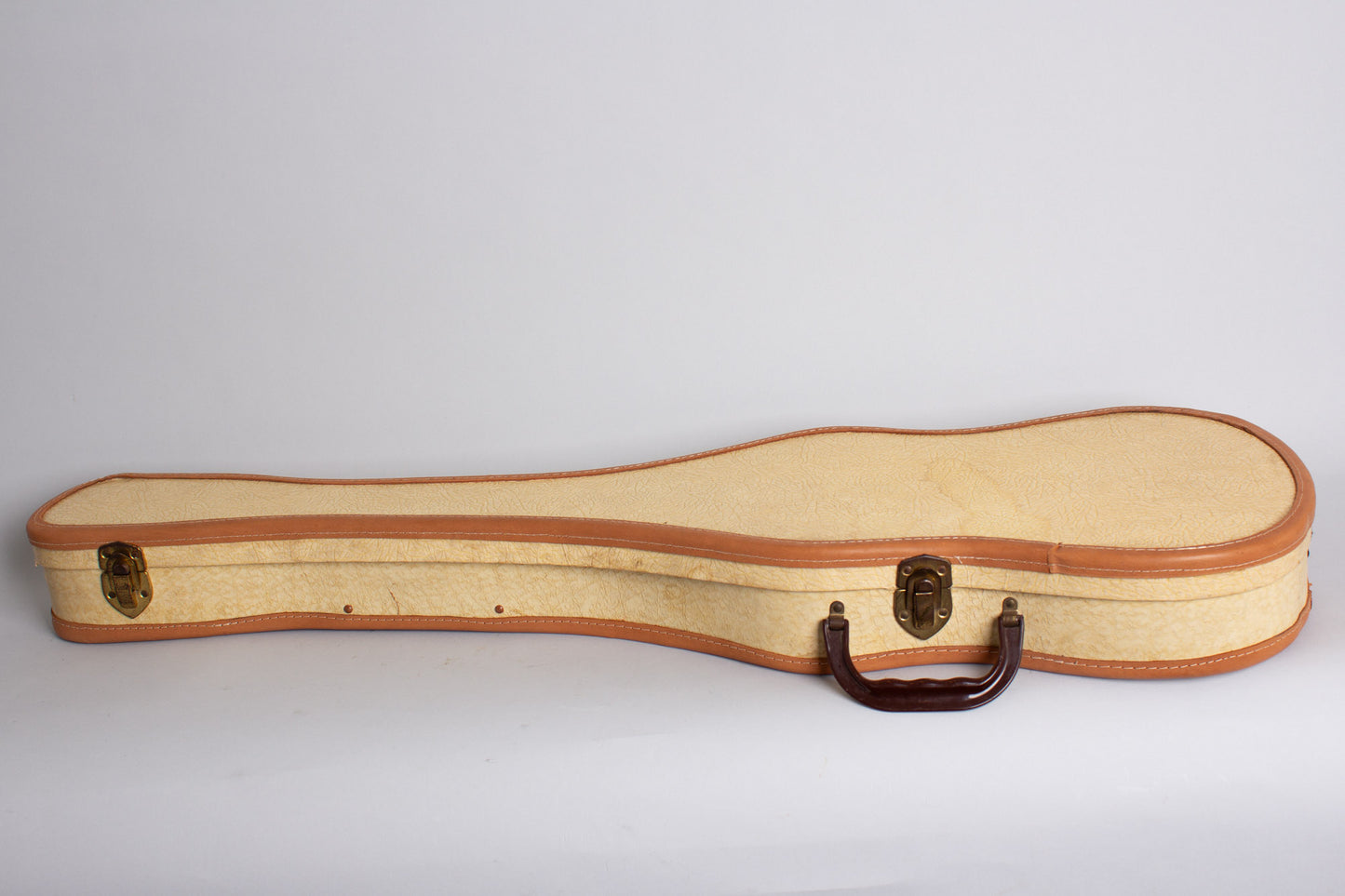
Silvertone Stratotone Newport Model H-42/2 Model Solid Body Electric Guitar, made by Harmony (1956), made in Chicago, green metallic finish, hardwood body and neck, original two-tone chipboard case.
This is the Sears, Roebuck & Co. branded version of one of Harmony's slightly offbeat classics. Originally listed by Harmony at the grand sum of $67.50, the Harmony Stratotone Newport H-42/2 is about as small, simple, and handy as an electric guitar gets. The metallic green "Colorama" finish and the metal-and-rubber "Harmometal" body trim make this a fantastic example of 1950s "Populuxe" aesthetics. The through-body neck is very large and chunky but the body wings are very thin and light, making for a unique feel. You really could use this as a canoe paddle, which we would not recommend, although we've seen some that look like they spent some time upriver!
The pickup is the same DeArmond made unit as the more familiar and slightly more upscale Model H-44 which cost all of $5.00 more in most years. Despite its diminutive size and rather insubstantial feel, the guitar is quite chunky sounding when cranked. The controls are a single tone-bypass switch and a cool stacked tower of concentric tone and volume knobs on a single pot. This example carries a stacked CTS pot dated 550 (the end of 1955), so was probably shipped in 1956. The H-42/2 was sold under the Harmony and Silvertone names (apparently the rarer version) but in either case is a not a common guitar, especially in decently playable condition. These early solidbodies with festive trim are always a cool conversation piece guitar and a funky treat for the '50s pop culture connoisseur.
Overall length is 36 1/4 in. (92.1 cm.), 11 in. (27.9 cm.) wide at lower bout, and 1 3/8 in. (3.5 cm.) in depth, measured at side of rim. Scale length is 25 in. (635 mm.). Width of nut is 1 11/16 in. (43 mm.).
This guitar shows general light wear overall but is actually about the nicest of these we have had. The green lacquer has a lot of fade but not too much wear; it shows small dings, chips, and dents but is better preserved than most. The most notable chipping is to the unprotected sharp back body edge and headstock corners, with a decent sized spot rubbed away on the back of the neck in the lower positions; down to the wood behind the third fret.
All the (fairly minimal) hardware is original, down to the stacked knobs, tiny pickguard screws and bulb-head screw used as an endpin. (Yes that is the endpin!). The screwed-on soft wood bridge has a visibly repaired split (most of them do) around the upper screw but remains intact and as functional as it ever was. This guitar will never play like a 1950s Les Paul, but this is actually a serviceable guitar to play with what look like practically unworn original frets. It is housed in the intact original two-tone chipboard case, a relic of more colorful times. Long live "Colorama" and "Harmometal" -- may they be a balm for our fractious modern era! Overall Excellent - Condition.