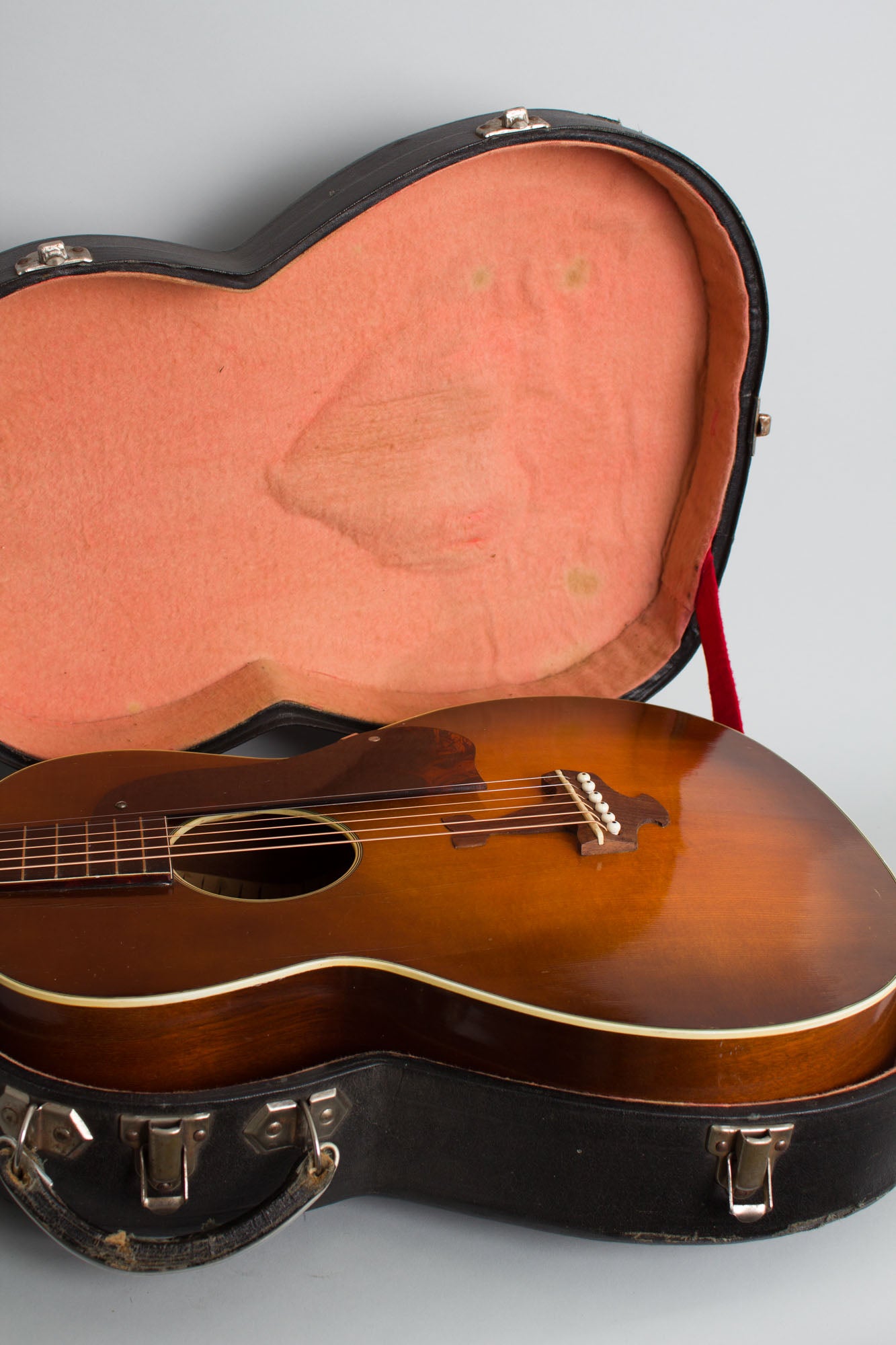
Arch Top Acoustic Guitar, made by Harmony, c. 1930, made in Chicago, sunburst lacquer finish, mahogany back, sides and neck, spruce top, ebonized fingerboard, black hard shell case.
This is an interesting and fairly stylish guitar from the early Depression era, unbranded but definitely made by the Harmony company of Chicago sometime around 1930. It shares some features with the 1928 Roy-Smeck endorsed "Vita" line but the construction is more akin to a roundhole Martin archtop like the C-1. It is built with a dramatically arched spruce top and mahogany back, both pressed to shape not carved. These are finished in a subtly shaded sunburst and triple bound. There is very little actual bracing in the instrument, but it has held its shape very well for something like 90 years.
The unique "Aero-Bridge" is a Harmony trademark, carved from rosewood shaped like a miniature airplane. The company claimed this was a great structural improvement over a conventional pin bridge, but despite use on a number of their better flat-top models it proved fairly short-lived in practice. Supposedly it was meant to capitalize on the period interest in aeronautics after Lindberg's celebrated solo Atlantic triumph. Up into the mid-'30s Harmony made a number of round-hole archtops, but with a more conventional tailpiece; this is the only pin-bridge model we have seen using this trademark component.
The fairly substantial neck has a medium "V" contour typical of the era, with a bound dyed maple "ebonized" fingerboard. This neck is nearly identical to the "Vita-Guitar' except for more elaborate shaped pearl inlay on the fingerboard. The slotted headstock has the same subtle bump profile as the Vita model, with good grade strip tuners fitted. A raised pickguard is fitted to the top.
Like all Harmony products this was a relatively budget-minded instrument, but along with the Vitas would have been at the top end of their scale, probably in the $30 retail price range. At this time nobody really knew what an arch top should be, especially a less expensive one. Eventually nearly everyone copied Gibson's F-hole design but for a few years a number of round or oval hole archtops were tried in many variations. This pin-bridge, pressed wood model is an interesting early attempt at an archtop that retains more of a flat-top feel and sound.
This is a high-quality instrument for Harmony, very neatly made from higher grade solid woods. The design is perhaps eccentric but has proved quite sound as considering its age the guitar is extremely well preserved with no notable structural issues. The sound is fairly powerful and much richer than the average budget archtop; this guitar offered a good value at the time when many players couldn't afford an expensive one. With its classy but offbeat styling and surprisingly rich tone, this unnamed 6-string would be at home in many styles, period or modern and look sharp on any bandstand!
Overall length is 38 1/2 in. (97.8 cm.), 14 3/4 in. (37.5 cm.) wide at lower bout, and 4 in. (10.2 cm.) in depth at side, taken at the end block. Scale length is 25 in. (635 mm.). Width of nut is 1 13/16 in. (46 mm.).
This guitar appears to have seen comparatively little use since the early Depression period and remains about as fine an example as we would expect to see. The finish shows typical checking and minor wear overall, with some dings, dents and chips and a small spot of "strap burn" on the lower back. Structurally it is excellent, with the top showing a tightly sealed grain split by either waist (a weak point perhaps) but otherwise the instrument is crack free.
The neck has been cleanly reset, the original bridge saddle artfully compensated and the original frets lightly polished. These show virtually no wear and playability is excellent. The pickguard is a nicely done replacement, otherwise the guitar remains original. This is an unusually but really neat guitar, something of a rarity and a cool authentic depression-era player; a much higher-quality instrument than most in its price class. Overall Excellent Condition.