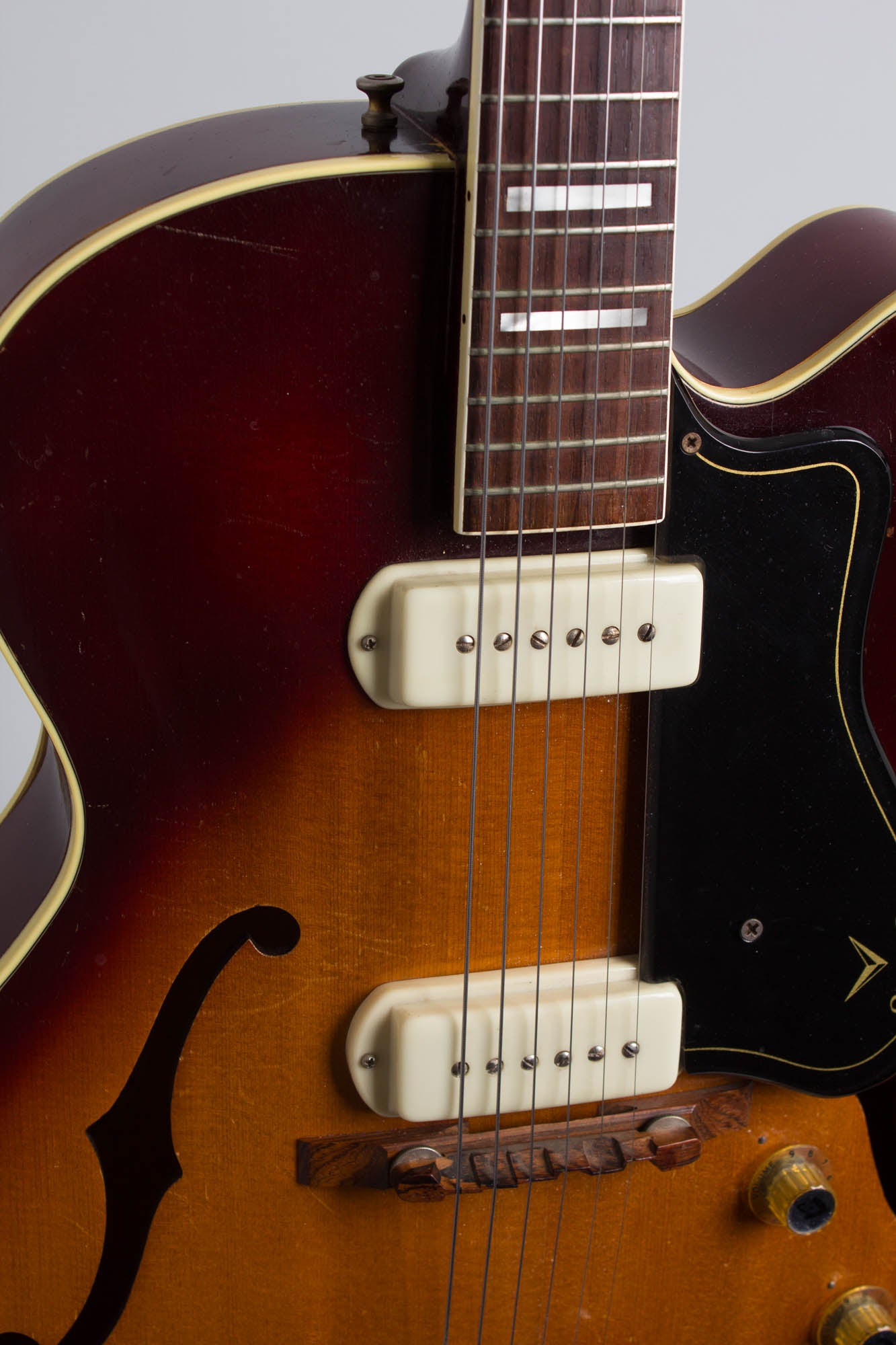
Guild X-175 Model Arch Top Hollow Body Electric Guitar (1961), made in Hoboken, NJ, serial # 15720, sunburst top, dark stained back and sides finish, laminated spruce top, laminated maple body and mahogany neck, original black hard shell case.
The X-175 is one of Guild's most venerable designs, a full-depth body two pickup electric archtop at home both as a straight jazz guitar and with more vintage rock'n'roll styles. This one dates to 1961, a transitional time for Guild moving between the older 1950s style instruments and the sleeker 1960s look. This guitar has a mix of features typical of the time.
The X-175 is a classy if not top-end guitar, positioned in the middle of Guild's line but both larger and fancier than Gibson's similar ES-175. The 17" full-depth body is triple bound back and front and is built with a laminated spruce top like its New York Epiphone ancestors. The two white-plastic covered Franz single coil pickups are wired to a metal-tipped selector switch and individual tone and volume controls with silver-capped clear amber-tinted plastic knobs. By 1961 these pickups (used since the company's beginnings) were being phased out at Guild, disappearing entirely by 1963. The back-painted Lucite pickguard, knobs and metal switch tip are 1960s style fittings, while the screwed-on switch ring is still an older '50s style piece.
The neck is laminated mahogany with a maple center strip, carved to a comfortable medium "C" profile. The rosewood fingerboard is bound and inlaid with pearloid blocks, the older style "open book" headstock carries an inlaid Guild logo and vertical "Chesterfield" column. The metal truss rod cover is another new-for-the-1960s touch. The tuners are the fancy covered Kolb units with diamond-shaped pearloid buttons often seen in the 1960s on more expensive Guilds.
This is a medium-rare Guild instrument, less common than some other models. By the early '60s an older style full-body guitar electrics were proving less popular than the company's thinlines, especially the new Starfire series. It is a very fine playing guitar; the Franz pickups are not as powerful as the Gibson P-90s they resemble but have a lovely more transparent sound. We don't see Guilds from this period that much, like this one they are often lovely guitars.
Overall length is 41 3/4 in. (106 cm.), 17 in. (43.2 cm.) wide at lower bout, and 3 in. (7.6 cm.) in depth, measured at side of rim. Scale length is 24 3/4 in. (629 mm.). Width of nut is 1 5/8 in. (41 mm.).
This is nice all original guitar, showing some typical play and general aging wear but no alterations or repair. The all-original finish has some micro-checking overall with small dings, dents and fairly random chips but no large areas of wear. The back of the neck is very clean with just some tiny scuffs and dings. There is a small area of binding shrinkage on the upper back waist but no deterioration to the Celluloid at all.
All hardware is original and complete. The original frets have some light wear in the lower position but still play well. All in all this is a lovely piece, a bit played in but unaltered, complete in its original purple-lined HSC. Overall Excellent - Condition.