Guild Starfire I Semi-Hollow Body Electric Bass Guitar (1968)


1
/
of
6
Couldn't load pickup availability
Item #3376
Guild Starfire I Model Semi-Hollow Body Electric Bass Guitar (1968), made in Hoboken, NJ, sunburst lacquer finish, laminated maple body, mahogany neck with rosewood fingerboard, original black hard shell case.
The 1960's Guild Starfire bass has gained more attention lately as one of the decade's most distinctive bass guitars. Despite its general resemblance to the Gibson EB-2 and Epiphone Rivoli, the Starfire is a completely different animal sonically, putting out a very clear and powerful sound with a wide frequency range and an almost piano-like growl unusual in a hollowbody bass.
Starfire basses became a prominent part of the San Francisco sound in the late 60's with both Phil Lesh of the Grateful Dead and Jack Casady of the Jefferson Airplane choosing the model for their psychedelic explorations of the low end. With a very slim and fast-playing neck the Starfire is the perfect bass to "take off" on and remains as unique as when first designed.
Guild did not even enter the electric bass arena until 1965, when the semi-hollow double-cutaway Starfire line and the solid-body line both had a single-pickup bass added. While the solid-body Jetstar soon crashed and burned, the Starfire became one of the company's most popular items. The body is not fully hollow; there is a solid block running through the center in the manner of an ES-335, giving a tighter response than a true hollowbody bass.
The real secret to the early Guild basses' unique sound is the large Hagstrom-made Bi-sonic pickup, which looks like a double-coil unit but is in fact more akin to a giant DeArmond. With large magnet slugs for polepieces, this pickup has a very powerful attack and a broad harmonic range quite unlike either the more familiar giant Gibson bass humbucker or the Guild humbucking pickup which replaced it in 1970.
This particular Starfire I is from early 1968, and has several developments from the earlier models. There is a pushbutton "baritone" switch which cuts low end and increases clarity even further. This feature was added to the line around the time when the pickup was moved to the position just under the fingerboard; the earliest Starfire basses feature the single P.U. closer to the bridge.
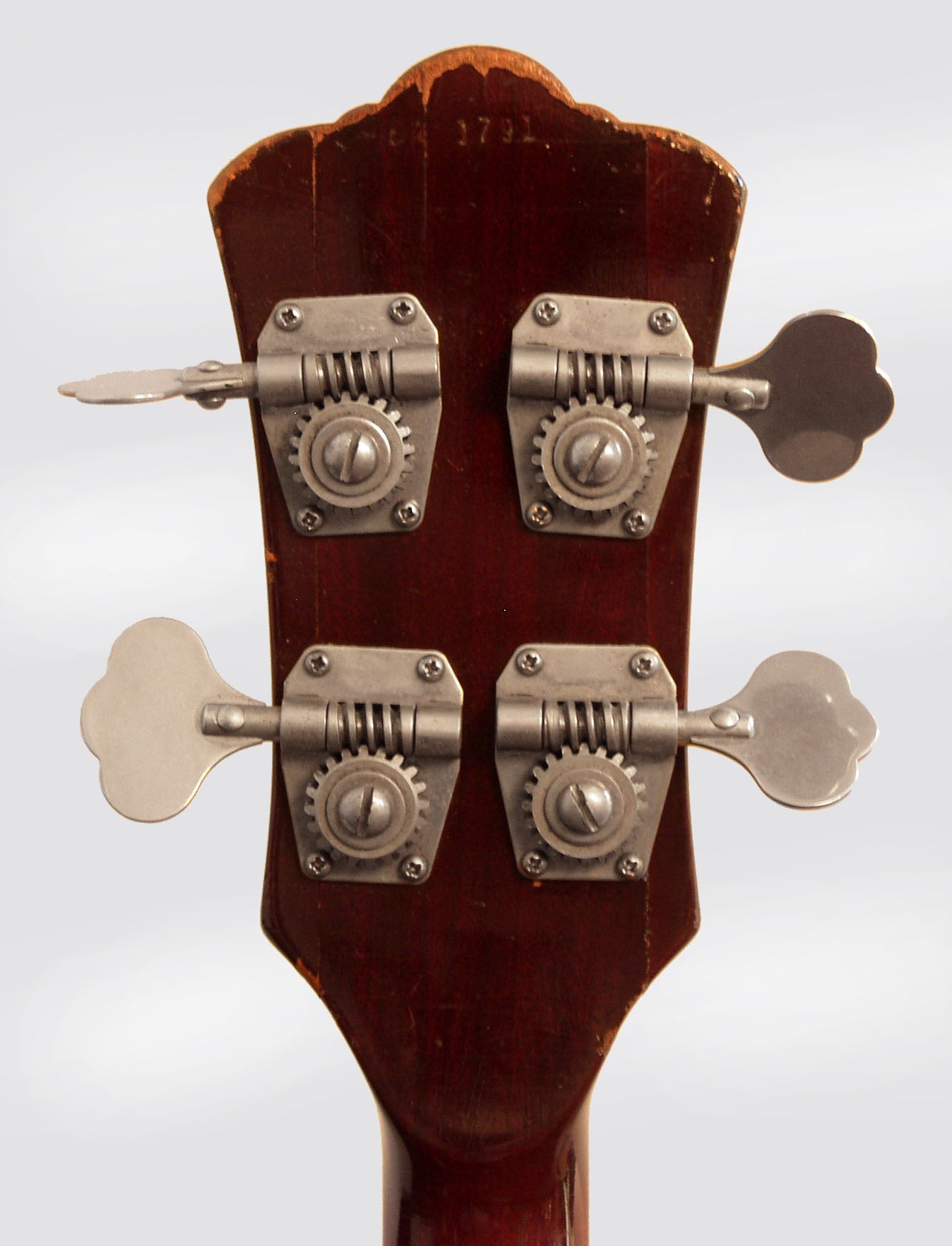
The chrome Hagstrom bridgeplate is extended on the treble side to allow for longer saddle travel; it also looks rather more like Guild's traditional "harp" tailpiece in an attractive, if possibly unintended, touch. The tuners are the typical American-made Klusons where the first models had European Van Ghents. The triple bound body is finished in a vibrant sunburst, somewhat less common by 1968 compared to the cherry red finish.
This bass is all original and a fine gigging example of this 1960's classic.
Overall length is 45 15/16 in. (116.7 cm.), 16 3/8 in. (41.6 cm.) wide at lower bout, and 1 3/4 in. (4.4 cm.) in depth, measured at side of rim. Scale length is 30 1/2 in. (775 mm.). Width of nut is 1 1/2 in. (38 mm.).
Well-played but not abused. Some areas of finish loss, most noticeable on the back of the neck, in the armwear area, and above the thumbrest. This bass has seen a lot of gig time but is overall very nice and a great-sounding and playing Starfire. Original Guild hard case is well-worn but completely functional. Very Good + Condition.
View full details
The 1960's Guild Starfire bass has gained more attention lately as one of the decade's most distinctive bass guitars. Despite its general resemblance to the Gibson EB-2 and Epiphone Rivoli, the Starfire is a completely different animal sonically, putting out a very clear and powerful sound with a wide frequency range and an almost piano-like growl unusual in a hollowbody bass.
Starfire basses became a prominent part of the San Francisco sound in the late 60's with both Phil Lesh of the Grateful Dead and Jack Casady of the Jefferson Airplane choosing the model for their psychedelic explorations of the low end. With a very slim and fast-playing neck the Starfire is the perfect bass to "take off" on and remains as unique as when first designed.
Guild did not even enter the electric bass arena until 1965, when the semi-hollow double-cutaway Starfire line and the solid-body line both had a single-pickup bass added. While the solid-body Jetstar soon crashed and burned, the Starfire became one of the company's most popular items. The body is not fully hollow; there is a solid block running through the center in the manner of an ES-335, giving a tighter response than a true hollowbody bass.
The real secret to the early Guild basses' unique sound is the large Hagstrom-made Bi-sonic pickup, which looks like a double-coil unit but is in fact more akin to a giant DeArmond. With large magnet slugs for polepieces, this pickup has a very powerful attack and a broad harmonic range quite unlike either the more familiar giant Gibson bass humbucker or the Guild humbucking pickup which replaced it in 1970.
This particular Starfire I is from early 1968, and has several developments from the earlier models. There is a pushbutton "baritone" switch which cuts low end and increases clarity even further. This feature was added to the line around the time when the pickup was moved to the position just under the fingerboard; the earliest Starfire basses feature the single P.U. closer to the bridge.
The chrome Hagstrom bridgeplate is extended on the treble side to allow for longer saddle travel; it also looks rather more like Guild's traditional "harp" tailpiece in an attractive, if possibly unintended, touch. The tuners are the typical American-made Klusons where the first models had European Van Ghents. The triple bound body is finished in a vibrant sunburst, somewhat less common by 1968 compared to the cherry red finish.
This bass is all original and a fine gigging example of this 1960's classic.
Overall length is 45 15/16 in. (116.7 cm.), 16 3/8 in. (41.6 cm.) wide at lower bout, and 1 3/4 in. (4.4 cm.) in depth, measured at side of rim. Scale length is 30 1/2 in. (775 mm.). Width of nut is 1 1/2 in. (38 mm.).
Well-played but not abused. Some areas of finish loss, most noticeable on the back of the neck, in the armwear area, and above the thumbrest. This bass has seen a lot of gig time but is overall very nice and a great-sounding and playing Starfire. Original Guild hard case is well-worn but completely functional. Very Good + Condition.