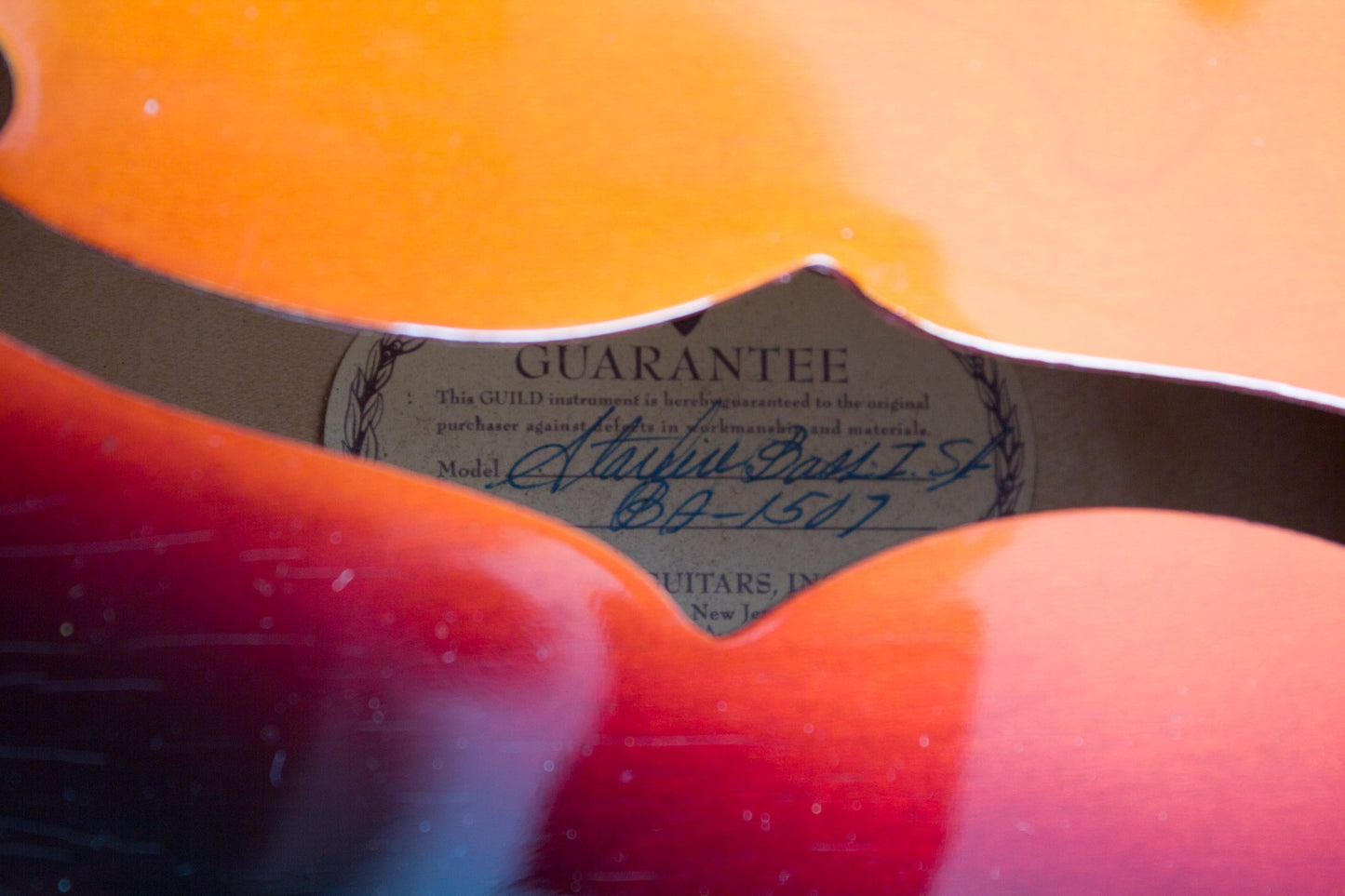
Guild Starfire Bass Model Semi-Hollow Body Electric Bass Guitar (1967), made in Hoboken, NJ, serial # BA-1507, sunburst lacquer finish, laminated maple body, laminated mahogany neck with rosewood fingerboard, original black hard shell case.
The 1960s Guild Starfire bass has in recent years re-gained attention as one of the decade's most distinctive bass guitars. Despite its general resemblance to the Gibson EB-2 and Epiphone Rivoli, the Starfire is a completely different animal sonically, putting out a very clear and powerful sound with a wide frequency range and an almost piano-like growl unusual in a hollow-body bass.
Starfire basses became a prominent part of the San Francisco sound in the late '60s with both Phil Lesh of the Grateful Dead and Jack Casady of the Jefferson Airplane choosing the model for their psychedelic explorations of the low end. With a very slim and fast-playing neck, the Starfire is the perfect bass to "take off" on and remains as unique as when first designed.
Guild did not even enter the electric bass arena until 1965, when the semi-hollow double-cutaway Starfire line and the solid body line both had a single-pickup bass added. While the solid body Jetstar soon crashed and burned the Starfire became one of the company's most popular items. The neck is very slim and comfortable to play, especially compared to most other American basses of the 1960s. The body is not fully hollow, there is a solid block running through the center in the manner of a Gibson ES-335 giving a tighter response and more resistance to feedback than a true hollowbody bass.
The real secret to the early Guild basses' unique sound is the large Hagstrom-made Bi-Sonic pickup, which looks like a double-coil unit but is in fact more akin to a giant single-coil DeArmond. With large magnet slugs for polepieces, this pickup has a very powerful attack and a broad harmonic range quite unlike either the more familiar giant Gibson bass humbucker or the Guild humbucking pickup which replaced it in 1970.
This particular Starfire Bass dates to late 1967 and has features specific to that period. The major difference from earlier models is the pickup position, with the large Bi-Sonic mounted just below the fingerboard: the earliest Starfire basses feature a single P.U. closer to the bridge. This bass would be one of the first equipped with the baritone tone switch which was added later in 1967, not too long after the pickup placement was revised. The tuners are typical American-made Klusons, the bridge is also a Hagstrom-made piece with four adjustable wooden saddles. The triple bound body is finished in a deep 3-color sunburst finish. This bass has some light signs of wear from use but remains all original and a fine example of this 1960s classic.
Overall length is 46 in. (116.8 cm.), 16 1/4 in. (41.3 cm.) wide at lower bout, and 1 3/4 in. (4.4 cm.) in depth, measured at side of rim. Scale length is 30 1/2 in. (775 mm.). Width of nut is 1 1/2 in. (38 mm.).
This bass is nicely original and in excellent playing condition with just some light fairly wear. The color in the sunburst lacquer finish is still strong with some typical minor checking. The finish is nicely preserved overall with just some very small chips and dings, most notably a small spot of finish worn away just above the upper finger rest. There are also some small dings and chips to the finish to the spine on the back of the neck.
The top layer of the headstock veneer has shrunk up as is typical with Guilds of this period and there are some marks and clouded spots on the face from apparent attempts to glue it back down. Most of the plating is very clean with hardly any corrosion, only the tuners show any notable corrosion. Two of the small screws securing the bridge saddle cradles are old replacements, but you'd have to look pretty closely to notice.
The original frets show just minimal wear. Overall this a very fine example of the original 1960s Starfire bass; the lovely straight neck has a very good angle, and the bass plats excellent with the typical punchy sound. It comes in the original Guild-marked HSC with the original warranty card and instruction sheet. Excellent Condition.