Guild Starfire Bass II Semi-Hollow Body Electric Bass Guitar (1974)


1
/
of
6
Couldn't load pickup availability
Item #7345
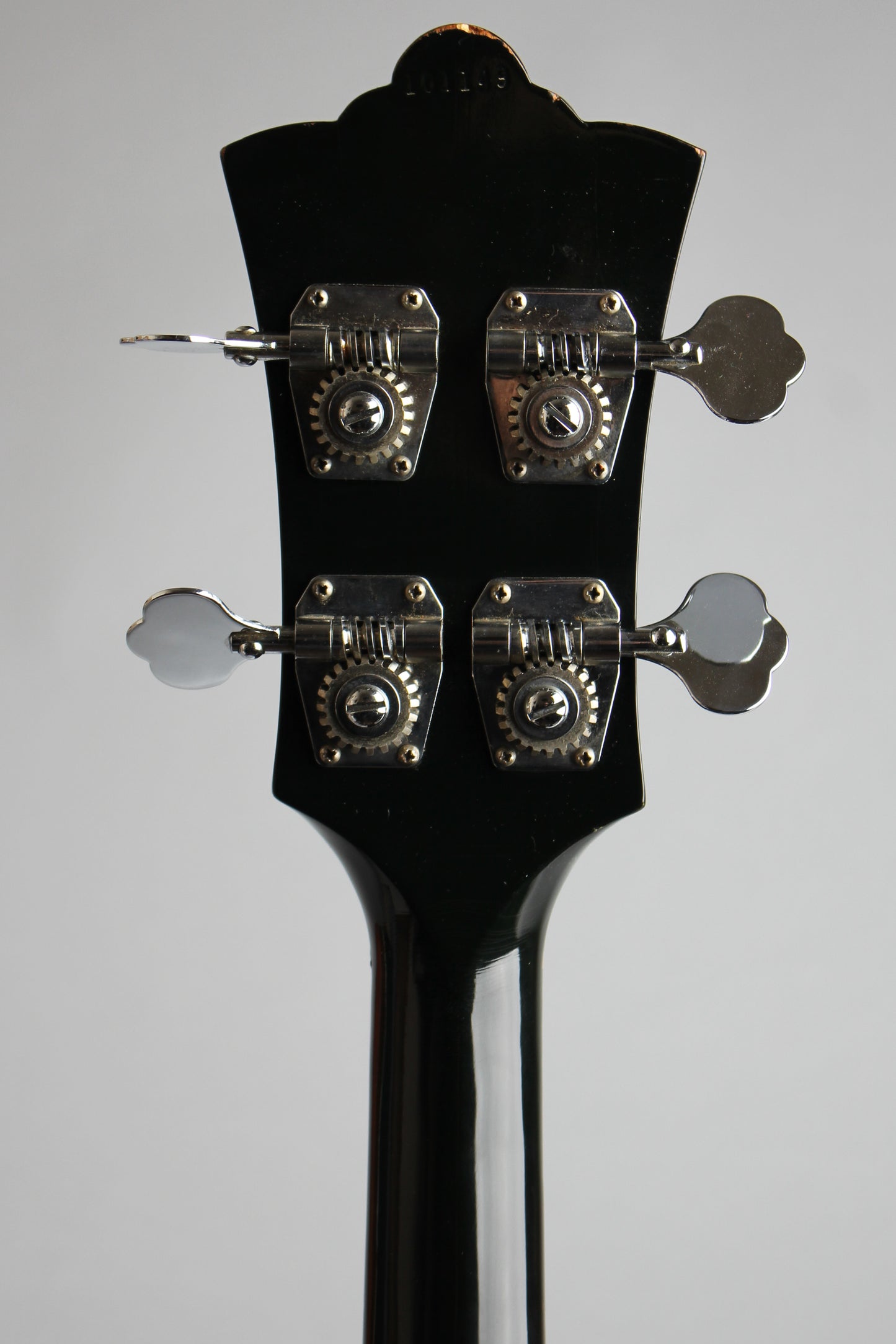
Guild Starfire Bass II Model Semi-Hollow Body Electric Bass Guitar (1974), made in Westerly, RI, serial # 101149, black lacquer finish, laminated maple body, laminated maple neck with rosewood fingerboard, original black hard shell case.
In recent years the Guild Starfire bass has gained attention as one of the most distinctive of all bass guitars, and the double-pickup Starfire II model is the most sought-after version. Despite a general resemblance to the more common Gibson EB-2 and Epiphone Rivoli the Starfire is a completely different animal sonically, putting out a very clear and powerful sound with a wide frequency range and almost piano-like growl unusual in a hollowbody bass. Starfire II basses, which from this period are fairly rare became a prominent part of the San Francisco sound in the late 60's with both Phil Lesh of the Grateful Dead and Jack Casady of the Jefferson Airplane choosing the model for their psychedelic explorations of the low end. With a very slim and fast-playing neck the Starfire is the perfect bass to "take off" with and remains as unique as when first designed.
Guild did not even enter the electric bass arena until 1965, when the semi-hollow double-cutaway Starfire line and the solidbody line both had a single-pickup bass added. While the solid body Jetstar crashed and burned the Starfire Bass soon became one of the company's most popular items. The body is not fully hollow, there is a solid block running through the center in the manner of an ES-335 giving a tighter response than a true hollowbody bass. This bass features the Guild humbucking pickup which replaced the Hagstrom pickups originally used around 1970. The double-pickup Starfire II had been added to the line in 1967; it carries a rather lavish electronics package with a master volume control, pickup selector switch, individual tone and volume knobs for each PU and a mini-toggle "baritone" switch which cuts low end on the neck PU. The chrome Hagstrom bridge plate is extended on the treble side to allow for longer saddle travel; it also looks rather more like Guild's traditional "harp" tailpiece in an attractive if possibly unintended touch.
This particular Starfire II is from 1974, with a jet black finish that is a catalog option but is rarely seen. Most Starfire Basses were originally cherry or sunburst-this custom order finish is noted on the label as "SBB2 Black" This bass is all original and a superb example of the 1970's version of this 1960's classic. The sound is darker than the '60's models but still extremely well-defined and powerful, and a most sonically versatile bass. Playability is excellent and we are most pleased to offer this fine example of what has been one of out most frequently requested instruments.
Overall length is 45 7/8 in. (116.5 cm.), 16 3/8 in. (41.6 cm.) wide at lower bout, and 1 7/8 in. (4.8 cm.) in depth, measured at side of rim. Scale length is 30 3/4 in. (781 mm.). Width of nut is 1 1/2 in. (38 mm.). Superb all-original condition-no repairs or alterations and only some light finish wear, including a few chips to the edge. A fantastic example, a rare and great playing bass complete with the original HSC. Excellent + Condition.
View full details
In recent years the Guild Starfire bass has gained attention as one of the most distinctive of all bass guitars, and the double-pickup Starfire II model is the most sought-after version. Despite a general resemblance to the more common Gibson EB-2 and Epiphone Rivoli the Starfire is a completely different animal sonically, putting out a very clear and powerful sound with a wide frequency range and almost piano-like growl unusual in a hollowbody bass. Starfire II basses, which from this period are fairly rare became a prominent part of the San Francisco sound in the late 60's with both Phil Lesh of the Grateful Dead and Jack Casady of the Jefferson Airplane choosing the model for their psychedelic explorations of the low end. With a very slim and fast-playing neck the Starfire is the perfect bass to "take off" with and remains as unique as when first designed.
Guild did not even enter the electric bass arena until 1965, when the semi-hollow double-cutaway Starfire line and the solidbody line both had a single-pickup bass added. While the solid body Jetstar crashed and burned the Starfire Bass soon became one of the company's most popular items. The body is not fully hollow, there is a solid block running through the center in the manner of an ES-335 giving a tighter response than a true hollowbody bass. This bass features the Guild humbucking pickup which replaced the Hagstrom pickups originally used around 1970. The double-pickup Starfire II had been added to the line in 1967; it carries a rather lavish electronics package with a master volume control, pickup selector switch, individual tone and volume knobs for each PU and a mini-toggle "baritone" switch which cuts low end on the neck PU. The chrome Hagstrom bridge plate is extended on the treble side to allow for longer saddle travel; it also looks rather more like Guild's traditional "harp" tailpiece in an attractive if possibly unintended touch.
This particular Starfire II is from 1974, with a jet black finish that is a catalog option but is rarely seen. Most Starfire Basses were originally cherry or sunburst-this custom order finish is noted on the label as "SBB2 Black" This bass is all original and a superb example of the 1970's version of this 1960's classic. The sound is darker than the '60's models but still extremely well-defined and powerful, and a most sonically versatile bass. Playability is excellent and we are most pleased to offer this fine example of what has been one of out most frequently requested instruments.
Overall length is 45 7/8 in. (116.5 cm.), 16 3/8 in. (41.6 cm.) wide at lower bout, and 1 7/8 in. (4.8 cm.) in depth, measured at side of rim. Scale length is 30 3/4 in. (781 mm.). Width of nut is 1 1/2 in. (38 mm.). Superb all-original condition-no repairs or alterations and only some light finish wear, including a few chips to the edge. A fantastic example, a rare and great playing bass complete with the original HSC. Excellent + Condition.