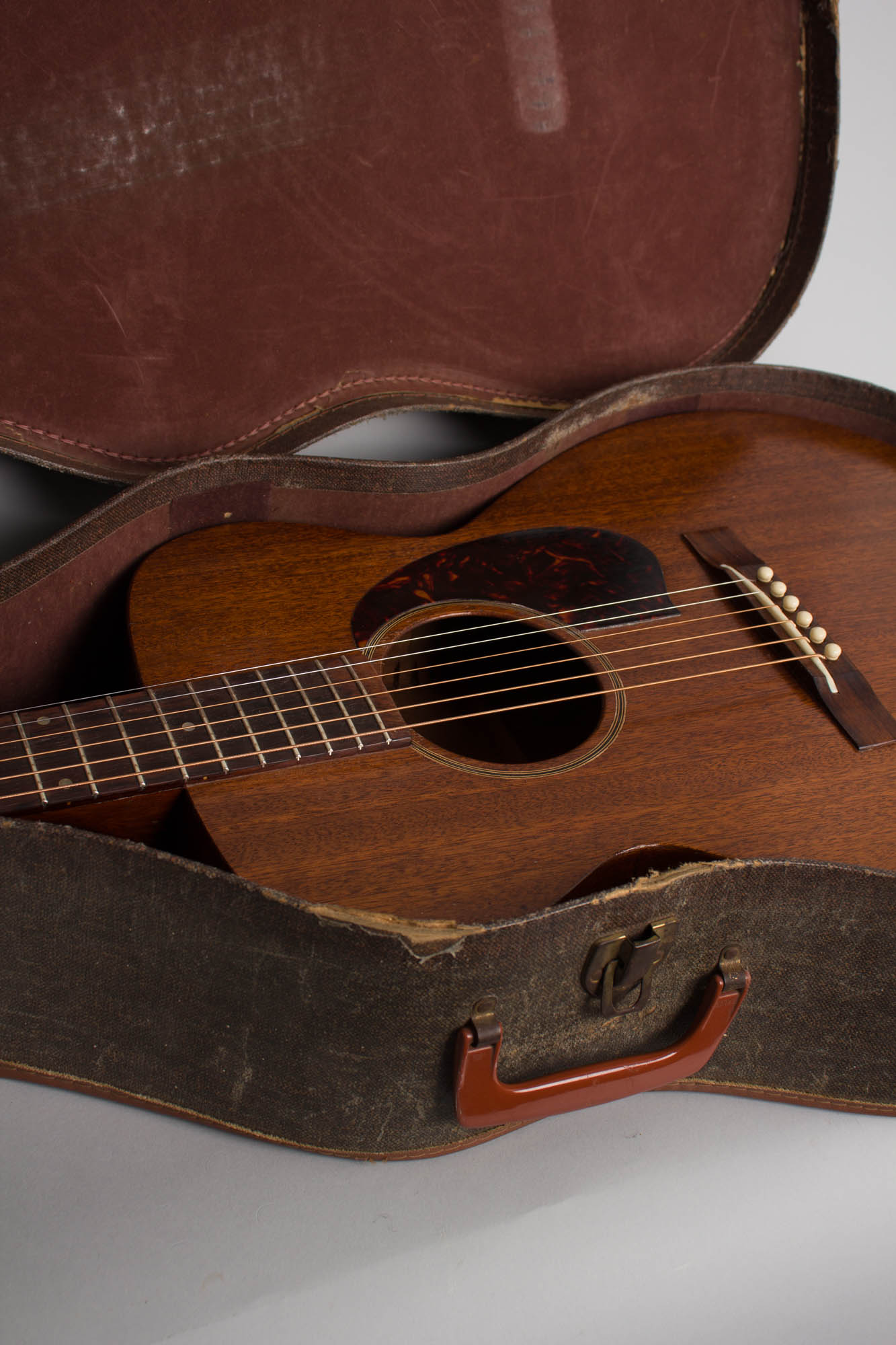
Guild M-20 Model Flat Top Acoustic Guitar (1962), made in Hoboken, NJ, serial # 21106, dark mahogany finish, mahogany body and neck, rosewood fingerboard, original brown chipboard case.
Good examples of the often very fine sounding Guild flattops of the 1960's can be hard to find these days, and they remain the best value in a vintage solid-wood flat top out there. The M-20 was Guild's least expensive guitar in the 1950's and '60's and while not a rare model per se has become one of the company's most sought-after vintage instruments. The highly influential English singer/songwriter Nick Drake is known to have played the M-20 (or at least posed with one on the cover of "Bryter Layter") and so the model is linked in the popular imagination to his legend. Even apart from this connection the guitar itself has much to recommend it.
A small body all-mahogany guitar, the M-20 is most similar to Martin's 0-15 model. The mahogany top gives it a different tonal character from any other Guild and the M-20 excels particularly as a fingerpicking instrument. This early 1960s model is very lightly built, especially for a Guild! The neck is slim and comfortable, somewhat in between typical Martin and Gibson spec. of the period.
With no binding and only the plainest inlay the M-20 has a very austere look but a typically expansive sound. This M-20 was built in Guild's Hoboken factory around mid-1962 and is a much rarer find than the typical late 1960's/early '70's models made in Westerly Rhode Island, with a much thinner finish and more responsive sound. A lovely little guitar, this is a superb playing example of an instrument we receive many requests for.
Overall length is 38 3/4 in. (98.4 cm.), 13 1/2 in. (34.3 cm.) wide at lower bout, and 4 in. (10.2 cm.) in depth at side, taken at the end block. Scale length is 24 1/2 in. (622 mm.). Width of nut is 1 11/16 in. (43 mm.).
This is a very fine playing and sounding example, with a recent neck reset and refret with vintage style wire bringing it up to optimum playability. The original very thin finish has some general wear overall, including dings, dents and scrapes most heavily on the back and lower edges. Still, the top is free of the common pickwear often found on old flattops and the back of the neck is clean with just a few small dents and dings. The upper edge of the back of the headstock has a decent amount of the edge worn down from case contact.
There is a large polished-out scrape mark on the rear side just above the endpin, somewhat scruffy looking but in a fairly inconspicuous spot. We at first thought this might be a repair of some sort, but there is no corresponding damage inside the body. The original rosewood bridge was lowered just a bit long ago, but does not appear to have ever been off or reglued. The bone saddle has been re-worked. This may not be the cleanest M-20 we have had but it is just about the best sounding, with a huge ringing sound for a small mahogany guitar. It resides in the original chipboard case, a bit scruffy still quite functional after 60 years. Excellent - Condition.