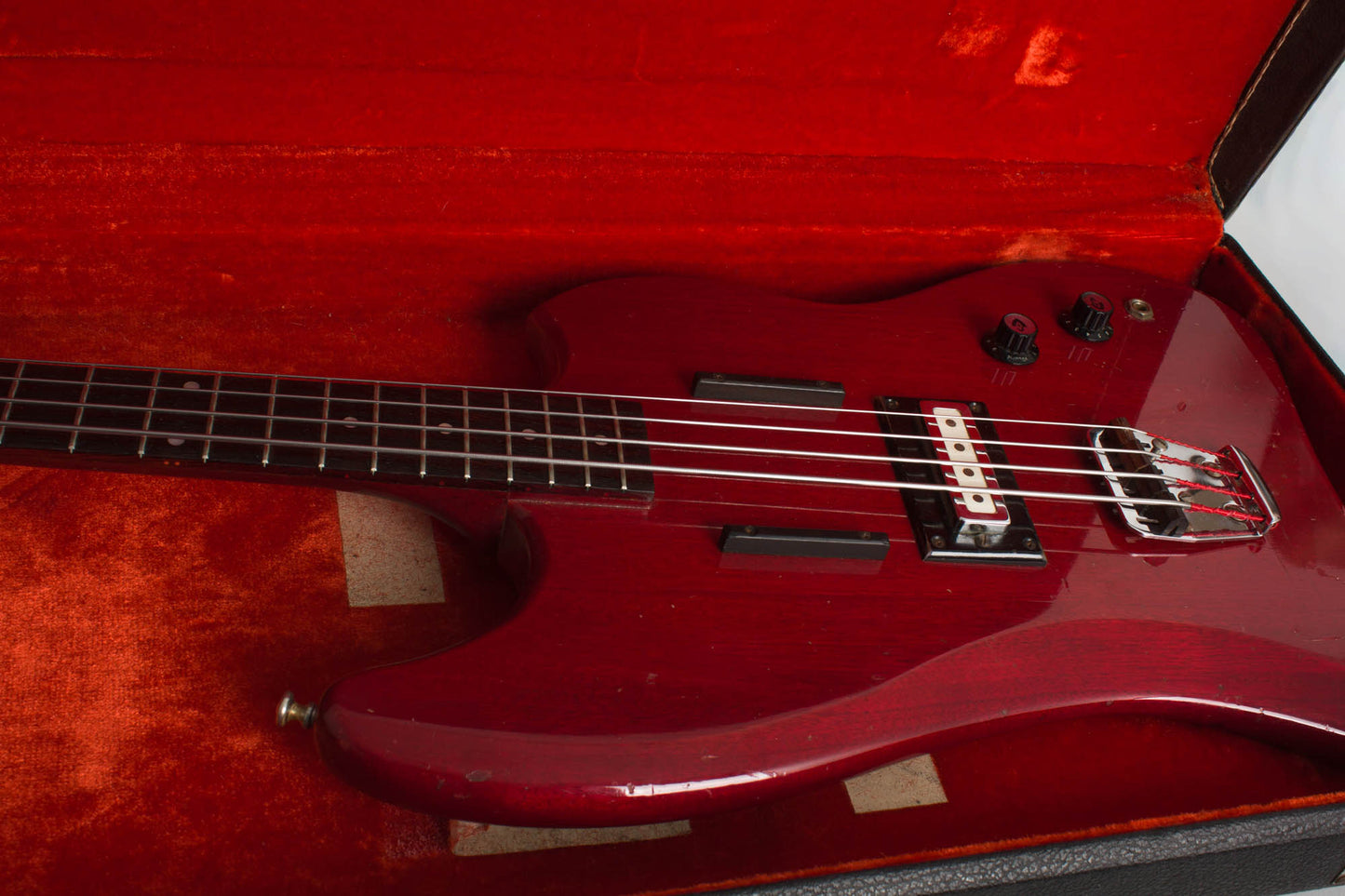
Guild Jet Star Model Solid Body Electric Bass Guitar (1966), made in Hoboken, NJ, serial # SD-280, cherry lacquer finish, mahogany body and neck, rosewood fingerboard, black tolex hard shell case.
Guild was a late starter in the electric bass market but by the end of 1964 had developed the semi-hollow Starfire Bass and this solid body Jet Star, built on the body of the S-200 Thunderbird guitar. The Starfire went on to become a beloved classic but the Jet Star, well; not so much. This rare bass was introduced around the end of 1964 (appearing in the October '64 pricelist at $245.00, which never changed) but few if any were sold before 1965, and only a handful that year. This 1966 model is one of around 200 shipped in the ONLY year the model was produced in any sizable numbers.
The Jet Star's design is vaguely reminiscent Gibson's EB-0, although with a sleeker more balanced feel. The slim, swooping asymmetrical body handles well but to most eyes looks somewhat ungainly. The two "feet" on the bottom edge were a vestige of the S-200 guitar's most questionable feature-the "Built-In Stand". Luckily someone at Guild had the good sense to omit this from the long-necked bass! An oddity shared with the S-200 was bodies built of different woods depending on finish; this cherry model is mahogany like most Gibsons while sunburst examples were alder, like a Fender. The face carries no pickguard at all which is unusual for a 1960s solidbody. Two prominent wooden finger-and-thumb rests are screwed above and below the strings, which terminate at a Hagstrom bridge/tailpiece unit with rosewood saddles.
The Jet-Star's 30 1/2" scale neck is made of mahogany with a center maple lamination and like the Starfire Bass is quite slim. This bass has metal-button Japanese-made tuning keys on its long sculpted single-sided headstock, the same machines used on some Gibsons around 1967. Besides a narrower string spacing a big difference from a Gibson EB was the pickup design and placement. The small single coil unit is mounted in a bridge/mid-body position, which gives the Jet-Star a much tighter, more aggressive midrange sound than many period short-scale basses. Although introduced with the now-vaunted Hagstrom Bi-Sonic pickup very few were actually built that way; 1966 models like this carry the small chrome and plastic covered "Mickey Mouse" PU; earlier models had a larger rout covered with an oversize wooden mounting plate.
This interesting but sadly obscure bass saw few visible users in the 1960's but a sunburst model had brief moments of glory in the hands of the Monkees. Peter Tork used a it during one multi-song lip-synch session aired over the show's second season, where it was also "played" by Davy Jones. The group's 1968 feature HEAD has just one true live performance, with Tork's Jet Star front and center on a killer version of Mike Nesmith's "Circle Sky". Former New York Doll Arthur Kane often played a Jet-Star in his post-Dolls combo The Corpse Grinders. "That was Artie's favorite bass" band co-founder Rick Rivets once proclaimed. This is only the third Jet Star we have had for sale in 20+ years and it is a comfortable playing, great sounding bass that is as unique and unmistakable as it gets!
Overall length is 45 in. (114.3 cm.), 13 in. (33 cm.) wide at lower bout, and 1 1/2 in. (3.8 cm.) in depth, measured at side of rim. Scale length is 30 1/2 in. (775 mm.). Width of nut is 1 1/2 in. (38 mm.).
This exactly 60 year old bass remains all original with no structural damage but shows general wear overall. There are small finish dings and chips over the entire instrument, most heavily on the back and lower body edge which has some deeper gouges. There is not much checking or fade-the deep cherry color is still very strong. The back of the neck has a lot of finish chipping mostly on the treble side of the center spine.
All hardware and fittings are original and complete including the tuners, pickup and controls, bridge and fingerrests. The strap button was moved from the back of the neck heel to the more obvious point on the upper body horn, leaving a small scar in the original spot. The wooden pickup mounting ring has some finish chipping, and the G string saddle shows a common repair along the centerline. The nut was replaced long ago but the original frets show very little wear and the bass plays and sounds excellent, strung with LaBella flatwound strings for maximum period tone. It lives in a period Fender black Tolex HSC Overall Very Good + Condition.