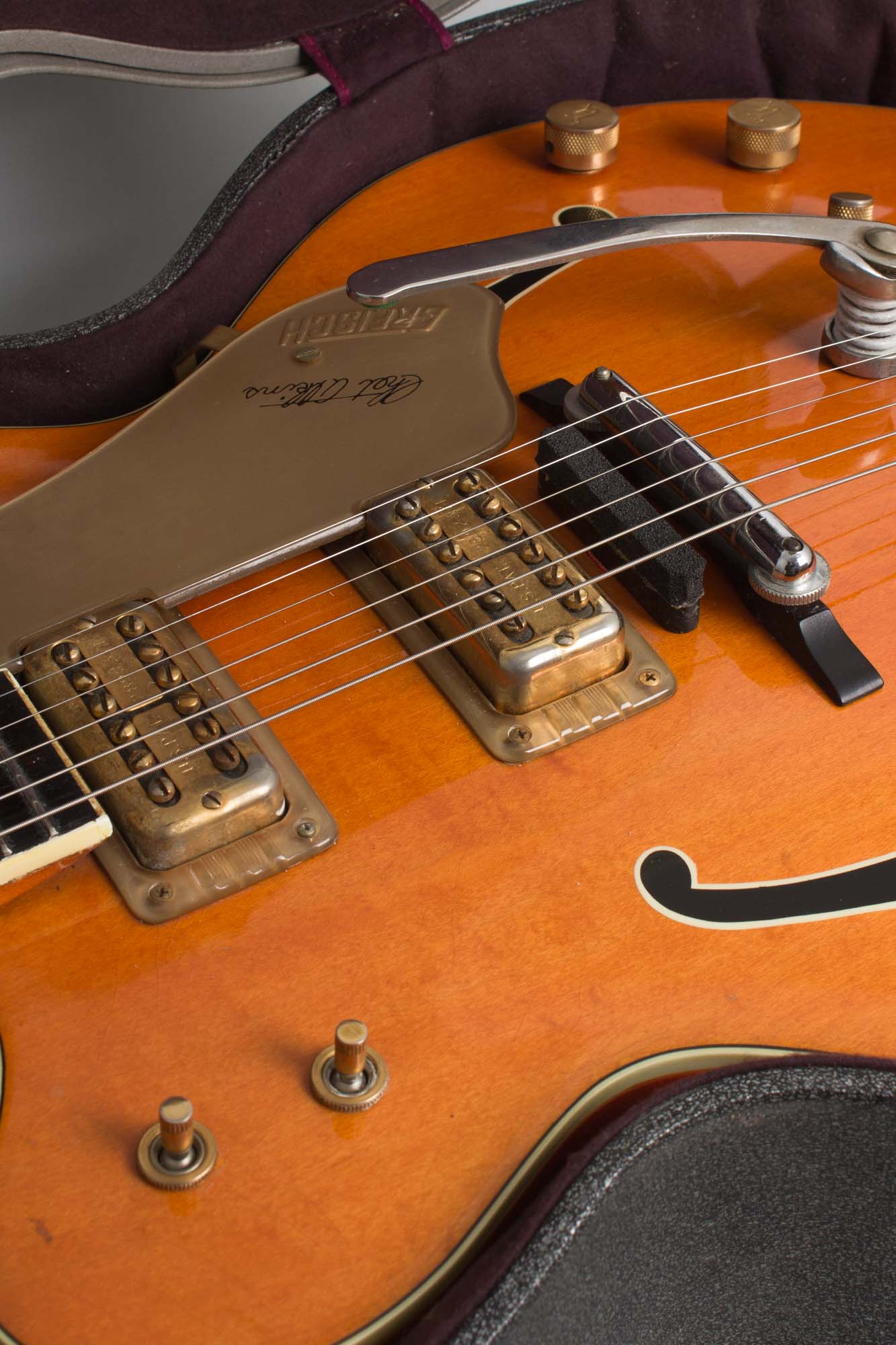
Gretsch Model 6120 Chet Atkins Hollowbody Model Thinline Hollow Body Electric Guitar (1965), made in Brooklyn, NY, Western Orange lacquer finish, laminated maple body; laminated maple neck with ebony fingerboard, original grey hard shell case.
This is a fine playing example of a 1965 double cutaway Chet Atkins Model 6120, one of Gretsch's classic 1960's designs. It has some wear and one notable quirk; there is no serial number visible on the instrument. Usually in 1965 Gretsch hand-stamped the # in small digits across the top edge of the headstock, but on this guitar that area is blank. The visible date codes on the pots is 6516 with all original wiring, so we can date the guitar roughly to the summer/fall of 1965. We don't know if this was an employee guitar or simply slipped out the back door of the Brooklyn factory unstamped but that is how it is. Some quirks like this are not atypical of guitars built in this peak guitar boom year, even if the story is lost.
This guitar has typical features for that year. The iconic 1950's 6120 with a single cutaway, open-F hole body was retired after a seven year run at the end of 1961 in favor of this new design in keeping with the "modern" '60's Gretsch aesthetic. The revamped 6120 body is still fully hollow but thinner at the rim, only 2" deep with "F-holes" simulated by decals and a symmetrical double cutaway. The finish remained a vibrant orange and the electronics (two Filter 'Tron pickups and a 3-knob, 2 switch rig) were unaltered, save for the addition of a "standby" switch on the lower treble bout. The Atkins-specified Bigsby vibrato unit and solid metal bar bridge were also retained.
A new addition was a mechanical mute assembly; the lever action "Muffler" seen on many '60's Gretsch models was never a popular feature with players and many have been discarded; this one is still intact and working. This mechanism required an access hatch cut in the back, conveniently covered by a gold-trimmed black vinyl pad that was described as a comfort-enhancing feature. The red felt mute pad on the lever switch is another 1965 and earlier marker; this guitar also does not feature the "Chet Atkins Nashville model" gold headstock plaque added in 1966, retaining the older horseshoe inlay in the headstock veneer.
Despite the changes this model remained a very popular instrument among professional users in the 1960's even with a stiff $500 price tag. Although not considered an iconic "Beatle" guitar all Gretsch Atkins models benefited from the brand's association with the group. John Lennon did in fact play a nearly identical 6120 on at least one Beatle recording session in 1966. Many other 1960's bands featured this instrument in both the US and the UK and the 6120 remains a prime "beat group" instrument as well as a perfect vehicle for the fingerstyle playing its namesake Chet Atkins specialized in.
This 6120's lack of an impressed serial number is odd, if not tragic and of course does not affect the guitar in any functional way. This is one of the best playing double-cut 6120's we have had in some time and a really good sounding classic 60's Gretsch .
Overall length is 42 in. (106.7 cm.), 15 3/4 in. (40 cm.) wide at lower bout, and 2 in. (5.1 cm.) in depth, measured at side of rim. Scale length is 24 1/2 in. (622 mm.). Width of nut is 1 11/16 in. (43 mm.).
This guitar remains in original condition, with no major alterations except for a new piece of foam on the mute and some binding repair. All hardware and fittings appear original. The body binding shows some incipient celluloid deterioration just in the area of the treble side cutaway near the heel; this was adjacent to the celluloid block on the treble side of the heel which had started to go bad and has been replaced. The fingerboard has been neatly rebound; the rest of the body binding is original with minor shrinkage but no cracking or other deterioration, as is the headstock binding. A large percentage of mid-1960s Gretsch guitars have binding issues, many far more seriously than this one. The heelcap remains original, and has a previous owner's social security number very lightly etched in. This was also done lower on the back of the heel extension and on the face of the headstock below the horseshoe inlay. Somebody really didn't want this non-serialized guitar stolen!
The original finish is also relatively clean; it shows some light wear with dings, chips, a few small glue marks and scratches here and there, but still retains excellent color with minimal fade. The gold plating shows some typical wear, mostly on the pickup covers. The guitar may have had the neck reset but we don't think so; if so it was a FAR cleaner job than many. It shows a very good neck angle with plenty of height to the bridge and good break angle off the Bigsby, in this critical regard one of the best we have seen from this period. The original frets have some minor wear but nothing that affects playability. This is a good sounding 6120, very comfortable to play compared to many from this period when Gretsch's workmanship was inconsistent at best. The guitar includes the original purple-lined HSC. Overall Very Good + Condition.