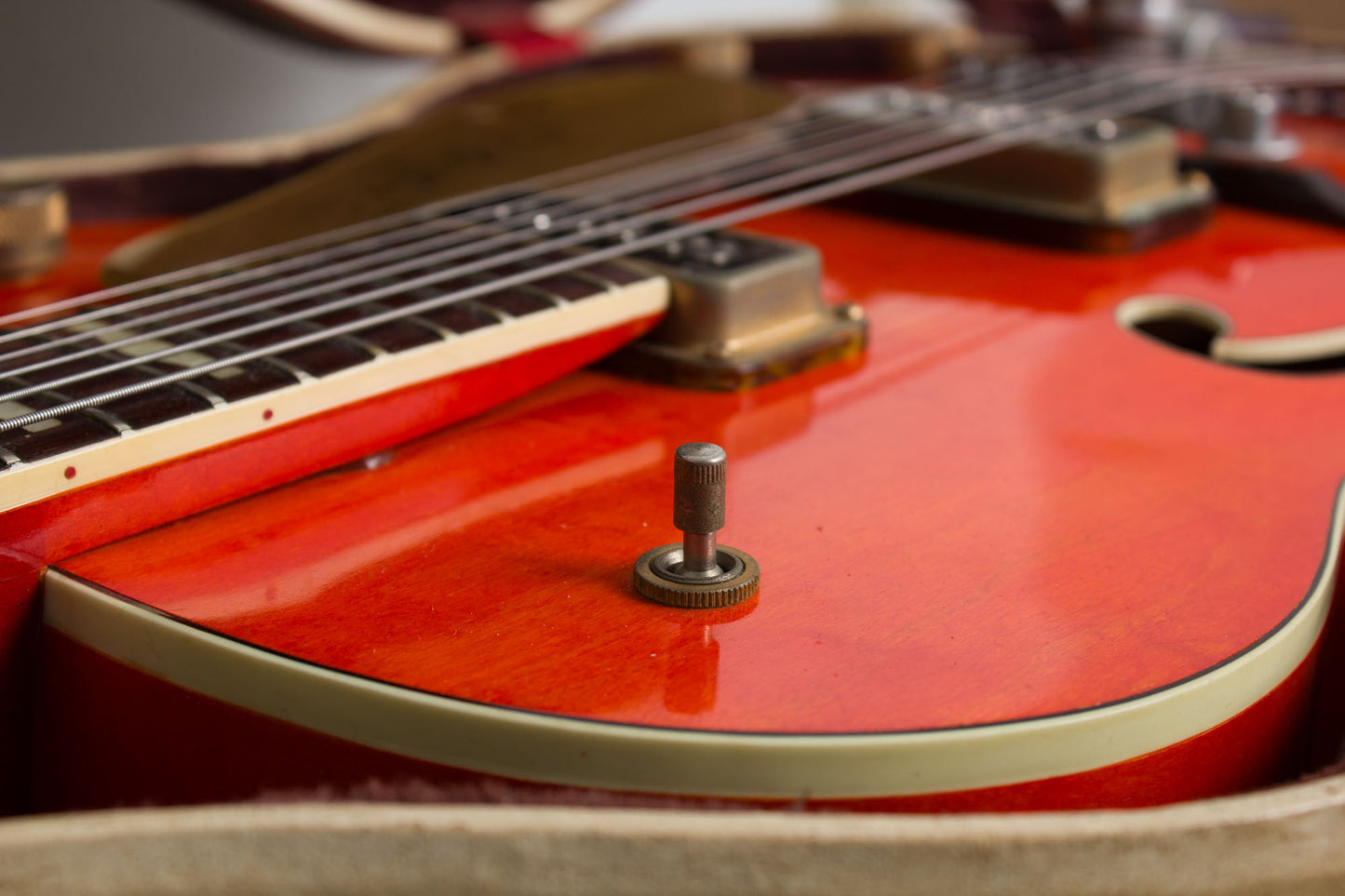
Gretsch Model 6120 Chet Atkins Hollow Body Model Arch Top Hollow Body Electric Guitar (1957), made in Brooklyn, NY, serial # 23274, Western Orange lacquer finish, laminated maple body, maple neck with rosewood fingerboard, original blond tolex hard shell case.
This 1957 Model 6120 Chet Atkins hollow body is a prime example of one of the Gretsch company's most classic creations, one of the truly iconic '50s American vintage guitars. Along with the even flashier but much rarer White Falcon, the "Western Orange" 6120 has long embodied the Gretsch aesthetic, especially symbolic of the early rock'n'roll era and the 1950s in general.
In the 1950s Gretsch guitars often evolved quickly; the 1957 features of the "Chet Atkins hollow Body" were transitioning away from the full-out western blitz of the first 1955 models towards sleeker '60's stylings. This guitar is from mid-1957 (built in the fourth batch of the year) and is distinguished by an especially bold "Western Orange" lacquer finish. Some 6120s from this batch are more subdued but this one wears its bright "Western Orange" coating proudly!
Many of this guitar's features are specific to this period. The hump-block inlay in the bound rosewood fingerboard was only used this year, replacing the earlier rectangular blocks with western engraving. The two DeArmond Dynasonic pickups were the type fitted by Gretsch to all electric guitars up into early 1958. Chet Atkins himself was not enamored of these units, and so requested they be replaced with the Filter 'Tron humbuckers designed for him by Ray Butts, which Gretsch was happy to do as it allowed them to bring the manufacture in-house. These DeArmonds impart a sharper, more cutting sound with a lot of punch and attack, especially for a fully hollowbody instrument.
A distinctive fitting for this year is the Bigsby tailpiece with the rotation stop built integral to the cast arm with a slot-screw attachment. This is nicknamed the "Duane Eddy" arm as it equipped his iconic 6120, and he used it a lot! The next year Bigsby simplified the design with a flat metal arm, the arm stop moving to the cast support piece so this earlier design was only in use for a year or so. This guitar mounts an aluminum Bigsby bridge saddle on a wooden base, a fitting also specific to the earlier 6120.
As noted the finish is a bold and bright variant of the "Western Orange" look. The Model 6120 used by Duane Eddy on all of his early records had features identical to this one; that guitar has a serial number dating some months later, but no major differences. This is one of the nicest playing Gretsch guitars we have had, a real stunner too look at with a sound and feel as good as they come!
Overall length is 41 1/2 in. (105.4 cm.), 15 3/4 in. (40 cm.) wide at lower bout, and 2 3/4 in. (7 cm.) in depth, measured at side of rim. Scale length is 24 1/2 in. (622 mm.). Width of nut is 1 11/16 in. (43 mm.).
This beautiful 6120 shows only very minor wear and overall looks really superb, remaining in largely original condition. The all-original lacquer has hardly any checking or fade and only the most minor dings, dents and scuffs; really not a lot of disturbance for a nearly 70 year old guitar. The finish on the back of the neck shows hardly any play wear; it looks like this "cool Cat" twang machine has seen only light use since the original heyday of rockabilly! This guitar retains stronger color to the "Western Orange" lacquer than many and really stands out in a crowd!
The instrument remains original and presents as correct with some minor restoration. The tortoise celluloid riser rings under the pickups have been neatly replaced with exact replicas as the originals often outgas, which can damage the finish and often ruin the pickup coils. The tuners are the correct style openback Waverly machines but not gold plated; these have been re-installed in place of '70s Schallers that left fairly inconspicuous pressure rings on the headstock and very small filled screw holes in the headstock rear. The bridge is a re-construction in the correct style using the original rosewood base with a vintage Bigsby saddle (notched a bit deeper than stock) posts and wheels. There are patched screw holes to the top underneath the base from an old attempt to pin it in place; these are not visible.
The guitar shows no other issues; there is NONE of the common Gretsch binding deterioration at all. The neck angle is very good, it looks like a clean neck re-set was done a long time ago leaving little evidence around the heel but a bit of errant glue under the fingerboard extension. The guitar plays and sounds excellent; the original small fret wire shows hardly any wear and as noted the metal Bigsby bridge saddle was notched slightly deeper than usual but does not present any problems.
Even if not absolutely original (though very close!) this is a really fine playing and sounding 6120 from one of the classic years, a treat for any Gretsch fan and in particular the Duane Eddy afficionado. It includes the original Gretsch Cowboy case still in solid shape but with much more external wear than the guitar; it looks to have been moved around a lot or perhaps poorly stored. Overall Excellent - Condition.