


Goya G-50 Classical Guitar (1966)


1
/
of
16
Couldn't load pickup availability
Item #13824
Goya G-50 Model Classical Guitar (1966), New York City, serial # 1004.
This rare high-end Goya branded classical guitar is a one of the more curious instruments borne out of the 60's folk craze, and an interesting piece of New York guitar history. Introduced in Hershman Musical Instrument Co's 1966 Goya catalog, the Model G-50 was marketed towards professionals desiring "a hand-made, custom built, rosewood guitar made in the U.S.A. to world concert standards." The 1967 Goya price list shows this guitar retailing for $700, by far the most expensive guitar Goya offered; most are fairly inexpensive imports. It appears that very few of these were ever ordered; considering that in 1966 a Gibson L-5C would run you about the same amount, this was a VERY expensive guitar. A short lived idea, the G-50 was phased out by 1968, no longer appearing in Goya catalogs.
This G-50 bears the signature "Victor Manuel Pineiro NYC" on the underside of the top. Thanks to the research of Puerto Rican music historian Nestor Murray-Irizarry, we know that Pineiro was an employee of Manuel Velazquez in his expanded 1960s New York City shop. As cited by Murray-Irizarry, an article on Manuel Velazquez published in the August 25th, 1962 issue of Puerto Rico's El Mundo Newspaper lists "Victor Pineiro of Humacao" as one of his four shop assistants, alongside fellow Puerto Rican natives Rafael Rivera of Ciales, Miguel Vissepo' of Mayaguez, and Fermin Diaz of Vega Baja.
According to Alfredo Velazquez, Victor was the apprentice charged with finishing the guitars. He also remembers his father describing Victor as humble and always respectful, and that Victor had incredible potential to be a guitar builder. It is worth noting that the people Don Manuel hired as apprentices, he did so because he saw potential in them to become great guitar makers of their own right. The instruments this shop produced were labeled "El Clasico" under Velazquez name, but not marketed as hand made by him personally.
This instrument was built in the 205 E 23rd St. loft shop originally set up by Manuel Velazquez to expand his one-man lutherie into a workshop production situation. Due to disagreements with the company's management and direction under his partners, the Brothers Valdes-Blain, Don Manuel exited the operation returning to Puerto Rico in 1963. Utilizing the materials and hardware already sourced and by Sr. Velazquez, M. Velazquez Guitars Inc. continued business building instruments under this name through 1965. With Velazquez out of the picture, the business began to lose credibility, and after his return to New York in 1965 as a solo builder, that management was forced to pivot the operation due to a strained relationship with Velazquez. Hershman Musical Instrument Co. was based just four blocks away at 53 W 23rd St, so apparently a deal was struck for distribution of the El Clasico series under the Goya brand name and nomenclature.
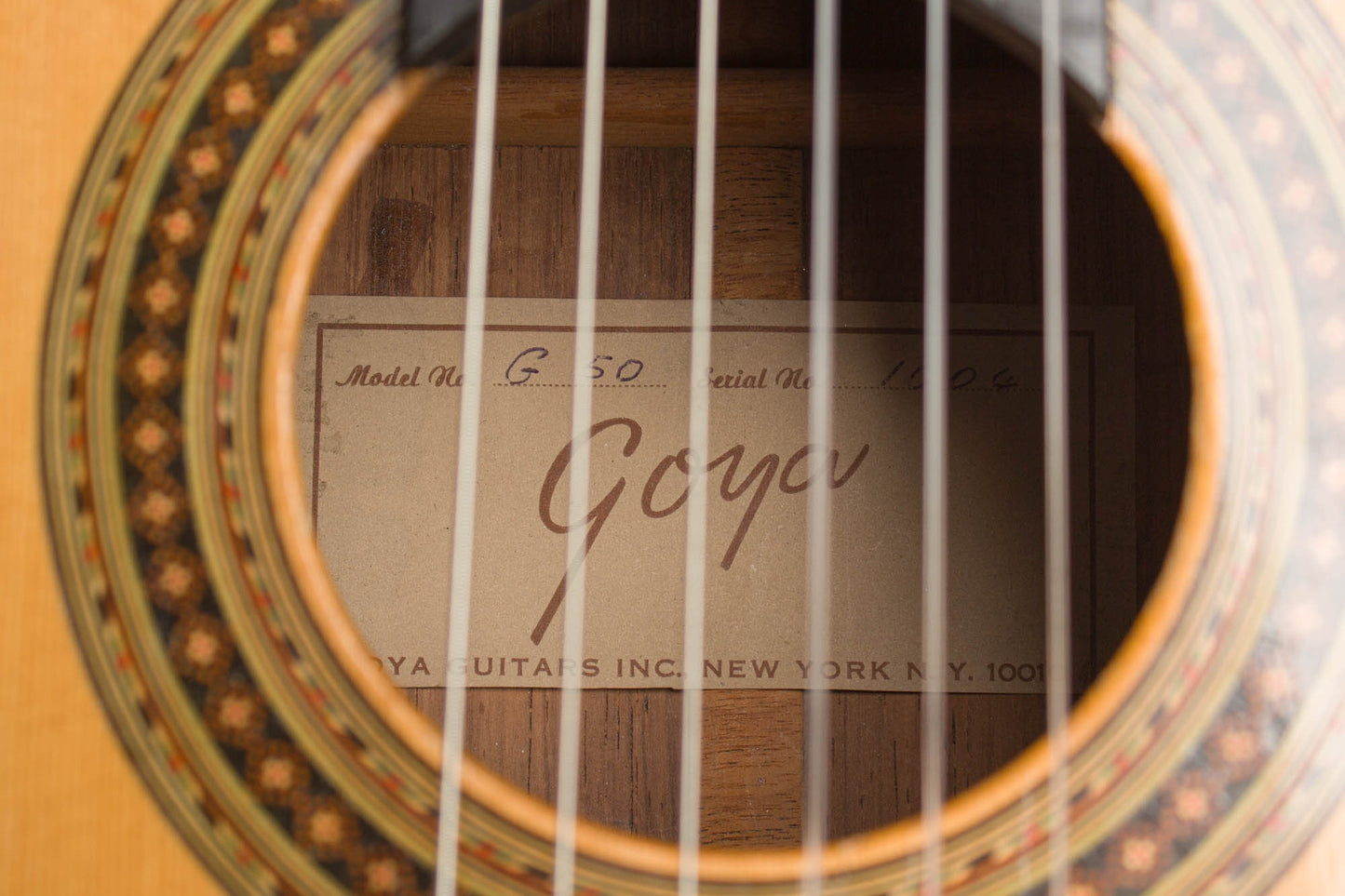
The Goya catalog spread of G-50 model options matches exactly that of the Velazquez shop series guitars of the earlier 1960s: the G-50C "El Clasico", the G-50F "El Flamenco", and the G-50L "La Mixta". This guitar's label has no suffix, simply labeled "Model: G-50". The Plantilla, headstock shape, hardware, and bracing pattern are identical to the Velazquez El Clasico series models we have handled, though the construction and finishing are less sophisticated than the typical Velazquez.
The serial number hand-written on the Goya label is 1004 likely indicating the fourth example; there were not many of these made!
The body is built of fairly light colored but dramatically figured rosewood, the top is tight grained spruce with a typical 7-fan Torres bracing pattern. All bindings and trim are wood. The Honduras Mahogany neck has a 52mm nut and a 650mm scale with an ebony fingerboard and is topped by a rosewood-faced headstock. This has a three lobed crest identical to 1960s M. Velazquez Inc shop models, a design used in the early 1950s by Velazquez that appears to be inspired by Domingo Esteso's 1930s headstock. It is outfitted with what appear to be "fishscale" Landstorfers with pearloid buttons. The neck is shallower than a typical Velazquez, with more of a "C" profile; there is a long grain flaw along the treble side of the neck that is plainly visible but not a structural issue. Although the neck block appears to be a Spanish "slipper foot" we suspect the actual joint is a dovetail or mortise construction. Overall the workmanship is not nearly as neat as Velazquez himself, but this is a solidly well built handmade instrument.
There is evidence of once installed tap plates, which likely indicate it was once used as a flamenco guitar; the action is quite supple, closer to what one would expect for flamenco playing. The sound is deep and rich with considerable volume, and responds to a light touch while being capable of a wide dynamic range. This is a fine sounding guitar, constructed by an apprentice of one of the later 20th century's most esteemed luthiers. Although carrying the Goya name this is a truly handmade instrument with some master heritage but at a far more affordable price than a genuine Valazquez.
Overall length is 38 1/4 in. (97.2 cm.), 14 1/2 in. (36.8 cm.) wide at lower bout, and 4 in. (10.2 cm.) in depth at side, taken at the end block. Scale length is 25 1/2 in. (648 mm.). Width of nut is 2 in. (51 mm.).
This guitar has seen some wear and repair but remains in original condition and a good playing and sounding instrument. There are finger impressions in the original finish on the treble side of the top near the fingerboard extension and general wear overall with dings, scratches and scuffs along with spots where the clear coat has worn through.
The long grain flaw that runs the length of the neck extends from the treble side near the heel all the way through the treble side of the headstock is visible under the finish. A portion of this grain opened up a bit near the heel which has been visibly glued.
The neck shows evidence of being reset with a shim added under the fingerboard extension. There is a repaired partial crack through the heel just above the heel cap, likely due to this reset work. Some of the back/side seams have been reglued; internally a number of the braces have also been reglued. The fingerboard has an added side dot sticker at the 7th fret.
Although not a genuine Valazquez this guitar has some of the DNA of his work in it. It is a fine sounding, excellent playing 60 year old handmade classical guitar with a unique New York pedigree, housed in a period HSC. Overall Very Good + Condition.
View full details
This rare high-end Goya branded classical guitar is a one of the more curious instruments borne out of the 60's folk craze, and an interesting piece of New York guitar history. Introduced in Hershman Musical Instrument Co's 1966 Goya catalog, the Model G-50 was marketed towards professionals desiring "a hand-made, custom built, rosewood guitar made in the U.S.A. to world concert standards." The 1967 Goya price list shows this guitar retailing for $700, by far the most expensive guitar Goya offered; most are fairly inexpensive imports. It appears that very few of these were ever ordered; considering that in 1966 a Gibson L-5C would run you about the same amount, this was a VERY expensive guitar. A short lived idea, the G-50 was phased out by 1968, no longer appearing in Goya catalogs.
This G-50 bears the signature "Victor Manuel Pineiro NYC" on the underside of the top. Thanks to the research of Puerto Rican music historian Nestor Murray-Irizarry, we know that Pineiro was an employee of Manuel Velazquez in his expanded 1960s New York City shop. As cited by Murray-Irizarry, an article on Manuel Velazquez published in the August 25th, 1962 issue of Puerto Rico's El Mundo Newspaper lists "Victor Pineiro of Humacao" as one of his four shop assistants, alongside fellow Puerto Rican natives Rafael Rivera of Ciales, Miguel Vissepo' of Mayaguez, and Fermin Diaz of Vega Baja.
According to Alfredo Velazquez, Victor was the apprentice charged with finishing the guitars. He also remembers his father describing Victor as humble and always respectful, and that Victor had incredible potential to be a guitar builder. It is worth noting that the people Don Manuel hired as apprentices, he did so because he saw potential in them to become great guitar makers of their own right. The instruments this shop produced were labeled "El Clasico" under Velazquez name, but not marketed as hand made by him personally.
This instrument was built in the 205 E 23rd St. loft shop originally set up by Manuel Velazquez to expand his one-man lutherie into a workshop production situation. Due to disagreements with the company's management and direction under his partners, the Brothers Valdes-Blain, Don Manuel exited the operation returning to Puerto Rico in 1963. Utilizing the materials and hardware already sourced and by Sr. Velazquez, M. Velazquez Guitars Inc. continued business building instruments under this name through 1965. With Velazquez out of the picture, the business began to lose credibility, and after his return to New York in 1965 as a solo builder, that management was forced to pivot the operation due to a strained relationship with Velazquez. Hershman Musical Instrument Co. was based just four blocks away at 53 W 23rd St, so apparently a deal was struck for distribution of the El Clasico series under the Goya brand name and nomenclature.
The Goya catalog spread of G-50 model options matches exactly that of the Velazquez shop series guitars of the earlier 1960s: the G-50C "El Clasico", the G-50F "El Flamenco", and the G-50L "La Mixta". This guitar's label has no suffix, simply labeled "Model: G-50". The Plantilla, headstock shape, hardware, and bracing pattern are identical to the Velazquez El Clasico series models we have handled, though the construction and finishing are less sophisticated than the typical Velazquez.
The serial number hand-written on the Goya label is 1004 likely indicating the fourth example; there were not many of these made!
The body is built of fairly light colored but dramatically figured rosewood, the top is tight grained spruce with a typical 7-fan Torres bracing pattern. All bindings and trim are wood. The Honduras Mahogany neck has a 52mm nut and a 650mm scale with an ebony fingerboard and is topped by a rosewood-faced headstock. This has a three lobed crest identical to 1960s M. Velazquez Inc shop models, a design used in the early 1950s by Velazquez that appears to be inspired by Domingo Esteso's 1930s headstock. It is outfitted with what appear to be "fishscale" Landstorfers with pearloid buttons. The neck is shallower than a typical Velazquez, with more of a "C" profile; there is a long grain flaw along the treble side of the neck that is plainly visible but not a structural issue. Although the neck block appears to be a Spanish "slipper foot" we suspect the actual joint is a dovetail or mortise construction. Overall the workmanship is not nearly as neat as Velazquez himself, but this is a solidly well built handmade instrument.
There is evidence of once installed tap plates, which likely indicate it was once used as a flamenco guitar; the action is quite supple, closer to what one would expect for flamenco playing. The sound is deep and rich with considerable volume, and responds to a light touch while being capable of a wide dynamic range. This is a fine sounding guitar, constructed by an apprentice of one of the later 20th century's most esteemed luthiers. Although carrying the Goya name this is a truly handmade instrument with some master heritage but at a far more affordable price than a genuine Valazquez.
Overall length is 38 1/4 in. (97.2 cm.), 14 1/2 in. (36.8 cm.) wide at lower bout, and 4 in. (10.2 cm.) in depth at side, taken at the end block. Scale length is 25 1/2 in. (648 mm.). Width of nut is 2 in. (51 mm.).
This guitar has seen some wear and repair but remains in original condition and a good playing and sounding instrument. There are finger impressions in the original finish on the treble side of the top near the fingerboard extension and general wear overall with dings, scratches and scuffs along with spots where the clear coat has worn through.
The long grain flaw that runs the length of the neck extends from the treble side near the heel all the way through the treble side of the headstock is visible under the finish. A portion of this grain opened up a bit near the heel which has been visibly glued.
The neck shows evidence of being reset with a shim added under the fingerboard extension. There is a repaired partial crack through the heel just above the heel cap, likely due to this reset work. Some of the back/side seams have been reglued; internally a number of the braces have also been reglued. The fingerboard has an added side dot sticker at the 7th fret.
Although not a genuine Valazquez this guitar has some of the DNA of his work in it. It is a fine sounding, excellent playing 60 year old handmade classical guitar with a unique New York pedigree, housed in a period HSC. Overall Very Good + Condition.


Loading...
Just arrived!
Item #