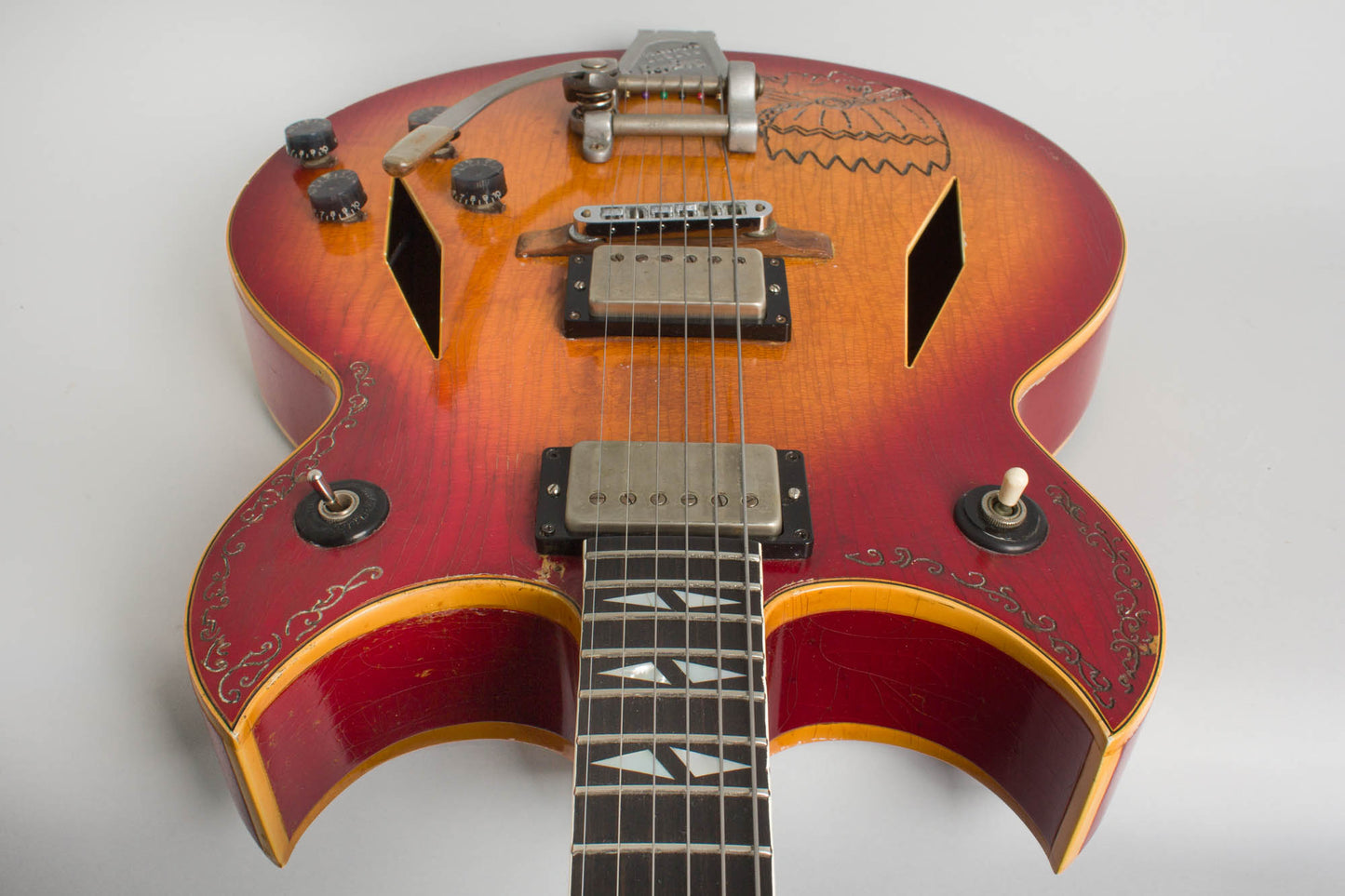
Gibson Trini Lopez Deluxe Owned by Jeff Tweedy of Wilco Model Arch Top Hollow Body Electric Guitar (1968), made in Kalamazoo, Michigan, serial # 508536, cherry sunburst finish, laminated maple body, mahogany neck with rosewood fingerboard, black hard shell case.
Here is a whimsically customized player grade example of one of our favorite slightly oddball 1960s Gibsons, the Trini Lopez Deluxe. This model is essentially a Barney Kessel with an eccentric cosmetic edge (and that's not even including the custom wood engravings)! The proprietary diamond shaped f-holes and position markers give the guitar a rakish air, while the bound, single-sided headstock with a hooked tip adds a certain extra pizzazz. This one comes from one of our favorite slightly oddball guitarists, Mr. Jeff Tweedy of Wilco and beyond.
The serial #508536 dates it at either 1965 or 1968. With some of the original appointments no longer in place and the original pots hidden under the "cans" that Gibson had started using at this time, our educated opinion places this at a 1968 based on the nature of the burst. Typically, earlier examples we have seen have a thicker red burst that is more diffuse; this one, like others we've seen from the latter half of production, have a thinner and more abrupt burst. Of course, this one has a character all its own having been heavily aged, checked, and ambered from years of play and possibly tobacco smoke (though neither guitar nor case carries a foul odor).
Originally, this would have featured all chrome-plated hardware, including enclosed single unit Grover Roto-Matic tuners, a logo-block tailpiece and the "amp"-style black molded knobs. Much of the hardware has been replaced on this player-grade Trini. It has been fitted with a period Bigsby vibrato tailpiece in place of the original tailpiece and the pickups are later Seymour Duncan antiquity humbuckers. This one obviously also has some unmissable custom modifications. The profile of a Native American in feather head dress and some additional ornate flourishes were semi-professionally woodburned into the top of the guitar long ago, likely decades before it found its way to the Wilco Loft. Woodburning hobby kits were popular in the 1960s, but we don't often see them having been used on such an expensive instrument!
While these guitars are usually referred to as having a "Firebird Style" headstock, this model in fact slightly predates the non-reverse Firebirds it shares the design with, so really the later Firebirds have a "Trini head". The other unique feature is a Gretsch-like standby switch, supposedly included at Mr. Lopez's request so he could quickly turn the guitar on and off during the audience sing-along part of his act! "Mr. Lemon Tree" himself played this Deluxe model, a personalized variant of the Barney Kessel that he used in the early 1960s. A fairly expensive Gibson never shipped in large numbers, the Trini Lopez Deluxe is a colorful, visually striking guitar as well as a fine-playing instrument. This one-of-a-kind custom-decorated example has a history all its own, and is certainly a singular piece with a very cool provenance!
Overall length is 43 3/4 in. (111.1 cm.), 16 7/8 in. (42.9 cm.) wide at lower bout, and 2 7/8 in. (7.3 cm.) in depth, measured at side of rim. Scale length is 25 1/2 in. (648 mm.). Width of nut is 1 5/8 in. (41 mm.).
This guitar has seen the open road through a cloud of smoke with plenty of checking, dings, scrapes and signs of playwear all around the instrument. The original finish is faded to a deeper amber color with areas of wear and deep-seated gunk here and there and all-over heavy checking. The only notable area of repair on the guitar is a repaired crack stretching diagonally over the heel; this area was well sealed and the neck was reset at the time of the repair. Some overspray/touch-up and glue residue is visible around the heel and in the cutaways. Some of the binding in the cutaways seemingly separated and was reglued; there are some cracks and chips in the binding generally speaking, but no major areas of loss or decay.
The pickguard is gone, the logo'd tailpiece replaced with a Bigsby, and the headstock Groverized more than once with some telltale unfilled holes. There is a bit of overspray near the top of the neck and headstock, but it does not appear to hiding any cracks or repairs. The bridge top is a later replacement though the rosewood base is period, and the original "witch hat" knobs have been replaced by 70s style black "hatbox" knobs. The pickups are Seymour Duncan Antiquity Humbuckers with nickel covers; most of the other electronics appear original after the splices for these except for the treble side 2-way switch which was also replaced with an all-metal variant.
Overall, this is a prime example of a player grade guitar with many cool stories to tell. The fingerboard has been refretted with some divots filled in the lower positions and plays very well. It offers a fine sound and cool "real relic" look with enough wear and replaced hardware to offer a little price relief, ornate woodcarvings of debatable cultural sensitivity, and a particularly cool case that was heavily reworked, with the covering removed and the top edge studded like an old frontier rifle stock. It seems obvious that whoever is responsible for the wood etching on the face of the guitar is also responsible for the custom case: hand painted wood trimmed with a studded leather detail that is certainly reminiscent of the classic leatherworking of the Indigenous residents of the Southwest. Along the bottom of the case are the usual markings of the Wilco loft, and inside the case is a signed Certificate of Authenticity from the Wilco Loft validating the provenance of this one-of-a-kind piece. Overall Very Good Condition.