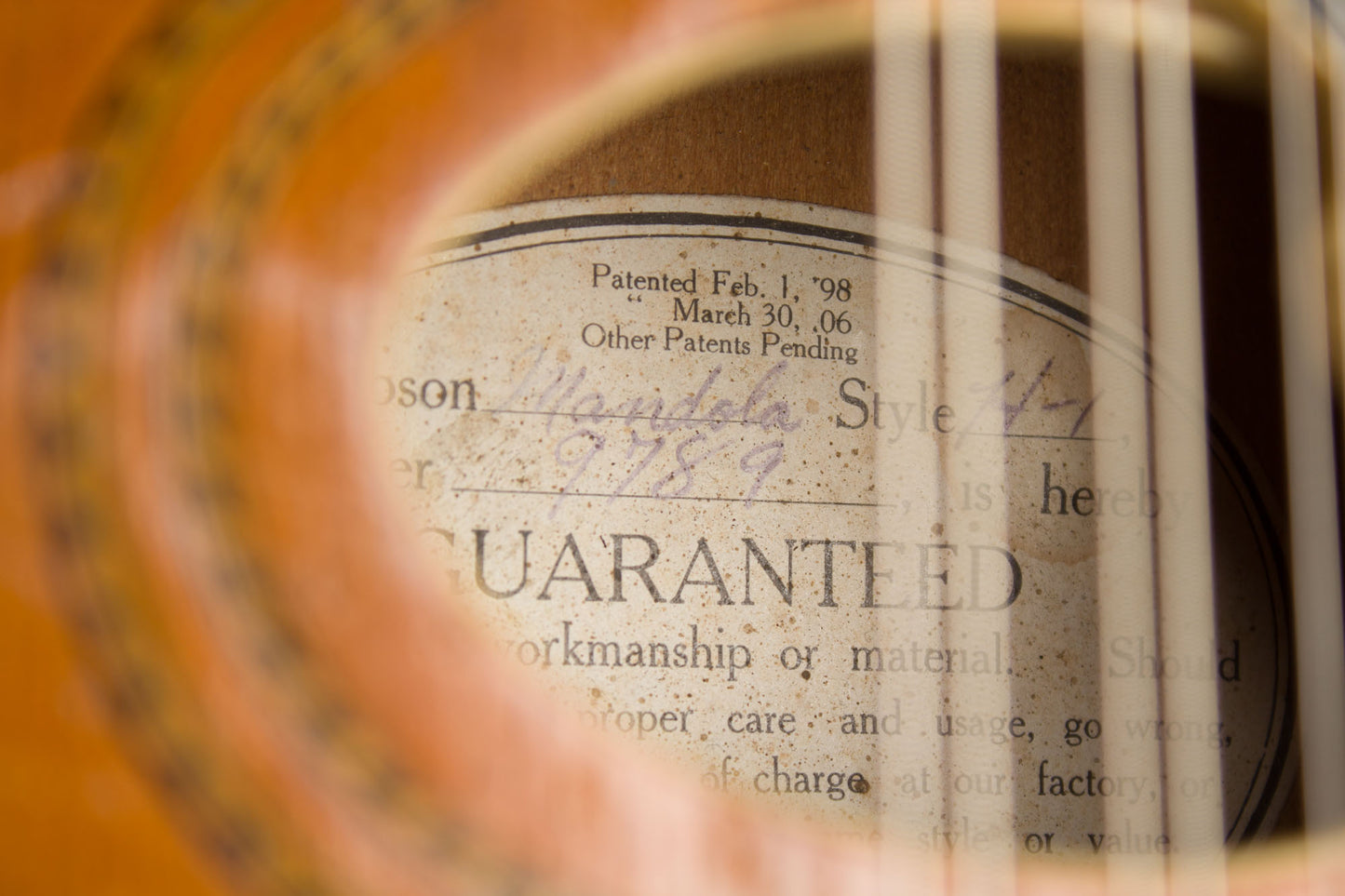
Gibson Style H-1 Model Carved Top Mandola (1910), made in Kalamazoo, Michigan, serial # 9789, natural varnish finish, birch back and sides, spruce top; mahogany neck with ebony fingerboard, original black hard shell case.
This is a well-used 115 year old example of an early style Gibson H-1 Mandola, showing noticeable wear but still with a lot of life left in it. The H-1 was the "basic" model of mandola, the middle-pitched instrument of the mandolin-mandola-mandocello trio. Compared to mandolins, mandolas from any era are fairly rare, although more were made in the 1910's than later periods this is still a fairly scarce item well over a century on. The H-1 lacks the decorative elements of the higher priced H-2 but is structurally the same. The headstock face has no ornament except the "The Gibson" inlaid in pearl, and the single-bound top has two half-herringbone soundhole rings with the inner edge also bound in ivoroid.
This H-1 is a fairly early example made around mid-1910; the then brand new "guarantee" label (which had just replaced one with Orville staring out of the soundhole) is pasted in but still carries a 4-digit serial number written in pencil. At this point Gibson's carved-top mandolin family instruments were becoming the most influential in the world but in some ways had not yet been fully perfected. The neck angle is shallower and the bride lower than later construction; while this is often held to be sonically inferior design we find this mandola to have a rich and sweet sound, less strident than many later examples with plenty of volume.
Other typical period features include a natural "pumpkin top" varnish finish top over lightly cherry stained back and sides, a tailpiece with the early "Pineapple" shaped Gibson-engraved cover and the Handel-made strip tuners used on all Gibsons of the period. The top is carved from spruce over birch back and sides. The neck is Honduras mahogany fitted with a heavy bound ebony fingerboard. While not the cleanest of these we have had this is a lovely sounding and fine playing example of this rare earlier style Gibson mandola, ready to play for another century at least.
Overall length is 28 1/4 in. (71.8 cm.), 11 1/16 in. (28.1 cm.) width, and 2 in. (5.1 cm.) in depth, measured at side of rim. Scale length is 15 3/4 in. (400 mm.). Width of nut is 1 5/16 in. (33 mm.).
This Mandola has seen some life with wear and repair along the way, but considering it was in use well before the First World war it has held up pretty well. The original thin varnish finish is intact with general wear over the entire instrument. There is typical fine checking and a collection of chips, dings and scrapes overall. The top finish retains a nice amber patina with some dings and scrapes and some oddly vertical pick wear to the top above and behind the soundhole. There is some rub wear to the wood on the back of the neck and the unbound back edge of the body.
The neck heel has an old crack repair, sealed but visible as it was not finished over. This is more common on these early Gibsons for some reason. The laminate seam on the face of the headstock has opened just a bit; this has also been sealed with no added finish work. There are some deep scratches but no visible cracks to the top, back or sides. The back/side seams do not appear to have opened and been resealed solidly a many have. The hardware remains original with the exception of the early elevated pickguard, which is long gone. The tuners, tailpiece and one-piece ebony bridge all remain in solid and relatively clean condition.
The instrument still carries the original thin 1910 frets with less wear on them than one might expect. The bass side fingerboard binding from the 15th fret to the end of the fingerboard has been replaced. Even with the wear and repair this is an attractive instrument and a very good player, a rare find in an early mandola with a warm and lovely sound. It is housed in an early pattern OHSC. Very Good + Condition.