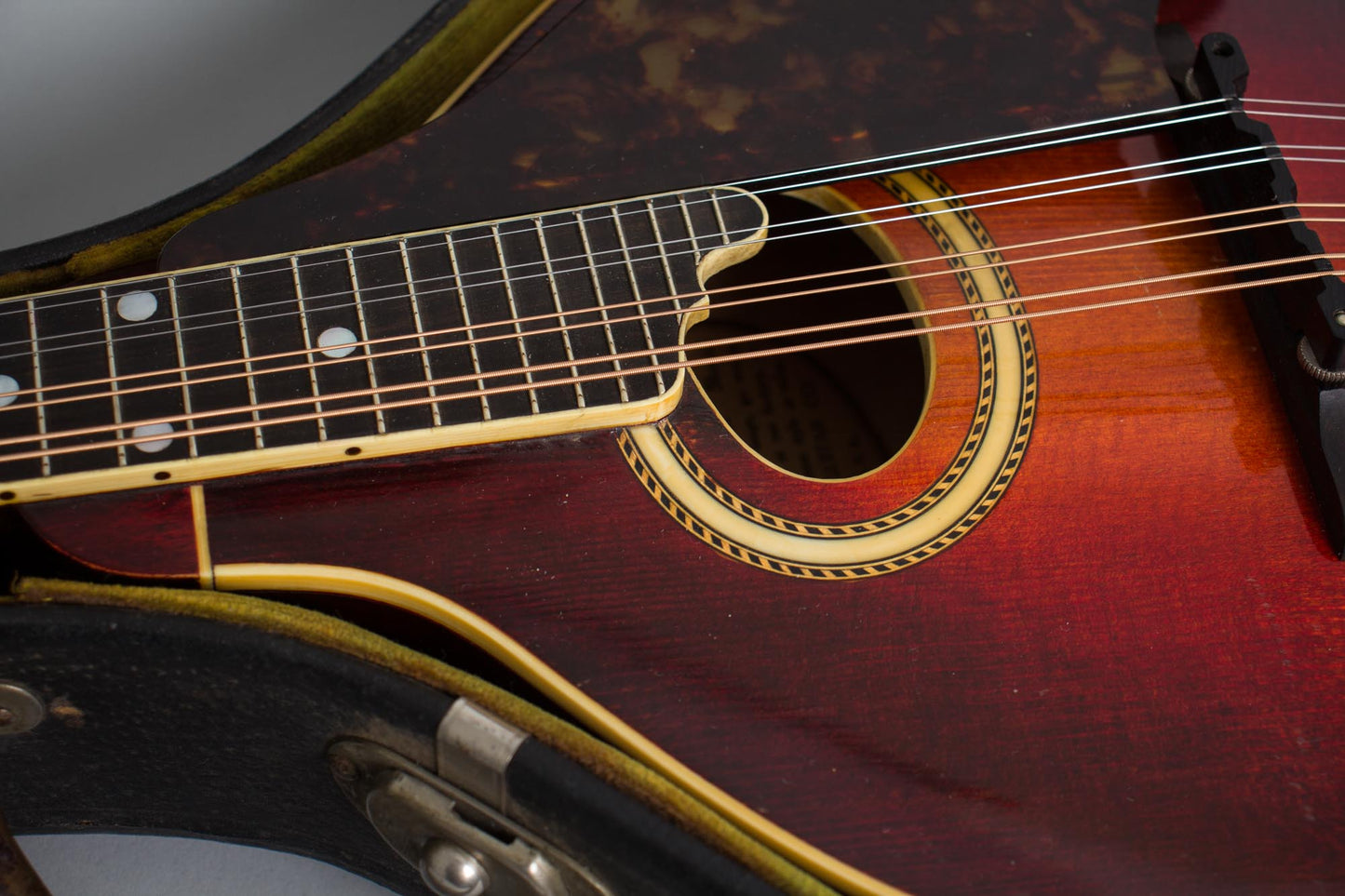
Gibson Model A-4 Snakehead Model Carved Top Mandolin (1923), made in Kalamazoo, Michigan, serial # 73655, sunburst top, dark cherry stained back and sides finish, birch back and sides, spruce top; mahogany neck with ebony fingerboard, original black hard shell case.
If there is a holy grail of Gibson "A"-style mandolins, this is it: a 1923 "snakehead" A-4 from the height of the Lloyd Loar era. This is one of the best and most powerful sounding "A" mandolins we have had and a great example of Gibson's craftsmanship at the apex of the mandolin era, before the company's focus shifted to banjos and then guitars.
These "Snakehead" instruments are revered for their unmatched tone and projection and have all the most advanced features of the period including the adjustable truss rod, raised adjustable bridge, and slim neck profile. The A-4 was Gibson's highest grade mandolin in the symmetrical-bodied "A" series and only the elaborately scrolled F-2, F-4, and F-5 were priced above it.
Lloyd Loar's tenure as "acoustic engineer" at Gibson has become so mythical that sometimes separating fact from fiction is difficult. Certainly the mandolin family instruments made during the period of Loar's employment are the most perfectly realized in Gibson's history, and have become the template for most similar instruments since.
The mandolins of the "Loar Era" show the influence of a master player on both design and execution, although other Gibson employees (especially Thaddeus McHugh and Lewis A. Williams) actually engineered many of the technical improvements of the early 1920s. Loar was primarily concerned with "voicing" the instruments properly; the Master Model Style 5 line was his greatest contribution with their violin-style f-hole tops, but all of the Gibson mandolin family instruments were refined and improved at the same time.
This A-4 dates to mid/late 1923, high water mark of the Loar era and is a lovely instrument to behold. equipped with all the newer 1920s features of the "Loar Era". These include the adjustable truss rod in the neck, adjustable ebony bridge and "modern" metal rod pickguard bracket. It still carries the model's trademark pearl fleur-de-lis and Gibson logo on the headstock. The sunburst top finish maintains beautiful deep color and even that fleur-de-lis inlaid in the peghead is made of unusually fine figured green abalone. The neck is a very slim "V" profile and extremely fast and comfortable. Besides its visual beauty this is an exceptionally fine-sounding and playing mandolin, with the combination of power, projection and complexity heard only in the finest Gibsons.
Overall length is 25 9/16 in. (64.9 cm.), 10 1/4 in. (26 cm.) width, and 1 13/16 in. (4.6 cm.) in depth, measured at side of rim. Scale length is 14 in. (356 mm.). Width of nut is 1 1/8 in. (29 mm.).
This is one of the cleanest, most original Loar-era mandolins we have seen in a while, now just about a century old. The all-original finish shows some rubbed away areas (mostly on the back of the neck and the areas near the heel) with small dings and scuffs but hardly any pickwear; the bulk of the finish is still very clean. The back/side seams do not appear to have ever been resealed, there is a tiny check in the wood on the upper side at the back end of the heelblock but no visible repair. All hardware is original and in excellent condition. This is a very beautiful but also great playing mandolin with a huge sound that never gets harsh, housed in the original HSC. Overall Excellent Condition.