


Gibson Les Paul Custom Solid Body Electric Guitar (1956)


1
/
of
18
Regular price
$49,500.00
Regular price
$49,500.00
Sale price
$49,500.00
Unit price
/
per
Item #14238
Gibson Les Paul Custom Model Solid Body Electric Guitar (1956), made in Kalamazoo, Michigan, serial # 6-7287, black lacquer finish, mahogany body and neck, ebony fingerboard, original black hard shell case.
"Wow" said the person who unpacked this guitar here "This one's got some VIBE!!". And so it does; this is a seriously cool 1956 Les Paul Custom with an original factory Bigsby, showing plenty of natural weathering and wear for 70 years on Earth but...yup...VIBE!
The Custom was Gibson's top-of-the-line solid-body through the 1950s, a shining "Black Beauty" with gold-plated hardware and deluxe appointments drawn from the company's flagship archtops. This model was introduced in 1954 with direct input from Les Paul himself; Gibson delivered, and Les and Mary Ford performed for the rest of the 1950s on (heavily modified) Customs. This example was made in 1956, the second full production year and appears much used and loved since.
The black finish was Les' idea -- he called it a "tuxedo effect" believing it made the player's hands stand out on black & white TV. Beyond this the Custom has several other unique features. The carved-top solid body is made entirely of mahogany; unlike the Standard model it has no maple cap. This was NOT Les' specification, and while he later claimed Gibson had "screwed it up," this does give the Custom a slightly warmer, airier natural sound with a less sharp top end which Gibson thought might appeal to the jazz artists considered the primary market in the 1950s.
All appointments are high-end; the bound fretboard is ebony with pearl block inlay and the elaborate split diamond motif on the headstock came from the Super 400, Gibson's most expensive guitar. There is multiple binding in the body and headstock and all hardware is gold-plated. Another feature specific to the Custom was the original low, flat "Fretless Wonder" fretwire. Like most well-used Customs this one has been refretted, in this case with more "normal" 1950s style wire making for a much more playable guitar. It also has a slightly shallower "C" neck profile than some with a bit more dress-away on the lower sides making for a very sleek feel.
The Custom was the only solidbody to carry the new high-end "Alnico V" staple-magnet pickup, again likely developed with input from Les himself. This is essentially Gibson's take on a DeArmond DynaSonic, which is what Les mounted in the neck position of in his personal Standard in 1953-4. Combined with the P-90 in the bridge position, this crisp and powerful pickup gives the Custom a wide tonal range unique among Gibson solid-bodies.
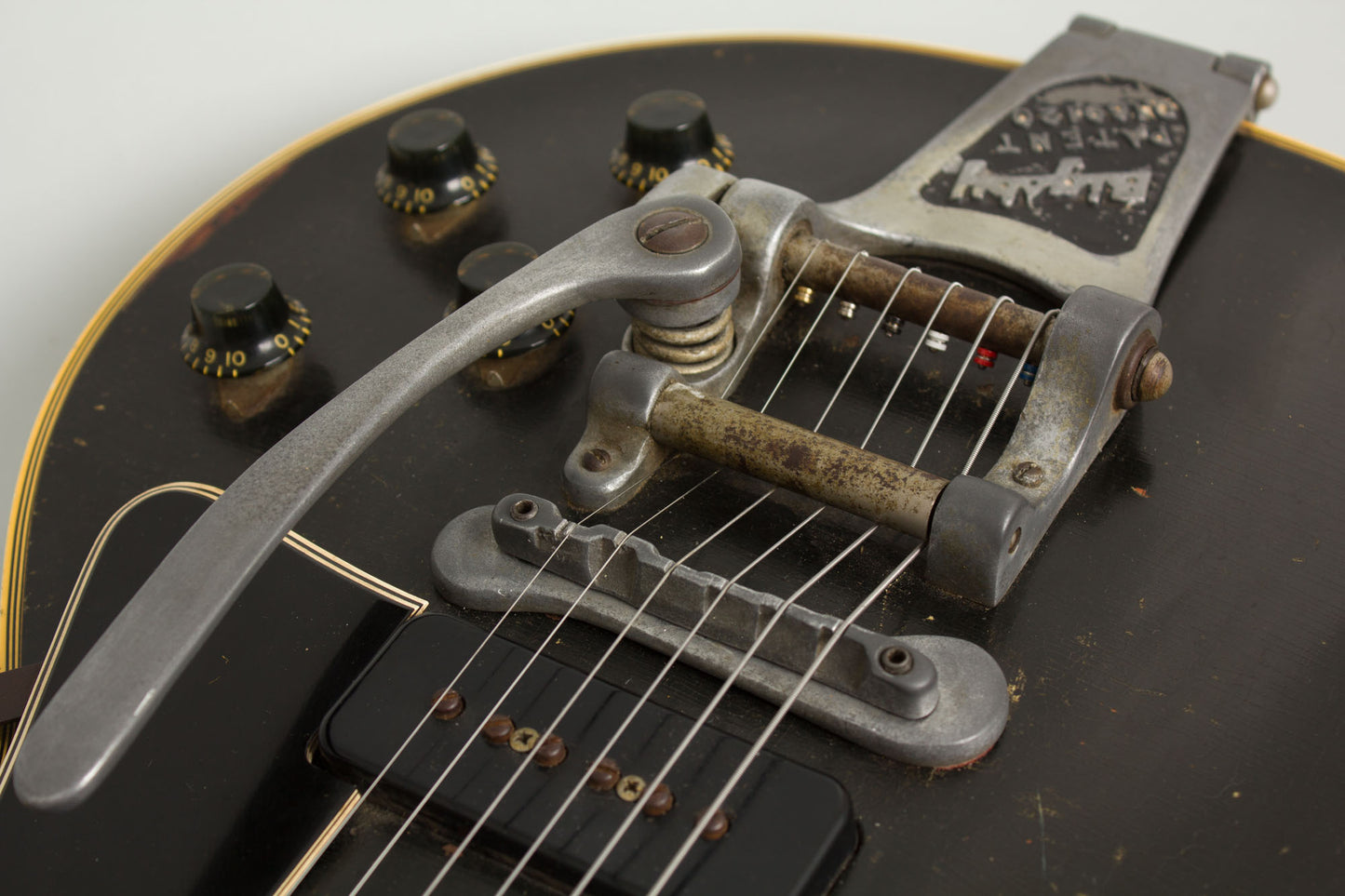
The stock model fitted Gibson's Tune-O-Matic bridge and stud-mounted tailpiece but this Custom was an early factory order with a Bigsby True vibrato tailpiece. This is the earliest swing-arm B-7 version with the cast "Duane Eddy" handle only used briefly in this period; it had just replaced the original "fixed arm" version and was at least partially designed by Gibson's ted McCarty. The "dogbone" aluminum Bigsby bridge is the early Les-Paul specific fitting; instead of fixed posts and elevating wheels, The base is thicker with the saddle adjusted for height by Allen screws in the wings.
In 1957 the Les Paul Custom was altered to feature three of the new Humbucking pickups, and the unique Alnico V/P-90 pickup mix was lost. Only around 1,000 of these first generation Customs were sold between late 1954 and mid-1957, 489of them in 1956, the model's best year. Several well-known players made extensive use of them at the time including R&B/Jazz specialist Mickey Baker and Bill Haley's Comets' guitarist Frannie Beecher. Jazz master Jim Hall used one for a time in the 1950s with Chico Hamilton.
This well-worn wangbar equipped Custom looks like it had some adventures in the 1950s but survived honestly worn but fully intact, still of one of the sharpest looking solid-body guitars ever designed and a unique sounding one as well. And this one sure has the vibe�
Overall length is 39 5/8 in. (100.6 cm.), 13 in. (33 cm.) wide at lower bout, and 2 in. (5.1 cm.) in depth, measured at side of rim. Scale length is 24 3/4 in. (629 mm.). Width of nut is 1 11/16 in. (43 mm.)., 9.1 lbs.
This is a beautifully original guitar overall showing considerable wear but really nothing tragic for 70 years on the planet; really it looks just heavily played over many years. This is an original factory Bigsby guitar; there are no stud holes drilled in the top. There are no alterations except the very well done refret. The all-original ebony finish is thinner than later examples; it has an aged patina with extensive micro-checking and mostly small scratches, dents and dings over the entire instrument. The back of the body has considerable belt-buckle worming mostly into but not through the lacquer, with some fairly small areas chipped away. The face is heavily checked but has mostly relatively small dinks and dents with some wear to the wood on the lower edge and very minor flaking .
The back of the neck has areas worn to the wood mostly on the bass side, heaviest oddly behind the 7th to 12th fret area. There are several feelable dinks to the back of the neck, most notable at the 3rd fret and nut areas but nothing too distracting. The headstock has some flaking to the face and wear off the back edge; the inked-on gold serial number is faded but still legible. There are four touched up screw holes in the lower rim where an enlarged metal jackplate was once mounted; this is still in the case as evidence! A correct-looking vintage plastic piece is installed currently. The buttons on the Kluson "Waffleback" tuners are very nice repros; the tuners themselves are correct.
The hardware remains original and complete; there is considerable wear to the gold plating overall and a super aged patina to the aluminum Bigsby and bridge. The electronics all appear completely original including the pickups, switch, pots, wiring and caps. There is some noticeable wear to the plastic pickup covers and minor scuffing to the pickguard; the bass pickup cover is slightly warped.
The ebony fingerboard was lightly trued when the guitar was refretted, which is a very neat job. If not the cleanest 1950s Les Paul Custom we have had is has the "real relic" vintage patina to spare, with the look and feel modern "relic" guitars never really capture. This custom was well used but not abused with the scars to show for it but no structural damage or repair. Both pickups have plenty of juice and the instrument offers a very powerful sound both clean and cranked. It comes in the original yellow lined pebble-grained black case, heavily worn with repairs to the edges and a modern molded plastic case for shipping. This is a Black Beauty one can play without fear of adding a few dings to; it is ready to go for the next 70 years and beyond. Overall Very Good + Condition.
View full details
"Wow" said the person who unpacked this guitar here "This one's got some VIBE!!". And so it does; this is a seriously cool 1956 Les Paul Custom with an original factory Bigsby, showing plenty of natural weathering and wear for 70 years on Earth but...yup...VIBE!
The Custom was Gibson's top-of-the-line solid-body through the 1950s, a shining "Black Beauty" with gold-plated hardware and deluxe appointments drawn from the company's flagship archtops. This model was introduced in 1954 with direct input from Les Paul himself; Gibson delivered, and Les and Mary Ford performed for the rest of the 1950s on (heavily modified) Customs. This example was made in 1956, the second full production year and appears much used and loved since.
The black finish was Les' idea -- he called it a "tuxedo effect" believing it made the player's hands stand out on black & white TV. Beyond this the Custom has several other unique features. The carved-top solid body is made entirely of mahogany; unlike the Standard model it has no maple cap. This was NOT Les' specification, and while he later claimed Gibson had "screwed it up," this does give the Custom a slightly warmer, airier natural sound with a less sharp top end which Gibson thought might appeal to the jazz artists considered the primary market in the 1950s.
All appointments are high-end; the bound fretboard is ebony with pearl block inlay and the elaborate split diamond motif on the headstock came from the Super 400, Gibson's most expensive guitar. There is multiple binding in the body and headstock and all hardware is gold-plated. Another feature specific to the Custom was the original low, flat "Fretless Wonder" fretwire. Like most well-used Customs this one has been refretted, in this case with more "normal" 1950s style wire making for a much more playable guitar. It also has a slightly shallower "C" neck profile than some with a bit more dress-away on the lower sides making for a very sleek feel.
The Custom was the only solidbody to carry the new high-end "Alnico V" staple-magnet pickup, again likely developed with input from Les himself. This is essentially Gibson's take on a DeArmond DynaSonic, which is what Les mounted in the neck position of in his personal Standard in 1953-4. Combined with the P-90 in the bridge position, this crisp and powerful pickup gives the Custom a wide tonal range unique among Gibson solid-bodies.
The stock model fitted Gibson's Tune-O-Matic bridge and stud-mounted tailpiece but this Custom was an early factory order with a Bigsby True vibrato tailpiece. This is the earliest swing-arm B-7 version with the cast "Duane Eddy" handle only used briefly in this period; it had just replaced the original "fixed arm" version and was at least partially designed by Gibson's ted McCarty. The "dogbone" aluminum Bigsby bridge is the early Les-Paul specific fitting; instead of fixed posts and elevating wheels, The base is thicker with the saddle adjusted for height by Allen screws in the wings.
In 1957 the Les Paul Custom was altered to feature three of the new Humbucking pickups, and the unique Alnico V/P-90 pickup mix was lost. Only around 1,000 of these first generation Customs were sold between late 1954 and mid-1957, 489of them in 1956, the model's best year. Several well-known players made extensive use of them at the time including R&B/Jazz specialist Mickey Baker and Bill Haley's Comets' guitarist Frannie Beecher. Jazz master Jim Hall used one for a time in the 1950s with Chico Hamilton.
This well-worn wangbar equipped Custom looks like it had some adventures in the 1950s but survived honestly worn but fully intact, still of one of the sharpest looking solid-body guitars ever designed and a unique sounding one as well. And this one sure has the vibe�
Overall length is 39 5/8 in. (100.6 cm.), 13 in. (33 cm.) wide at lower bout, and 2 in. (5.1 cm.) in depth, measured at side of rim. Scale length is 24 3/4 in. (629 mm.). Width of nut is 1 11/16 in. (43 mm.)., 9.1 lbs.
This is a beautifully original guitar overall showing considerable wear but really nothing tragic for 70 years on the planet; really it looks just heavily played over many years. This is an original factory Bigsby guitar; there are no stud holes drilled in the top. There are no alterations except the very well done refret. The all-original ebony finish is thinner than later examples; it has an aged patina with extensive micro-checking and mostly small scratches, dents and dings over the entire instrument. The back of the body has considerable belt-buckle worming mostly into but not through the lacquer, with some fairly small areas chipped away. The face is heavily checked but has mostly relatively small dinks and dents with some wear to the wood on the lower edge and very minor flaking .
The back of the neck has areas worn to the wood mostly on the bass side, heaviest oddly behind the 7th to 12th fret area. There are several feelable dinks to the back of the neck, most notable at the 3rd fret and nut areas but nothing too distracting. The headstock has some flaking to the face and wear off the back edge; the inked-on gold serial number is faded but still legible. There are four touched up screw holes in the lower rim where an enlarged metal jackplate was once mounted; this is still in the case as evidence! A correct-looking vintage plastic piece is installed currently. The buttons on the Kluson "Waffleback" tuners are very nice repros; the tuners themselves are correct.
The hardware remains original and complete; there is considerable wear to the gold plating overall and a super aged patina to the aluminum Bigsby and bridge. The electronics all appear completely original including the pickups, switch, pots, wiring and caps. There is some noticeable wear to the plastic pickup covers and minor scuffing to the pickguard; the bass pickup cover is slightly warped.
The ebony fingerboard was lightly trued when the guitar was refretted, which is a very neat job. If not the cleanest 1950s Les Paul Custom we have had is has the "real relic" vintage patina to spare, with the look and feel modern "relic" guitars never really capture. This custom was well used but not abused with the scars to show for it but no structural damage or repair. Both pickups have plenty of juice and the instrument offers a very powerful sound both clean and cranked. It comes in the original yellow lined pebble-grained black case, heavily worn with repairs to the edges and a modern molded plastic case for shipping. This is a Black Beauty one can play without fear of adding a few dings to; it is ready to go for the next 70 years and beyond. Overall Very Good + Condition.


Loading...
Just arrived!
Item #