Gibson L-C Century of Progress Flat Top Acoustic Guitar (1937)


1
/
of
6
Couldn't load pickup availability
Item #7758
Gibson L-C Century of Progress Model Flat Top Acoustic Guitar (1937), made in Kalamazoo, Michigan, serial # 125C-4, sunburst lacquer finish, maple back and sides, spruce top; mahogany neck with rosewood and celluloid fingerboard, original black - red line hard shell case.
The L-C "Century of Progress" model is one of Gibson's most distinctive acoustic guitar designs, and one of the most visually striking flattop guitars of any era. Combining a 14" 3/5 curly maple body with flashy pearloid ornamentation on the neck, the Century is visually somewhat reminiscent of a 1920's tenor banjo, and sonically a distinctive guitar in its own right. The maple back and sides give the L-C a crisp powerful sound perfectly suited to fingerpicking and ragtime, while played with a pick the guitar is both loud and bright enough to play rhythm in a small dance combo.
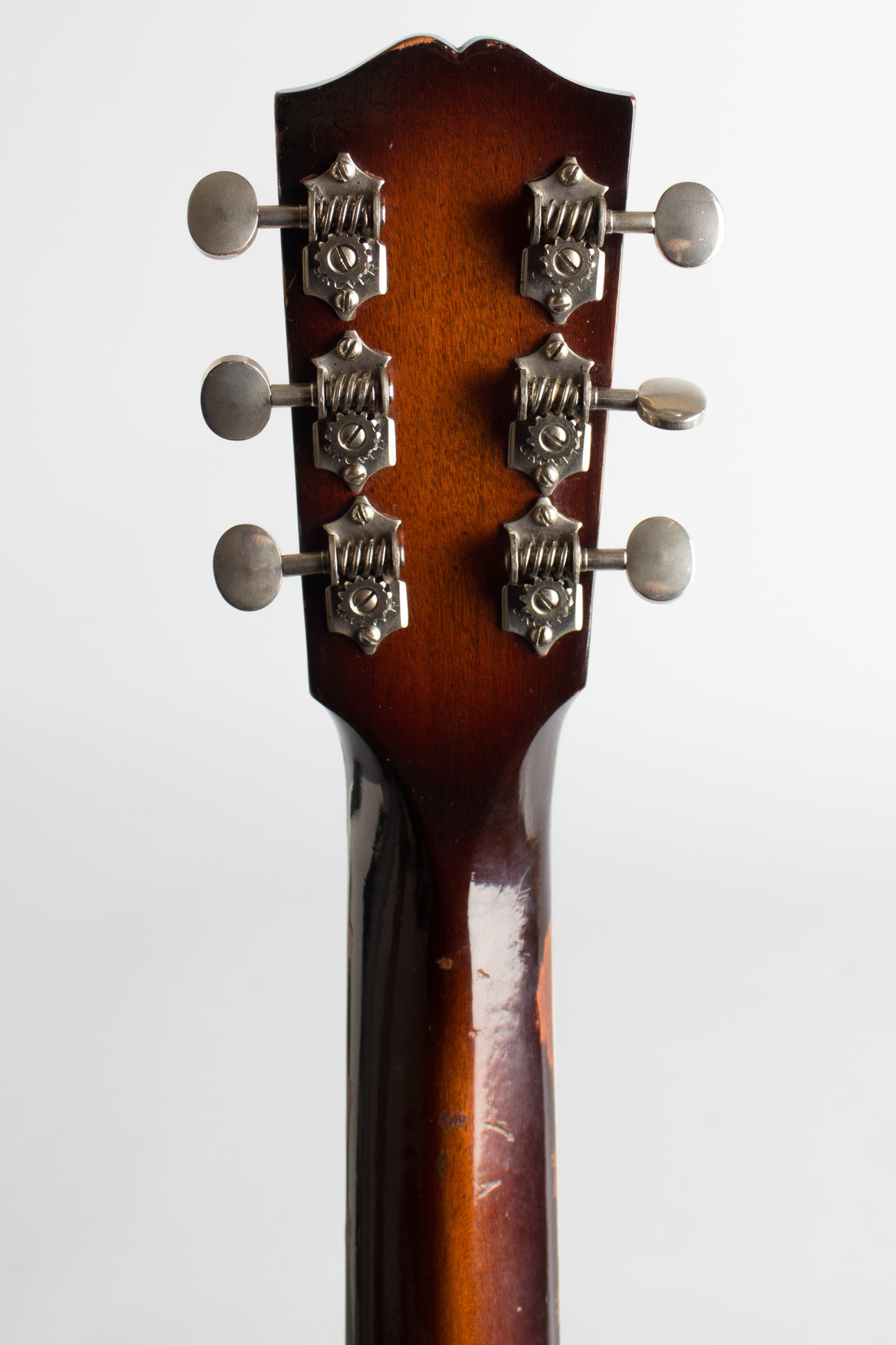
The body is single bound top and back, with finely shaded golden sunburst on all surfaces. The softly V-shaped mahogany neck is also subtly sunbursted. The tuners are individual metal button Grover Sta-Tites, the pearloid headstock and fingerboard are bound in black and white. Pearl diamonds are set in rosewood blocks in the celluloid fingerboard creating a dramatic three color visual scheme for the neck which nicely offsets the dark sunburst top. Soundhole ring is 3-ply WBW, the pickguard is Gibson's striking pre-war firestripe tortoise celluloid.
This is a relatively late example of the Century, with a larger sunburst area on the top typical of 1937. The model was introduced for the "Century of Progress" exhibition in Chicago in 1933, and was only produced until around 1939. The L-C was popular with many Hillbilly and Radio Cowboy acts of the 1930's, including the Girls of the Golden West and Mainer's Mountaineers. This beautiful example sounds and plays just as it should and is complete with the original red-line black hard case
Overall length is 40 in. (101.6 cm.), 14 3/4 in. (37.5 cm.) wide at lower bout, and 4 1/2 in. (11.4 cm.) in depth at side, taken at the end block. Scale length is 24 3/4 in. (629 mm.). Width of nut is 1 3/4 in. (44 mm.). This Century is in extremely fine condition overall, showing no major repair and only some light finish wear. It remains delightfully original, even down to small and usually lost details like the bridgepins and endpin. There is some slight pickwear to the top (mostly on the bottom rim of the soundhole) and slight edgewear to the fingerboard on both sides but the rest of the finish is very clean for a pre-WWII guitar with only small dings and dents-the largest area of scuffing is by the endpin, where some sort of strap tassle caused some deeper scratching. Remarkably there are only two very minor crack repairs; the two-piece maple back had the center seam resealed by the heel, and there was a very small typical b-string grain split off the top edge of the pickguard. This guitar plays extremely well, with an original bridge that has been lowered just a touch, a newer saddle and very good neck angle. This is one of the nicest Century Models we have had, not as bright sounding as some with a solid and rich tone and plenty of volume. Includes the original semi-hard red-line case in solid condition with some pieces of covering missing. Overall Excellent Condition.
View full details
The L-C "Century of Progress" model is one of Gibson's most distinctive acoustic guitar designs, and one of the most visually striking flattop guitars of any era. Combining a 14" 3/5 curly maple body with flashy pearloid ornamentation on the neck, the Century is visually somewhat reminiscent of a 1920's tenor banjo, and sonically a distinctive guitar in its own right. The maple back and sides give the L-C a crisp powerful sound perfectly suited to fingerpicking and ragtime, while played with a pick the guitar is both loud and bright enough to play rhythm in a small dance combo.
The body is single bound top and back, with finely shaded golden sunburst on all surfaces. The softly V-shaped mahogany neck is also subtly sunbursted. The tuners are individual metal button Grover Sta-Tites, the pearloid headstock and fingerboard are bound in black and white. Pearl diamonds are set in rosewood blocks in the celluloid fingerboard creating a dramatic three color visual scheme for the neck which nicely offsets the dark sunburst top. Soundhole ring is 3-ply WBW, the pickguard is Gibson's striking pre-war firestripe tortoise celluloid.
This is a relatively late example of the Century, with a larger sunburst area on the top typical of 1937. The model was introduced for the "Century of Progress" exhibition in Chicago in 1933, and was only produced until around 1939. The L-C was popular with many Hillbilly and Radio Cowboy acts of the 1930's, including the Girls of the Golden West and Mainer's Mountaineers. This beautiful example sounds and plays just as it should and is complete with the original red-line black hard case
Overall length is 40 in. (101.6 cm.), 14 3/4 in. (37.5 cm.) wide at lower bout, and 4 1/2 in. (11.4 cm.) in depth at side, taken at the end block. Scale length is 24 3/4 in. (629 mm.). Width of nut is 1 3/4 in. (44 mm.). This Century is in extremely fine condition overall, showing no major repair and only some light finish wear. It remains delightfully original, even down to small and usually lost details like the bridgepins and endpin. There is some slight pickwear to the top (mostly on the bottom rim of the soundhole) and slight edgewear to the fingerboard on both sides but the rest of the finish is very clean for a pre-WWII guitar with only small dings and dents-the largest area of scuffing is by the endpin, where some sort of strap tassle caused some deeper scratching. Remarkably there are only two very minor crack repairs; the two-piece maple back had the center seam resealed by the heel, and there was a very small typical b-string grain split off the top edge of the pickguard. This guitar plays extremely well, with an original bridge that has been lowered just a touch, a newer saddle and very good neck angle. This is one of the nicest Century Models we have had, not as bright sounding as some with a solid and rich tone and plenty of volume. Includes the original semi-hard red-line case in solid condition with some pieces of covering missing. Overall Excellent Condition.