


Gibson L-5 Master Model Arch Top Acoustic Guitar (1927)


1
/
of
15
Couldn't load pickup availability
Item #10795
Gibson L-5 Master Model Model Arch Top Acoustic Guitar (1927), made in Kalamazoo, Michigan, serial # 82506, Cremona Brown Sunburst finish, curly maple back and sides, spruce top; laminated maple neck with ebony fingerboard, original black hard shell case.
This beautiful and iconic early Gibson instrument is a considerable rarity: a 1927 Master Model L-5. The pre-eminent professional guitar of its era -- the original f-hole archtop guitar -- The first L-5s were incomparable in their day and a extremely fine-sounding instruments by any standard. While originally designed to supplement a mandolin orchestra, the L-5 and its legions of imitators became the first "jazz" guitars and the driving force behind the big-band rhythm sections of the next decade.
Debuting in 1923-4, the L-5 was the first modern archtop guitar combing violin style f-holes, a 14 fret neck joint and the elevated fingerboard for the first time. At the time this one in was built in late 1927 it was the top of Gibson's line and had no serious competition, universally considered the finest orchestra guitar made. Other makers would soon begin to explore this avenue, and the L-5 was the inspiration for all and a template for the legions of f-hole guitars that followed.
That said, the 1920s "Master Model" L-5 is a very rare guitar today. It was extremely expensive retailing at $275.00 (plus case!); a top-of-the-line pearl-trimmed Martin Style 000-45 was $105.00 less. There was also hardly any market for them. In 1927-8 at the apex of the jazz age the banjo was still the accepted orchestral rhythm instrument; there were very few professional guitarists who could afford or indeed would even conceive the need such an instrument. Eddie Lang, the era's most influential guitarist, changed all that. In the late 1920s he switched from a Gibson L-4 to a dot-neck (probably 1927-8) L-5, setting the trend for all to follow. This gave Gibson a market dominance that they never lost.
This guitar still carries the special "Master Model" label under the bass side F-hole used only on the top-line Style 5 instruments, a holdover from the original Lloyd Loar era. It disappeared in the 1928-9 period; the Style 5 instruments carrying it are now especially venerated. The serial number hand-written on this label indicates shipment right as 1928 dawned, the Factory Order Number (8747) clearly ink-stamped under the treble F-hole puts its construction in the latter portion of 1927.
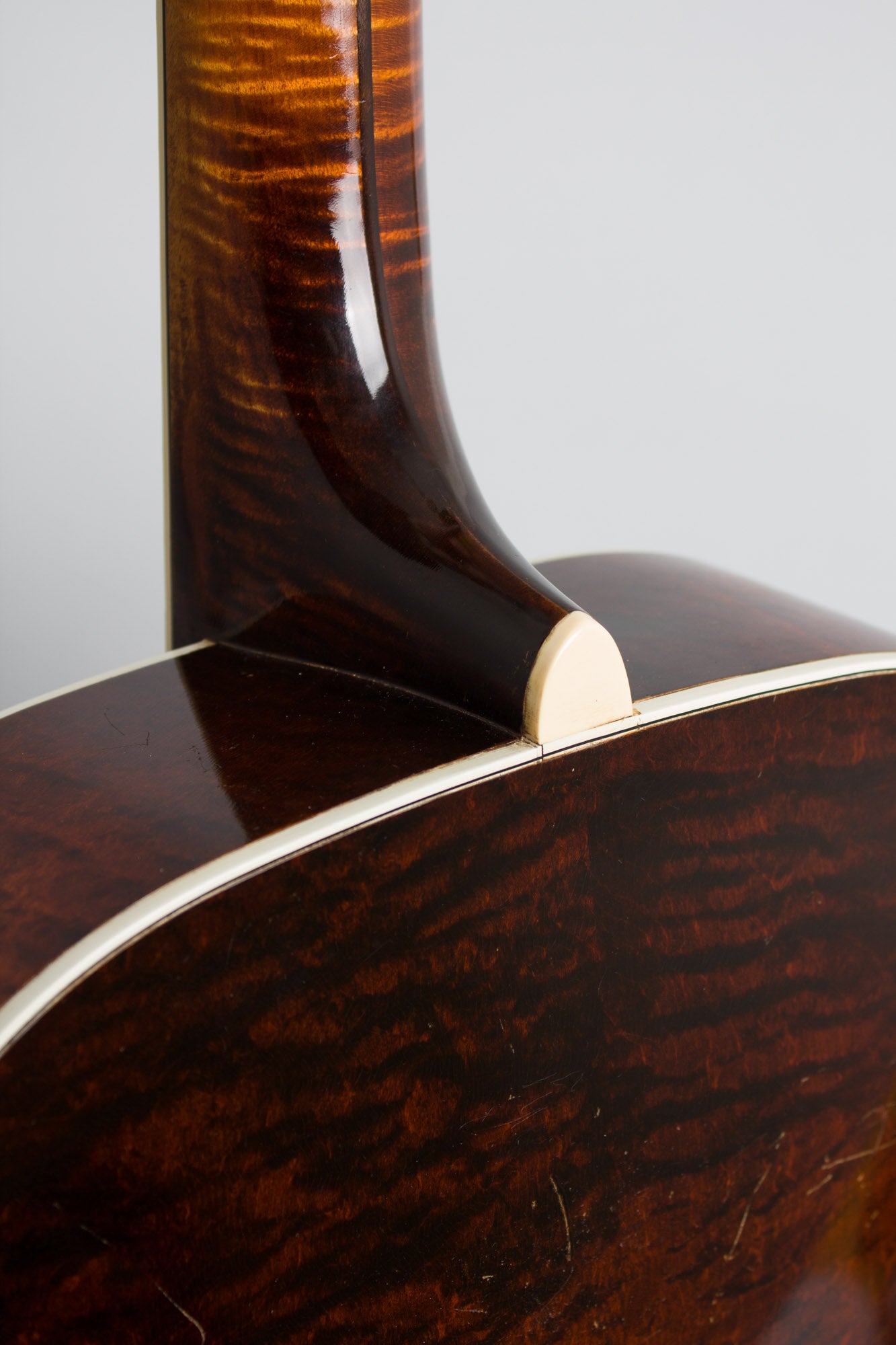
This guitar shows typical features for a 1927-8 "Master Model" L-5; mostly carried over from the Loar era. These would start to rapidly evolve at the end of the decade into the far more common swing-era versions. The pearl dot inlayed, 20 fret ebony fingerboard ends in a curled point. The 3-piece curly maple neck has a deep soft "V" profile, which gets sharper near the nut. The frets are modern replacements to the original specification; the original mother of pearl nut is intact.
The pearl inlaid flowerpot in the triple-bound headstock and angled "The Gibson" logo are the hallmarks of the original L-5; the back of the headstock has an ebony overlay. The engraved, gold plated and mother-of-pearl buttoned tuners are original, many L-5s have lost these over the decades. The original owner's name "Silvio Lavagno" is factory engraved on the truss rod cover.
The body on this guitar is, like many early L-5s, just a hair over 16 inches wide, triple-bound back and front. The carved spruce top and dramatically flamed maple back and sides carry a beautifully blended dark Cremona Brown sunburst finish. The first L-5's actually had birch bodies; after 1925 fancy flamed maple took over. The triple bound celluloid pickguard and mounting hardware are original. The gold-plated tailpiece with the older "string over" cross bar and ebony bridge base (stamped "PAT'D JAN 18-21.") are original, the ebony bridge top has been cut down from the bottom somewhat.
The parallel braces are the original solid hand-carved design; this guitar has a powerful and very versatile sound typical of the best early L-5s; simultaneously warm and incisive with plenty of depth. It plays extremely well and is exceptionally responsive for an archtop guitar...it even sounds lovely fingerstyle! This is a wonderful example of one of our all-time favorite instruments, both historically important and a true delight to play.
Most early 16" L-5s were used extensively for many years, some owners continuing to prefer them to any later guitars. They are still often seen in the hands of recording studio players well into the 1960s. As working guitars, these instruments have often been heavily modified, refitted, or refinished. This one is has a some general wear and repair but both structurally and cosmetically is better preserved than most, retaining all of its original character. Eddie Lang, MayBelle Carter, Snoozer Quinn, Nick Lucas and many more would approve!
Overall length is 40 1/2 in. (102.9 cm.), 16 1/16 in. (40.8 cm.) wide at lower bout, and 3 3/8 in. (8.6 cm.) in depth, measured at side of rim. Scale length is 24 3/4 in. (629 mm.). Width of nut is 1 3/4 in. (44 mm.).
This L-5 shows some wear and repair, but overall remains both cleaner and far more original than many. It has some old repair work to the top but remains structurally well-preserved and in excellent playing condition. Visually the instrument is extremely attractive with a subtle patina not unlike the old violins it was meant to evoke.
The original thin lacquer finish shows general wear throughout, with checking, scratches, and dings with no large areas of loss except the back of the neck is worn to the primer and wood along part of its length. The headstock has tight checking and a few small scratches and dings, and under the tailpiece crossbar the top is dinged from decades of errant string ends.
There are four well-repaired grain splits to the top, solidly sealed but visible with topical touch up; there was not a wholesale overfinish to the top itself. The longest runs from the upper ball of the treble side F-hole under the pickguard past the treble foot of the bridge and down to slightly below the tailpiece crossbar. Another below this runs forward from the F-hole past the waist and up to about 1-2: from the front rim. The bass side F-hole has a nearly identical split running forward past the upper waist, but not extending as far forward. A very short (less than 1") split runs forward off the upper ball of this soundhole.
These are the only notable structural repairs on the guitar; the work is very solidly done but visible, and appears to have been accomplished quite some time ago. The back, sides and neck have some dings and scratches but no cracks or structural damage. The neck has never been reset, there is a small touchup to the top just below the fingerboard. As noted it has been very neatly refretted, with the closest possible wire to the original spec. (smaller than most modern refrets) preserving the original radius. The frets have no subsequent wear.
As noted the original ebony bridge top has been lowered from the bottom, but the bridge and all other hardware remain original including the tailpiece, pickguard and pearl-button tuners are reproductions. The original label is fully intact including the hand-penciled serial number. The original factory order number was more boldly stamped than many and remains fully legible.
While bearing some scars from a long life this L-5 has survived 95 years in a far more original state than most, many of which were rebuilt, refitted and/or refinished long ago. It remains not only a historically important guitar but an exceptional player's tool that plays beautifully and sounds truly sublime, one of the most delightful arch top guitars it has been our pleasure to handle. The original case is still with it, somewhat worn but fully functional. Excellent - Condition.
View full details
This beautiful and iconic early Gibson instrument is a considerable rarity: a 1927 Master Model L-5. The pre-eminent professional guitar of its era -- the original f-hole archtop guitar -- The first L-5s were incomparable in their day and a extremely fine-sounding instruments by any standard. While originally designed to supplement a mandolin orchestra, the L-5 and its legions of imitators became the first "jazz" guitars and the driving force behind the big-band rhythm sections of the next decade.
Debuting in 1923-4, the L-5 was the first modern archtop guitar combing violin style f-holes, a 14 fret neck joint and the elevated fingerboard for the first time. At the time this one in was built in late 1927 it was the top of Gibson's line and had no serious competition, universally considered the finest orchestra guitar made. Other makers would soon begin to explore this avenue, and the L-5 was the inspiration for all and a template for the legions of f-hole guitars that followed.
That said, the 1920s "Master Model" L-5 is a very rare guitar today. It was extremely expensive retailing at $275.00 (plus case!); a top-of-the-line pearl-trimmed Martin Style 000-45 was $105.00 less. There was also hardly any market for them. In 1927-8 at the apex of the jazz age the banjo was still the accepted orchestral rhythm instrument; there were very few professional guitarists who could afford or indeed would even conceive the need such an instrument. Eddie Lang, the era's most influential guitarist, changed all that. In the late 1920s he switched from a Gibson L-4 to a dot-neck (probably 1927-8) L-5, setting the trend for all to follow. This gave Gibson a market dominance that they never lost.
This guitar still carries the special "Master Model" label under the bass side F-hole used only on the top-line Style 5 instruments, a holdover from the original Lloyd Loar era. It disappeared in the 1928-9 period; the Style 5 instruments carrying it are now especially venerated. The serial number hand-written on this label indicates shipment right as 1928 dawned, the Factory Order Number (8747) clearly ink-stamped under the treble F-hole puts its construction in the latter portion of 1927.
This guitar shows typical features for a 1927-8 "Master Model" L-5; mostly carried over from the Loar era. These would start to rapidly evolve at the end of the decade into the far more common swing-era versions. The pearl dot inlayed, 20 fret ebony fingerboard ends in a curled point. The 3-piece curly maple neck has a deep soft "V" profile, which gets sharper near the nut. The frets are modern replacements to the original specification; the original mother of pearl nut is intact.
The pearl inlaid flowerpot in the triple-bound headstock and angled "The Gibson" logo are the hallmarks of the original L-5; the back of the headstock has an ebony overlay. The engraved, gold plated and mother-of-pearl buttoned tuners are original, many L-5s have lost these over the decades. The original owner's name "Silvio Lavagno" is factory engraved on the truss rod cover.
The body on this guitar is, like many early L-5s, just a hair over 16 inches wide, triple-bound back and front. The carved spruce top and dramatically flamed maple back and sides carry a beautifully blended dark Cremona Brown sunburst finish. The first L-5's actually had birch bodies; after 1925 fancy flamed maple took over. The triple bound celluloid pickguard and mounting hardware are original. The gold-plated tailpiece with the older "string over" cross bar and ebony bridge base (stamped "PAT'D JAN 18-21.") are original, the ebony bridge top has been cut down from the bottom somewhat.
The parallel braces are the original solid hand-carved design; this guitar has a powerful and very versatile sound typical of the best early L-5s; simultaneously warm and incisive with plenty of depth. It plays extremely well and is exceptionally responsive for an archtop guitar...it even sounds lovely fingerstyle! This is a wonderful example of one of our all-time favorite instruments, both historically important and a true delight to play.
Most early 16" L-5s were used extensively for many years, some owners continuing to prefer them to any later guitars. They are still often seen in the hands of recording studio players well into the 1960s. As working guitars, these instruments have often been heavily modified, refitted, or refinished. This one is has a some general wear and repair but both structurally and cosmetically is better preserved than most, retaining all of its original character. Eddie Lang, MayBelle Carter, Snoozer Quinn, Nick Lucas and many more would approve!
Overall length is 40 1/2 in. (102.9 cm.), 16 1/16 in. (40.8 cm.) wide at lower bout, and 3 3/8 in. (8.6 cm.) in depth, measured at side of rim. Scale length is 24 3/4 in. (629 mm.). Width of nut is 1 3/4 in. (44 mm.).
This L-5 shows some wear and repair, but overall remains both cleaner and far more original than many. It has some old repair work to the top but remains structurally well-preserved and in excellent playing condition. Visually the instrument is extremely attractive with a subtle patina not unlike the old violins it was meant to evoke.
The original thin lacquer finish shows general wear throughout, with checking, scratches, and dings with no large areas of loss except the back of the neck is worn to the primer and wood along part of its length. The headstock has tight checking and a few small scratches and dings, and under the tailpiece crossbar the top is dinged from decades of errant string ends.
There are four well-repaired grain splits to the top, solidly sealed but visible with topical touch up; there was not a wholesale overfinish to the top itself. The longest runs from the upper ball of the treble side F-hole under the pickguard past the treble foot of the bridge and down to slightly below the tailpiece crossbar. Another below this runs forward from the F-hole past the waist and up to about 1-2: from the front rim. The bass side F-hole has a nearly identical split running forward past the upper waist, but not extending as far forward. A very short (less than 1") split runs forward off the upper ball of this soundhole.
These are the only notable structural repairs on the guitar; the work is very solidly done but visible, and appears to have been accomplished quite some time ago. The back, sides and neck have some dings and scratches but no cracks or structural damage. The neck has never been reset, there is a small touchup to the top just below the fingerboard. As noted it has been very neatly refretted, with the closest possible wire to the original spec. (smaller than most modern refrets) preserving the original radius. The frets have no subsequent wear.
As noted the original ebony bridge top has been lowered from the bottom, but the bridge and all other hardware remain original including the tailpiece, pickguard and pearl-button tuners are reproductions. The original label is fully intact including the hand-penciled serial number. The original factory order number was more boldly stamped than many and remains fully legible.
While bearing some scars from a long life this L-5 has survived 95 years in a far more original state than most, many of which were rebuilt, refitted and/or refinished long ago. It remains not only a historically important guitar but an exceptional player's tool that plays beautifully and sounds truly sublime, one of the most delightful arch top guitars it has been our pleasure to handle. The original case is still with it, somewhat worn but fully functional. Excellent - Condition.


Loading...
Just arrived!
Item #