


Gibson L-5 Arch Top Acoustic Guitar (1938)
Price reduced!


1
/
of
13
Couldn't load pickup availability
Item #10182
Gibson L-5 Model Arch Top Acoustic Guitar (1938), made in Kalamazoo, Michigan, serial # 95575, sunburst lacquer finish, flame maple back, sides and neck, spruce top, ebony fingerboard, black hard shell case.
This is a very interesting and unusual example of the pre-eminent orchestra guitar of its era, the Gibson L-5. This model was the original f-hole archtop guitar, debuting as a completely new and revolutionary design in 1923-4. This particular guitar dates to 1938, nearly 15 years later, when the design had evolved greatly from its original form. It is one of the very last built on the original 16" wide body, but all the other features match the new "advanced" 17' wide L-5 phased in in 1935-6. This is a very rare L-5 variant; only a few were built to this hybrid spec, and this is the first one we have ever seen "in the wood".
Only top professional users with steady salaries could afford the indulgence of a $275.00 (plus case!) instrument in the 1930s, and many L-5's were either custom-built or factory altered to fit a particular player's preferences. This one would have appealed to a player who wanted the new features of the new Advanced model but preferred the smaller body and shorter scale used earlier. It has the name "Bill Ashley" engraved on the truss rod cover; this appears to be factory work but it is impossible to verify if this was the original owner.
The factory order number (FON) 2544 under the treble side F-hole is not the typical coded number seen in 1938-9, it is hand-written in the red pencil usually used to designate a given instrument's rank in a batch. This might possibly indicate the instrument was the sole member of this batch. The serial number stamped on the paper label under the bass f-hole is registered as having been first shipped out by Gibson on April 7th 1939, to Hunleth Music in St. Louis, a major Gibson dealer. No mention of Mr. Ashley is noted! It was returned to the factory for a repair, and then shipped out again on September 5th 1941, to an individual named Tom Christian.
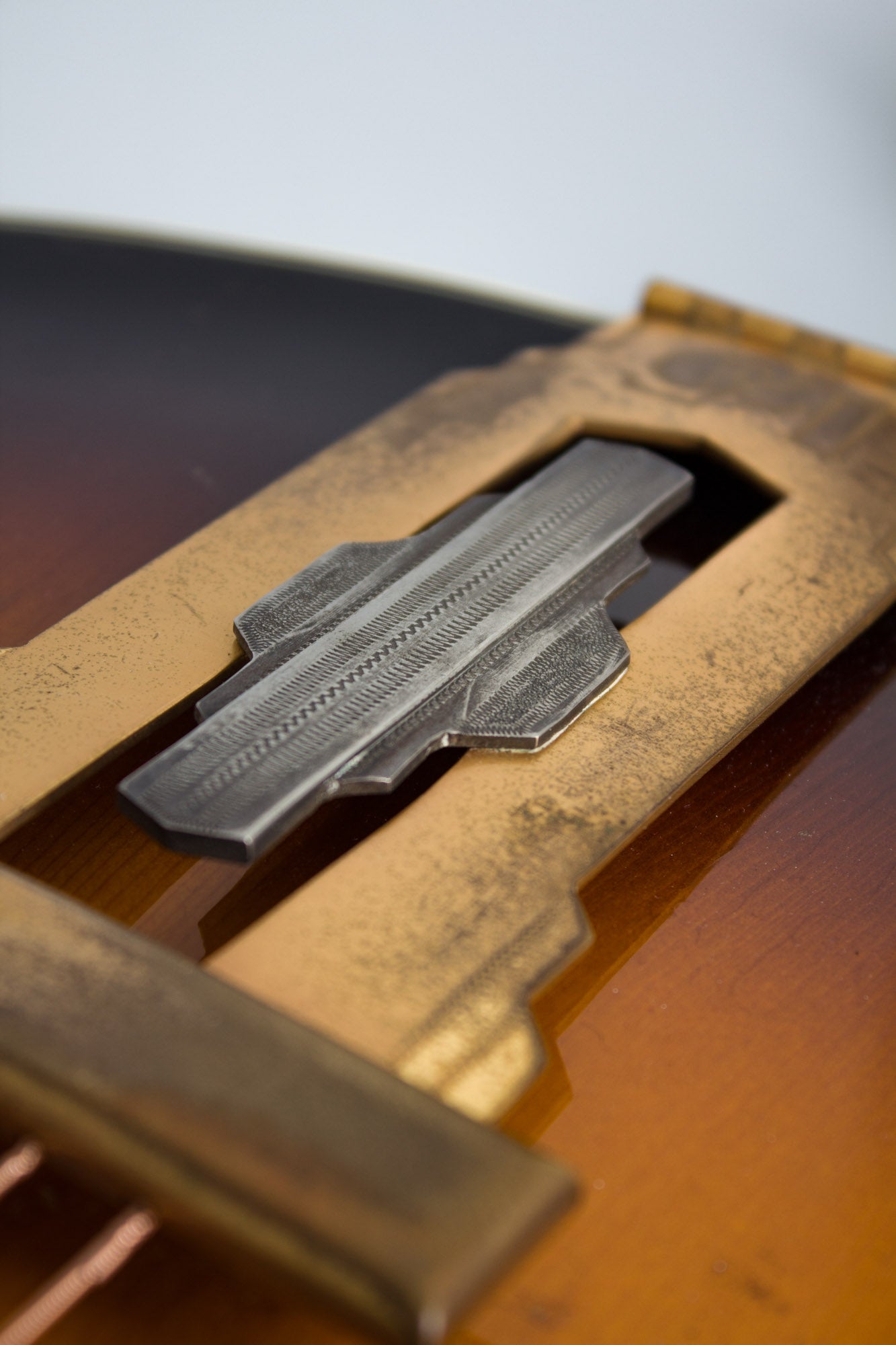
This guitar shows a number of unusual features for a 1938-9 L-5, even considering that the transition between variants of this model is particularly inexact. The 16 1/8" wide body is triple-bound back and five-ply bound front. The top, back, and sides carry a beautifully blended dark sunburst finish; the back is made of superb curly maple with a fairly wide figure. Unusually for a 16" L-5, the f-holes are bound in white, but retain the size and shape of f-holes from the early 1930's. The bracing is the kerfed parallel pattern common on mid-30's l-5's, not the X-pattern used on the early advanced models. The tailpiece is the later hinged engraved "L-5" style, gold plated with a silver insert which made its debut around this time.
The multi-bound, pointed-end ebony fingerboard has pearl block inlay in the advanced pattern, but the shorter scale of earlier models. The 3-piece laminated curly maple neck has a "D" shape -- it feels rounder than some -- with a medium/shallow profile. The pearl inlaid flowerpot in the five-ply-bound headstock and straight across large pearl "Gibson" logo are hallmarks of the late 1930s L-5. As noted the original bell-shaped wide-bevel truss rod cover has been engraved for Bill Ashley.
This guitar mounts the earliest version of the then-new Grover Imperial tuners with gold plating, "stair step" tuning buttons and patent applied for marks. These were not available yet in 1939 but may well have been fitted when the guitar war reworked at Gibson before its 1941 second shipment. At the time, these were a new product considered the finest tuning machine available. The five-ply-bound celluloid pickguard is an L-5 style pickguard from the same period as the guitar, but of the distinctive pattern used mostly on the Super 400. it is most likely a replacement; while the pickguard shows a screw hole by the neck block, there is no evidence on the guitar that a 'guard was ever mounted in this manner. It is now pinned to the side of the fingerboard as is standard for L-5's of the late 1930's.
While we may never know the full story of this instrument (Bill Ashley, phone home!) it remains a superb and wonderful, practically unique carved-top guitar. The combination of features from earlier and later models results in a handier instrument but with the cosmetic features of the larger 17" L-5; quite possibly what the original owner wanted in the first place. This L-5 has a powerful sound suited to big-band rhythm but is a more subtle instrument than many of its larger brethren; it even sounds good fingerstyle.
Overall length is 41 in. (104.1 cm.), 16 1/8 in. (41 cm.) wide at lower bout, and 3 5/16 in. (8.4 cm.) in depth, measured at side of rim. Scale length is 24 3/4 in. (629 mm.). Width of nut is 1 11/16 in. (43 mm.).
Many 1930s L-5s were professionally played extensively for many years; this example has seen some use but remains among the better preserved. As working guitars, they have often been heavily modified, refitted, or refinished; many reworked more than once. This guitar has had some repair work but remains substantially original and true to its era.
It has had a neck reset; the angle is excellent with quite a bit of leeway for adjusting the bridge. There is a vey well hidden heel crack repair extending only from the treble side of the heel to the center lamination. There is dark lacquer overspray around the heel so the crack repair is not visible except under black light inspection. The guitar shows no other significant repairs or alterations. The adjustable rosewood bridge is original to the guitar, as is the bone nut. The pickguard is period but not original to the instrument; it has bellied upwards in the center but not so much as to impede play.
The fingerboard has been levelled and expertly refretted with fretwire that is somewhat larger than the original specification, but still very comfortable to play. The back of the neck is partially worn down to the undercoat and worn through to the bare wood on the edges. The ebony center piece of the laminated neck has shrunken slightly and can be felt along the spine of the neck, but the laminates have not opened up significantly
The finish is original throughout, beyond the noted area of overspray on the heel. Overall the lacquer shows mostly minor dings, dents and scratches, but no excessive wear. There is some finish disturbance under the strings where a floating pickup was likely mounted and small stain marks possibly related to a previous deteriorating celluloid pickguard. This guitar retains a lovely patina and is a wonderful instrument to play, as well as a historically fascinating and practically unique swing-era Gibson. It is housed in a period case that appears New York made, the same style as occupied by many D'Angelicos. Overall Excellent - Condition.
View full details
This is a very interesting and unusual example of the pre-eminent orchestra guitar of its era, the Gibson L-5. This model was the original f-hole archtop guitar, debuting as a completely new and revolutionary design in 1923-4. This particular guitar dates to 1938, nearly 15 years later, when the design had evolved greatly from its original form. It is one of the very last built on the original 16" wide body, but all the other features match the new "advanced" 17' wide L-5 phased in in 1935-6. This is a very rare L-5 variant; only a few were built to this hybrid spec, and this is the first one we have ever seen "in the wood".
Only top professional users with steady salaries could afford the indulgence of a $275.00 (plus case!) instrument in the 1930s, and many L-5's were either custom-built or factory altered to fit a particular player's preferences. This one would have appealed to a player who wanted the new features of the new Advanced model but preferred the smaller body and shorter scale used earlier. It has the name "Bill Ashley" engraved on the truss rod cover; this appears to be factory work but it is impossible to verify if this was the original owner.
The factory order number (FON) 2544 under the treble side F-hole is not the typical coded number seen in 1938-9, it is hand-written in the red pencil usually used to designate a given instrument's rank in a batch. This might possibly indicate the instrument was the sole member of this batch. The serial number stamped on the paper label under the bass f-hole is registered as having been first shipped out by Gibson on April 7th 1939, to Hunleth Music in St. Louis, a major Gibson dealer. No mention of Mr. Ashley is noted! It was returned to the factory for a repair, and then shipped out again on September 5th 1941, to an individual named Tom Christian.
This guitar shows a number of unusual features for a 1938-9 L-5, even considering that the transition between variants of this model is particularly inexact. The 16 1/8" wide body is triple-bound back and five-ply bound front. The top, back, and sides carry a beautifully blended dark sunburst finish; the back is made of superb curly maple with a fairly wide figure. Unusually for a 16" L-5, the f-holes are bound in white, but retain the size and shape of f-holes from the early 1930's. The bracing is the kerfed parallel pattern common on mid-30's l-5's, not the X-pattern used on the early advanced models. The tailpiece is the later hinged engraved "L-5" style, gold plated with a silver insert which made its debut around this time.
The multi-bound, pointed-end ebony fingerboard has pearl block inlay in the advanced pattern, but the shorter scale of earlier models. The 3-piece laminated curly maple neck has a "D" shape -- it feels rounder than some -- with a medium/shallow profile. The pearl inlaid flowerpot in the five-ply-bound headstock and straight across large pearl "Gibson" logo are hallmarks of the late 1930s L-5. As noted the original bell-shaped wide-bevel truss rod cover has been engraved for Bill Ashley.
This guitar mounts the earliest version of the then-new Grover Imperial tuners with gold plating, "stair step" tuning buttons and patent applied for marks. These were not available yet in 1939 but may well have been fitted when the guitar war reworked at Gibson before its 1941 second shipment. At the time, these were a new product considered the finest tuning machine available. The five-ply-bound celluloid pickguard is an L-5 style pickguard from the same period as the guitar, but of the distinctive pattern used mostly on the Super 400. it is most likely a replacement; while the pickguard shows a screw hole by the neck block, there is no evidence on the guitar that a 'guard was ever mounted in this manner. It is now pinned to the side of the fingerboard as is standard for L-5's of the late 1930's.
While we may never know the full story of this instrument (Bill Ashley, phone home!) it remains a superb and wonderful, practically unique carved-top guitar. The combination of features from earlier and later models results in a handier instrument but with the cosmetic features of the larger 17" L-5; quite possibly what the original owner wanted in the first place. This L-5 has a powerful sound suited to big-band rhythm but is a more subtle instrument than many of its larger brethren; it even sounds good fingerstyle.
Overall length is 41 in. (104.1 cm.), 16 1/8 in. (41 cm.) wide at lower bout, and 3 5/16 in. (8.4 cm.) in depth, measured at side of rim. Scale length is 24 3/4 in. (629 mm.). Width of nut is 1 11/16 in. (43 mm.).
Many 1930s L-5s were professionally played extensively for many years; this example has seen some use but remains among the better preserved. As working guitars, they have often been heavily modified, refitted, or refinished; many reworked more than once. This guitar has had some repair work but remains substantially original and true to its era.
It has had a neck reset; the angle is excellent with quite a bit of leeway for adjusting the bridge. There is a vey well hidden heel crack repair extending only from the treble side of the heel to the center lamination. There is dark lacquer overspray around the heel so the crack repair is not visible except under black light inspection. The guitar shows no other significant repairs or alterations. The adjustable rosewood bridge is original to the guitar, as is the bone nut. The pickguard is period but not original to the instrument; it has bellied upwards in the center but not so much as to impede play.
The fingerboard has been levelled and expertly refretted with fretwire that is somewhat larger than the original specification, but still very comfortable to play. The back of the neck is partially worn down to the undercoat and worn through to the bare wood on the edges. The ebony center piece of the laminated neck has shrunken slightly and can be felt along the spine of the neck, but the laminates have not opened up significantly
The finish is original throughout, beyond the noted area of overspray on the heel. Overall the lacquer shows mostly minor dings, dents and scratches, but no excessive wear. There is some finish disturbance under the strings where a floating pickup was likely mounted and small stain marks possibly related to a previous deteriorating celluloid pickguard. This guitar retains a lovely patina and is a wonderful instrument to play, as well as a historically fascinating and practically unique swing-era Gibson. It is housed in a period case that appears New York made, the same style as occupied by many D'Angelicos. Overall Excellent - Condition.


Loading...
Just arrived!
Item #