


Gibson L-1 Flat Top Acoustic Guitar (1934)


1
/
of
14
Regular price
$9,500.00
Regular price
$9,500.00
Sale price
$9,500.00
Unit price
/
per
Item #14036
Gibson L-1 Model Flat Top Acoustic Guitar (1934), made in Kalamazoo, Michigan, serial # 928, sunburst top, dark back and sides finish, mahogany back, sides and neck, spruce top, rosewood fingerboard, hard shell case.
Most folks will look at this guitar and mark it down as yet another early 14-fret L-00, Gibson's most popular Depression era flat top. In 1934-5 the L-00 stood at the bottom of the company's guitar line, but there was a model directly above it carrying the older the L-1 designation. The differences? A sunburst finish, binding on the back and white bridge and endpins, which Gibson collectively valued at a $10.00 upcharge! Sure enough, this guitar is one of those late L-1's, bound on the back.
Unsurprisingly most depression-era customers did not see much advantage in a $37.50 L-1 when the L-00 could be had for $27.50; both were equally well-designed and offered a great value in sound, but in 1935 $10 was a LOT of money. The L-1 last appeared in Gibson's 1934-5 catalog W; By catalog X it was gone, leaving the L-00 to carry the low end by itself. Just to confuse the world further, a year or so later Gibson added back binding to the L-00, and reintroduced a "new" model with an unbound back, now designated the L-0. But that's another tangent...
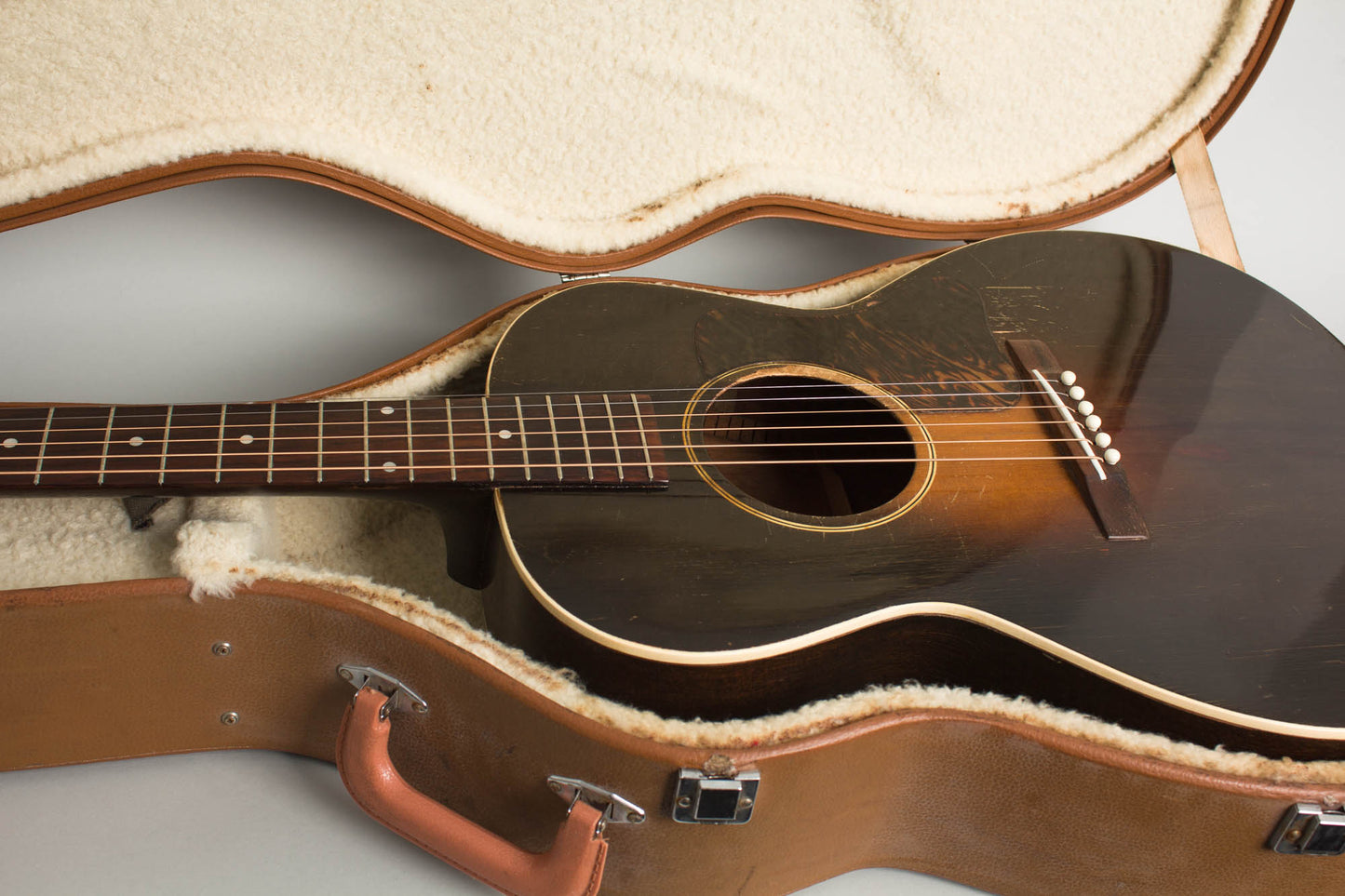
Getting back to this guitar, the FON code 928 on the heelblock indicates it was built in early-mid 1934, in a batch that included both L-1s and L-00s according to Spann. The top finish is a dark sunburst with a very small deep orangey center, hardly a burst at all. There is single-ply white celluloid binding around the top and back. The spruce top is ornamented with a dark and swirly early version of the "firestripe" celluloid pickguard and a three-ply sound hole ring. The back and sides are finished in dark mahogany as is the "V" profile neck with an unbound rosewood fingerboard. The headstock carries a white stenciled "Gibson" logo on the face and simple unplated strip, the exact same fitting as fitting as an L-00. The original rosewood bridge does not have any bolts with pearl dot caps.
Like the far better remembered L-00 this model was intended for student customers but prospered as a professional grade guitar affordable to blues players, Hillbilly string bands, and many other itinerant musicians. Each one of these small body pre-war guitars has its own character and this one is great-sounding both finger- and flat-picked, with a powerful ringing tone that never gets harsh. This is nice "not too clean, not too whupped" with enough wear to be played without worry.
Many of these pre-war Gibson flat-tops have been more heavily used and often amateurishly repaired while this one has survived a bit worn but still singing.
Overall length is 39 5/8 in. (100.6 cm.), 14 3/4 in. (37.5 cm.) wide at lower bout, and 4 1/4 in. (10.8 cm.) in depth at side, taken at the end block. Scale length is 24 3/4 in. (629 mm.). Width of nut is 1 11/16 in. (43 mm.).
This L-1 shows its age but is still a very nice player. The finish remains original, with some touched up areas on the top over older repairs. The guitar overall has edge wear, dings, dents and scrapes but no larger areas of loss except wear to the wood on the lower soundhole rim. The top has been polished out somewhat with touched up finish over a resealed center seam and the areas around it, with a lesser amount over the soundhole around the fingerboard extension. The back looks to have been lightly buffed as well but has no repair or topical touch up, while the sides are less affected. There is some minor lacquer wear-through and chipping on the back of the neck and small dinks, but no heavy capo wear. The headstock is heavily "smoked"; under blacklight it almost looks over finished but it's just old gunk! The edges have chips and dings but again no large areas of wear. The original Grover strip tuners are still intact.
The guitar is completely solid but with some old repairs. There is a spruce grain crack on either side of the fingerboard extension running to the soundhole rim, sealed, touched up and cleated with a wooden inset underneath spanning the entire upper edge of the soundhole under the strings. This is a very solid repair! The top center seam has been resealed as well, again with some touch up blended into the finish. There are several small splits and impact marks to the sides but no major repair. Structurally the top is in excellent shape, with the light arching it was built with but none of the heavier bulge distortion these very lightly-built guitars often suffer.
The neck has been reset, the original bridge reglued and lowered just slightly with a new bone saddle. The bone nut is original, as are the small-wire frets that were recently neatly recrowned, the fingerboard shows some light wear. Internally the guitar shows a couple of reglued braces ("only a Gibson isn't GLUED enough") the crack repairs are neatly cleated and the original small maple bridgeplate is intact and unaltered.. The action is very comfortable and this is a fine playing instrument, responsive with an even singing sound, a nice example of this rare and mostly forgotten (even by us!) Gibson, in a worn but functional '70s HSC. Very Good + Condition.
View full details
Most folks will look at this guitar and mark it down as yet another early 14-fret L-00, Gibson's most popular Depression era flat top. In 1934-5 the L-00 stood at the bottom of the company's guitar line, but there was a model directly above it carrying the older the L-1 designation. The differences? A sunburst finish, binding on the back and white bridge and endpins, which Gibson collectively valued at a $10.00 upcharge! Sure enough, this guitar is one of those late L-1's, bound on the back.
Unsurprisingly most depression-era customers did not see much advantage in a $37.50 L-1 when the L-00 could be had for $27.50; both were equally well-designed and offered a great value in sound, but in 1935 $10 was a LOT of money. The L-1 last appeared in Gibson's 1934-5 catalog W; By catalog X it was gone, leaving the L-00 to carry the low end by itself. Just to confuse the world further, a year or so later Gibson added back binding to the L-00, and reintroduced a "new" model with an unbound back, now designated the L-0. But that's another tangent...
Getting back to this guitar, the FON code 928 on the heelblock indicates it was built in early-mid 1934, in a batch that included both L-1s and L-00s according to Spann. The top finish is a dark sunburst with a very small deep orangey center, hardly a burst at all. There is single-ply white celluloid binding around the top and back. The spruce top is ornamented with a dark and swirly early version of the "firestripe" celluloid pickguard and a three-ply sound hole ring. The back and sides are finished in dark mahogany as is the "V" profile neck with an unbound rosewood fingerboard. The headstock carries a white stenciled "Gibson" logo on the face and simple unplated strip, the exact same fitting as fitting as an L-00. The original rosewood bridge does not have any bolts with pearl dot caps.
Like the far better remembered L-00 this model was intended for student customers but prospered as a professional grade guitar affordable to blues players, Hillbilly string bands, and many other itinerant musicians. Each one of these small body pre-war guitars has its own character and this one is great-sounding both finger- and flat-picked, with a powerful ringing tone that never gets harsh. This is nice "not too clean, not too whupped" with enough wear to be played without worry.
Many of these pre-war Gibson flat-tops have been more heavily used and often amateurishly repaired while this one has survived a bit worn but still singing.
Overall length is 39 5/8 in. (100.6 cm.), 14 3/4 in. (37.5 cm.) wide at lower bout, and 4 1/4 in. (10.8 cm.) in depth at side, taken at the end block. Scale length is 24 3/4 in. (629 mm.). Width of nut is 1 11/16 in. (43 mm.).
This L-1 shows its age but is still a very nice player. The finish remains original, with some touched up areas on the top over older repairs. The guitar overall has edge wear, dings, dents and scrapes but no larger areas of loss except wear to the wood on the lower soundhole rim. The top has been polished out somewhat with touched up finish over a resealed center seam and the areas around it, with a lesser amount over the soundhole around the fingerboard extension. The back looks to have been lightly buffed as well but has no repair or topical touch up, while the sides are less affected. There is some minor lacquer wear-through and chipping on the back of the neck and small dinks, but no heavy capo wear. The headstock is heavily "smoked"; under blacklight it almost looks over finished but it's just old gunk! The edges have chips and dings but again no large areas of wear. The original Grover strip tuners are still intact.
The guitar is completely solid but with some old repairs. There is a spruce grain crack on either side of the fingerboard extension running to the soundhole rim, sealed, touched up and cleated with a wooden inset underneath spanning the entire upper edge of the soundhole under the strings. This is a very solid repair! The top center seam has been resealed as well, again with some touch up blended into the finish. There are several small splits and impact marks to the sides but no major repair. Structurally the top is in excellent shape, with the light arching it was built with but none of the heavier bulge distortion these very lightly-built guitars often suffer.
The neck has been reset, the original bridge reglued and lowered just slightly with a new bone saddle. The bone nut is original, as are the small-wire frets that were recently neatly recrowned, the fingerboard shows some light wear. Internally the guitar shows a couple of reglued braces ("only a Gibson isn't GLUED enough") the crack repairs are neatly cleated and the original small maple bridgeplate is intact and unaltered.. The action is very comfortable and this is a fine playing instrument, responsive with an even singing sound, a nice example of this rare and mostly forgotten (even by us!) Gibson, in a worn but functional '70s HSC. Very Good + Condition.


Loading...
Just arrived!
Item #