


Gibson L-00 Flat Top Acoustic Guitar (1932)


1
/
of
14
Regular price
$6,000.00
Regular price
$6,000.00
Sale price
$6,000.00
Unit price
/
per
Item #14065
Gibson L-00 Model Flat Top Acoustic Guitar (1932), made in Kalamazoo, Michigan, black lacquer finish, mahogany back, sides and neck; spruce top, rosewood fingerboard, black hard shell case.
This is a somewhat well-lived but good playing example of a rare early version of the L-00, Gibson's most popular Depression era flat top. While the L-00 stood at the bottom of the company's guitar line when new, it was still a very well-designed guitar and offered great value in sound. This one has no visible FON code on the neck block (it likely faded into oblivion) but the combination of features (12 fret neck but with a pickguard) indicates it was built in later 1932-3 when the list price was down to a rock-bottom $25.00, without the case. This was the worst period of the depression and Gibson needed to make guitars as affordable as possible.
The finish is black lacquer overall, with single-ply white celluloid binding around the top and a three-ply sound hole ring. The pickguard is also white celluloid, giving a nice "tuxedo" effect lending a classy look to this budget guitar. The small rectangular rosewood bridge does not have the reinforcing bolts with their pearl dot caps added later. The bracing is a very light and slim "X" pattern giving this featherweight guitar an extremely lively sound.
The slim "C" profile neck joins the body at the 12th fret, changed soon after this guitar was made to a 14-fret design. It is fitted with an unbound dot inlaid rosewood fingerboard and has a rounded spine, flatter back to front than some but very comfortable, worlds away from the heavy "V" that was adopted for this model soon after. The headstock carries a white stenciled "Gibson" logo on the face and unplated brass strip tuners.
As a model the L-00 went through numerous design changes over a short period in the early 1930's. These final 12-fret 1932-era black L-00's are much rarer than the subsequent 14-fret sunburst examples, and some connoisseurs seek them out for both their visual and sonic appeal. In any form the model was a working-class standard of the day, a professional grade guitar at a price affordable to blues players, Hillbilly string bands, and many other itinerant musicians as well as Gibson's intended student customers. The 12-fret models are usually our favorites, always exceptionally light and responsive guitars. This black-and white "Tuxedo" model is really sharp looking and a makes a fabulous fingerpicker, with a huge sound even with light strings.
Overall length is 38 1/4 in. (97.2 cm.), 14 3/4 in. (37.5 cm.) wide at lower bout, and 4 11/16 in. (11.9 cm.) in depth at side, taken at the end block. Scale length is 24 3/4 in. (629 mm.). Width of nut is 1 3/4 in. (44 mm.).
This is a nice playing example of this rare Gibson with a decent amount of repair work but not too much heavy wear, still looking sharp. The original thin ebony finish has a some typical checking and shows general wear including dings, dents and scrapes over the entire instrument. The top has less pickwear than many with the only spot down to the wood being the lower soundhole rim. There are a couple of isolated spots that have been touched in, one in the center of the top behind the bridge and another on the upper treble bout. The back has some scuffing and dinging but not too much belt buckle wear. There is some wear-through to the wood on the lower back edge. The neck is worn through to the wood in places and has some small dings and dents but no heavy capo dinks. The headstock has some chips and dings, with typical wear to the edges.
There are a decent amount of repairs, all solid if in some cases not the neatest. There is an old hole through the base of the neck block internally, mirrored through the tailblock, fairly inexplicable unless perhaps once a dowel was in place running through the guitar? We have seen weirder things, but in any case the tailblock hole has since been sealed up. There are a number of major crack repairs on both the upper and the lower sides, all solidly sealed with bias tape internally but externally not lined up as well as they might have been and somewhat haphazardly touched up. The top side looks cleaner than the bottom. The back has some deep scrapes but no cracks, while the top has sealed grain splits along the center seam and the top edge of the pickguard. There is what looks like a small puncture on the top in the center of the upper treble bout, sealed from below with a wooden cleat and patched and touched up from above.
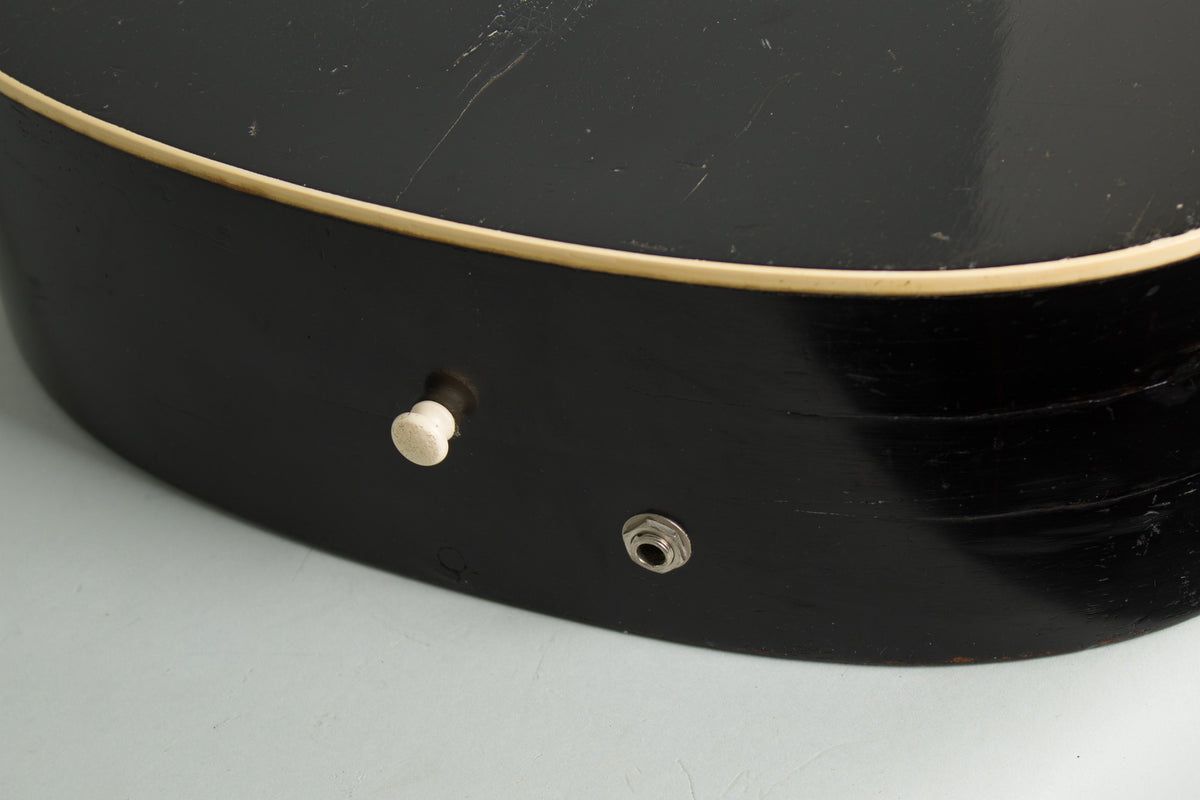
The neck has been neck reset and neatly refretted with wire larger than period standard but not obtrusively modern. Pearl position dots larger than Gibson standard were added to the side of the fingerboard, oddly staggered but in the right place anyway. The guitar is fitted with a replica rosewood bridge a thin maple bridgeplate with a larger footprint than the tiny original, but again not overly heavy. A 3-point contact pickup is attached to the bridgeplate, wired not to an endpin jack but a conventional jack mount through a hole in the lower side. The original very thin bracing remains intact with some visible regluing, with the addition of a spruce reinforcing plate under the fingerboard extension. The original brass strip tuners are still functional, a strap button has been added to the heel.
Even with the foregoing catalog of repair this is a fine playing and great sounding L-00; it would make a great gigger or recording guitar with a very even and responsive sound. It resides in an older but not original period HSC. Overall Very Good Condition.
View full details
This is a somewhat well-lived but good playing example of a rare early version of the L-00, Gibson's most popular Depression era flat top. While the L-00 stood at the bottom of the company's guitar line when new, it was still a very well-designed guitar and offered great value in sound. This one has no visible FON code on the neck block (it likely faded into oblivion) but the combination of features (12 fret neck but with a pickguard) indicates it was built in later 1932-3 when the list price was down to a rock-bottom $25.00, without the case. This was the worst period of the depression and Gibson needed to make guitars as affordable as possible.
The finish is black lacquer overall, with single-ply white celluloid binding around the top and a three-ply sound hole ring. The pickguard is also white celluloid, giving a nice "tuxedo" effect lending a classy look to this budget guitar. The small rectangular rosewood bridge does not have the reinforcing bolts with their pearl dot caps added later. The bracing is a very light and slim "X" pattern giving this featherweight guitar an extremely lively sound.
The slim "C" profile neck joins the body at the 12th fret, changed soon after this guitar was made to a 14-fret design. It is fitted with an unbound dot inlaid rosewood fingerboard and has a rounded spine, flatter back to front than some but very comfortable, worlds away from the heavy "V" that was adopted for this model soon after. The headstock carries a white stenciled "Gibson" logo on the face and unplated brass strip tuners.
As a model the L-00 went through numerous design changes over a short period in the early 1930's. These final 12-fret 1932-era black L-00's are much rarer than the subsequent 14-fret sunburst examples, and some connoisseurs seek them out for both their visual and sonic appeal. In any form the model was a working-class standard of the day, a professional grade guitar at a price affordable to blues players, Hillbilly string bands, and many other itinerant musicians as well as Gibson's intended student customers. The 12-fret models are usually our favorites, always exceptionally light and responsive guitars. This black-and white "Tuxedo" model is really sharp looking and a makes a fabulous fingerpicker, with a huge sound even with light strings.
Overall length is 38 1/4 in. (97.2 cm.), 14 3/4 in. (37.5 cm.) wide at lower bout, and 4 11/16 in. (11.9 cm.) in depth at side, taken at the end block. Scale length is 24 3/4 in. (629 mm.). Width of nut is 1 3/4 in. (44 mm.).
This is a nice playing example of this rare Gibson with a decent amount of repair work but not too much heavy wear, still looking sharp. The original thin ebony finish has a some typical checking and shows general wear including dings, dents and scrapes over the entire instrument. The top has less pickwear than many with the only spot down to the wood being the lower soundhole rim. There are a couple of isolated spots that have been touched in, one in the center of the top behind the bridge and another on the upper treble bout. The back has some scuffing and dinging but not too much belt buckle wear. There is some wear-through to the wood on the lower back edge. The neck is worn through to the wood in places and has some small dings and dents but no heavy capo dinks. The headstock has some chips and dings, with typical wear to the edges.
There are a decent amount of repairs, all solid if in some cases not the neatest. There is an old hole through the base of the neck block internally, mirrored through the tailblock, fairly inexplicable unless perhaps once a dowel was in place running through the guitar? We have seen weirder things, but in any case the tailblock hole has since been sealed up. There are a number of major crack repairs on both the upper and the lower sides, all solidly sealed with bias tape internally but externally not lined up as well as they might have been and somewhat haphazardly touched up. The top side looks cleaner than the bottom. The back has some deep scrapes but no cracks, while the top has sealed grain splits along the center seam and the top edge of the pickguard. There is what looks like a small puncture on the top in the center of the upper treble bout, sealed from below with a wooden cleat and patched and touched up from above.
The neck has been neck reset and neatly refretted with wire larger than period standard but not obtrusively modern. Pearl position dots larger than Gibson standard were added to the side of the fingerboard, oddly staggered but in the right place anyway. The guitar is fitted with a replica rosewood bridge a thin maple bridgeplate with a larger footprint than the tiny original, but again not overly heavy. A 3-point contact pickup is attached to the bridgeplate, wired not to an endpin jack but a conventional jack mount through a hole in the lower side. The original very thin bracing remains intact with some visible regluing, with the addition of a spruce reinforcing plate under the fingerboard extension. The original brass strip tuners are still functional, a strap button has been added to the heel.
Even with the foregoing catalog of repair this is a fine playing and great sounding L-00; it would make a great gigger or recording guitar with a very even and responsive sound. It resides in an older but not original period HSC. Overall Very Good Condition.


Loading...
Just arrived!
Item #