Gibson K-2 Model Carved Top Mandocello (1914), made in Kalamazoo, Michigan, serial # 26465, sunburst top, natural back and sides finish, birch back and sides, spruce top; mahogany neck with ebony fingerboard, original black hard shell case.
The Gibson Mandocello remains one of the great under-appreciated instruments of the early 20th century. Originally designed for the 1910s mandolin orchestra craze, these imposing beasts never found a home in other styles of music despite being often wonderful and always unique-sounding instruments. Double-strung and tuned in fifths starting with the C below the low E on the guitar, the mandocello has an imposing tone and deep resonance unlike any other fretted instrument. OK, we're starting to sound like an old Gibson catalog here, but we really like these and are always happy to get one in stock!
This worn but beautiful 1914 K-2 Mandocello dates to the decade when Gibson was the defining force in the market for these instruments. In the 1910s Gibsons were only available from licensed teacher-agents, and were often purchased on a time payment plan along with the lessons. As part of the deal the students got to play in the teacher's fretted orchestra, and the low-tuned mandocello was crucial to achieving a full sound in these ensembles. Far fewer were sold compared to mandolins, however, and the Gibson mandocellos from any era are a comparative rarity.
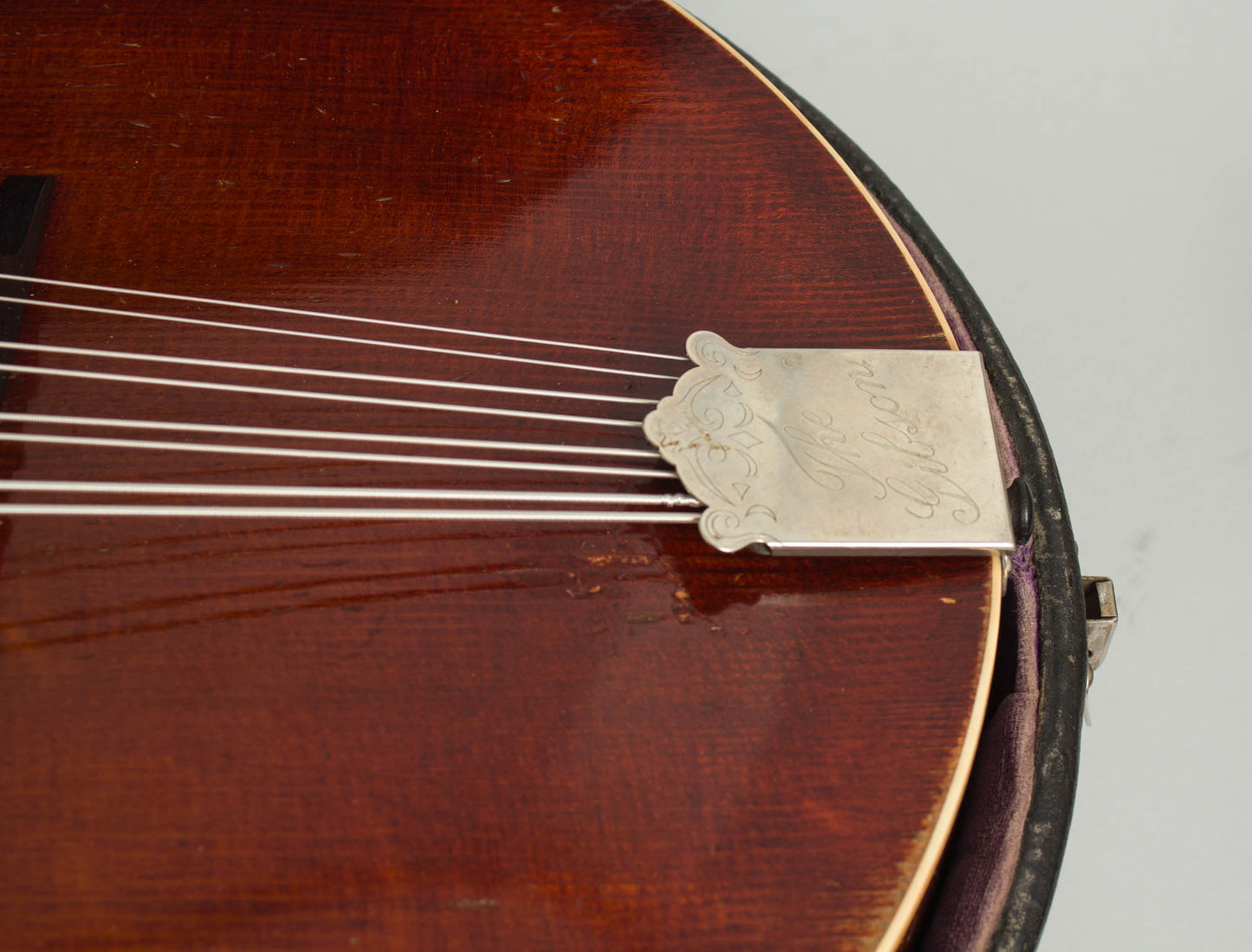
This particular instrument is a K-2, the midline model of three mandocello styles offered. It was an expensive instrument when new, priced in the purple-plush lined case this one still retains at $62.50. This package cost was around $15.00 more than the K-1 in 1914, which would have bought a pretty nice mandolin by itself from the likes of Sears. The two models are structurally the same with the K-2 simply offering some extra "geegaw" (decoration). The headstock face carries an inlaid Fleur-de-Lys in pearl and abalone. The sound hole ring is embellished with extra half-herringbone rings and the top has a rich deep red sunburst finish. Features the same on both models include a bound top, back, and fingerboard, raided pickguard and "crown" engraved tailpiece cover.
Often misunderstood and under-appreciated, the mandocello with its 8 strings and "C" orchestral tuning has a totally unique sound and can be used for a wide range of playing styles, some yet to be explored! "Perhaps the most satisfying instrument, of all the fretted instruments, is the Mandocello" wrote Lewis A. Williams in the 1912 Gibson catalog "In tonal broadness, richness and carrying power it is peculiarly distinctive and phenomenally gratifying". We couldn't have said it better ourselves, but will just add that this particular K-2 is a very nice sounding one and comes closer to Mr. Williams grandiose claims than many.
Overall length is 38 in. (96.5 cm.), 14 1/16 in. (35.7 cm.) width, and 3 1/4 in. (8.3 cm.) in depth, measured at side of rim. Scale length is 25 in. (635 mm.). Width of nut is 1 5/8 in. (41 mm.).
This over 110 year old K-2 shows a decent amount of wear and tear but remains a fine playing and sounding example. The thin original finish appears intact and unaltered, showing play and handling wear overall but fewer pick marks to the top than many. The varnish shows micro-checking with dings, dents and scratches over the entire instrument, with heavier scratches to the lower side and back where the pickguard clamp once mounted and a couple of areas worn to the wood on the back around the edges. The soundhole ring shows heavier wear than the rest of the top with a piece of binding patched in on the lower half.
The back of the neck has loss down to the wood over a decent amount of its length, largely on the treble side. The headstock is cleaner than some but has some chipping at the base on the back side. There are no detectable crack repairs but some of the back side seams have likely been resealed and there is a visibly patched jack hole in a predictable spot on the lower rim.
This instrument is not fitted with the inlaid-button tuners usually used on the K-2; the strips fitted are vintage correct machines but likely from another instrument. The top shaft on the treble side is noticeable bent but still functional. The carved ebony bridge is original and has been re-shaped a bit on the top to lower the action. The tailpiece and cover remain original, the often missing pickguard and bracket clamp are indeed long gone. The two-piece mahogany neck is still quite straight and original thin wire frets have some light wear but still play well. This one is perhaps a but scruffy looking but remains an excellent playing and sounding mandocello offering a powerful ringing sound with plenty of volume and depth. The included original hardshell case is well worn but still fully functional. Overall Very Good Condition.