


Gibson K-1 Carved Top Mandocello (1924)


1
/
of
15
Couldn't load pickup availability
Item #14104
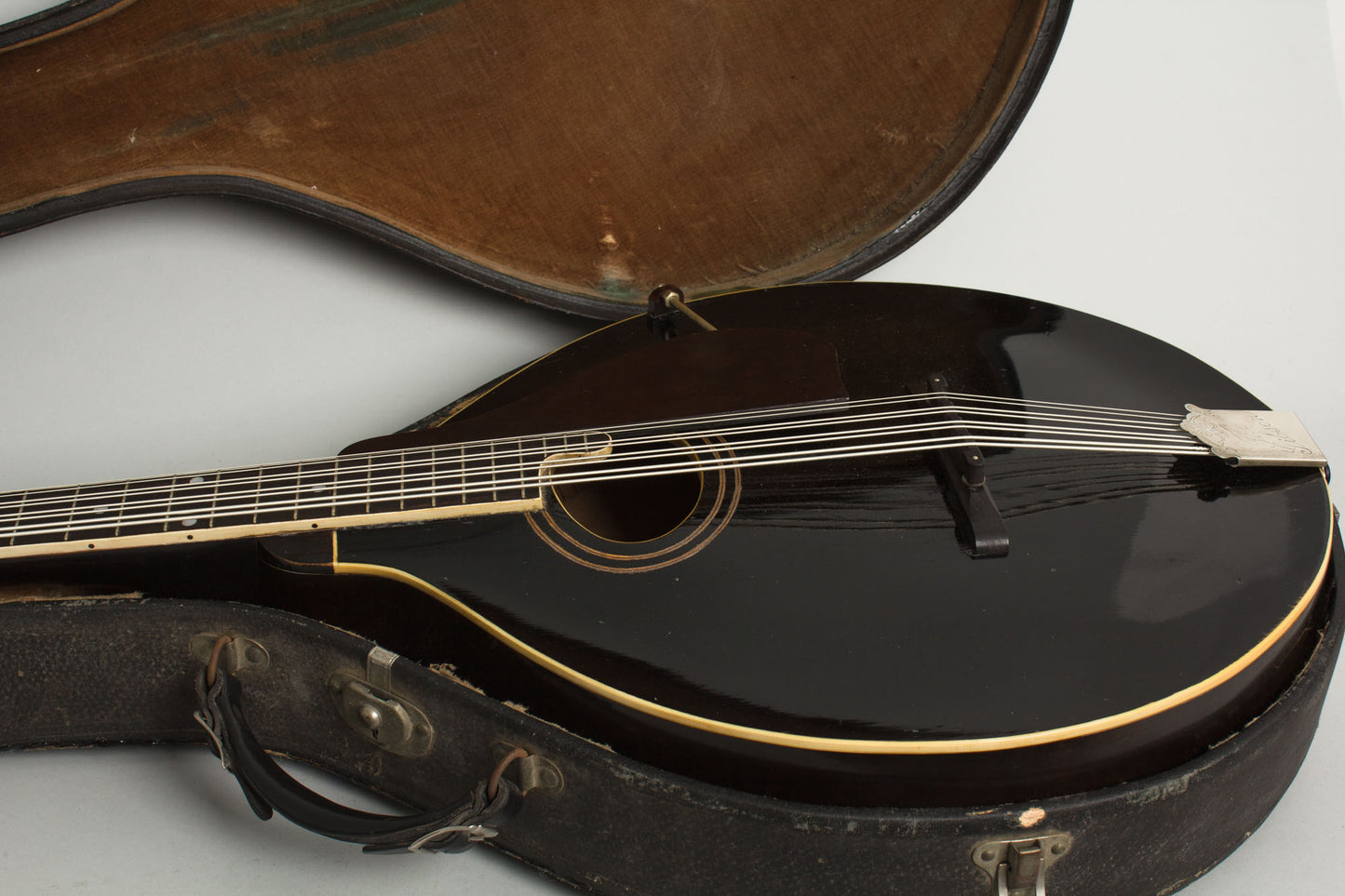
Gibson K-1 Model Carved Top Mandocello (1924), made in Kalamazoo, Michigan, serial # 76184, black top, dark back and sides finish, birch back and sides, mahogany neck with ebony fingerboard, original black hard shell case.
This is a somewhat enigmatic Gibson K-1 mandocello, according to the serial number built over a century ago at the height of the "Loar Era" at Kalamazoo but also substantially re-worked at Gibson's Nashville factory much more recently. The body remains original but the neck was substantially reworked, repaired and refinished in 2009; the repair receipt detailing the work is included. It may not be fully original but is one of the best sounding and plating of these we have ever had.
We feel the Gibson Mandocello is one of the under-appreciated instruments of the early 20th century. Designed for use in 1910s-era mandolin orchestras, these imposing beasts never found a home in any other style of music despite being unique-sounding creations. Double-strung and tuned in fifths starting with the C below the low E on the guitar, the mandocello has an imposing tone and deep resonance unlike any other fretted instrument. OK, we're starting to sound like an old Gibson catalog here, but we really like these and are always happy to get one in stock! The Style K-1 was the most basic of the original three mandocello models Gibson offered but still a fairly expensive instrument when new, listing at $80 in 1924.
This mandocello includes a Gibson factory repair receipt dated to April 2009. It details work done including: "Pull fingerboard, install graphite rod in neck, repair broken neck, refret w/plane and nut, install new bridge, install new pickguard". The repair was noted as "Non-warranty" and the cost came to $2250 plus $85 for shipping. The work was noted as completed on June 9, 2009.
This instrument had some oddities even before the Gibson rebuild. The serial number hand written on the label dates to 1924, a year when few Gibson mandocellos were leaving Kalamazoo and the model was starting to head towards extinction. The FON (Factory Order Number) stamped on the neck block (twice, so not a mistake!) is 70143, which is not in any documented format for period Gibson FON's but would be correct as a serial number from around late 1922. This is an anomaly we have never seen before.
The neck is also rather unusual; as it was reworked by Gibson in 2009 it is hard to tell what is original to 1924 and what is not. It is very sleek in the manner of the few 1930's Gibson mandocellos we have seen but not equipped with an adjustable truss rod, so Gibson added the graphite rod during the rebuild. The feel is considerably slimmer in profile than the earlier models both in girth and depth with a soft "V" profile; compared to most period Gibsons this is a very comfortable neck to play.
The body finish is a black lacquer top with dark back and sides typical of the 1920's. The neck carries a modern dark finish. The top and back are ivoroid bound and sound hole decoration is two separate wood inlaid rings and a bound edge. The neck is mahogany with a bound, dot-inlaid ebony fingerboard. The tuners, pickguard and bridge are correct 1920's style. From a player's point of view, this instrument's slimmer neck has a very different feel than the traditional 1910's deep "V", being both narrower and slimmer. This makes for a much more modern feel than the typical 1910's mandocello, and the sound is equally fine, with plenty of volume and both clarity and depth in equal measure.
With its 8 strings and "C" orchestral tuning the mandocello has a totally unique sound and makes an excellent recording instrument. While mandolin orchestras are rather thin on the ground in the 21st century these instruments can be employed for a wide range of playing styles, some still yet to be explored!
Overall length is 38 1/4 in. (97.2 cm.), 14 3/8 in. (36.5 cm.) width, and 3 1/4 in. (8.2 cm.) in depth, measured at side of rim. Scale length is 24 3/4 in. (629 mm.). Width of nut is 1 3/8 in. (35 mm.).
This century old K-1 shows extensive re-working to the neck but the body remains original and really not too heavily worn. If not absolutely an original instrument sonically it is a particularly fine player's example, one of the best sounding we have had. The body finish is completely original and fairly clean overall; the top shows micro-checking and small dings, scrapes and chips but no notable pickwear. The sides and back of the body have some slightly heavier scrapes and scratches, with a couple of transfer lines running down the back from something left in the case long ago.
The neck finish is entirely new from 2009. It shows hardly any subsequent wear but there is a small spot of rough lacquer on the treble side between the second and third frets. There are a few old laminate checks on the headstock veneer under the newer lacquer. Gibson noted a neck repair in their invoice ("neck broken") but exactly what was done is not visible under the refinish. The body shows no visible evidence of any major damage or repair work. The tuners, bridge base and tailpiece are original, the ebony bridge top is newer as are the tuner grommets. The pickguard was fabricated by Gibson in 2009 using the original bracket.
The fingerboard was trued and refretted as part of the Gibson re-work and these frets show little subsequent wear. The instrument is set up with a very comfortable action, an excellent playing and sounding mandocello with its very slim, comfortable neck and a forceful tone. While no longer a fully original instrument this is one of the best playing and sounding Mandocellos we have had, well above average for a K-1. The slim neck would also make it very suitable for stringing and tuning as an octave mandolin if desired. The original HSC is included with some repairs and an interior we would describe as decrepit, BUT it is still functional and if missing today these cases are almost impossible to replace without having a custom build done. Overall Very Good Condition.
View full details
This is a somewhat enigmatic Gibson K-1 mandocello, according to the serial number built over a century ago at the height of the "Loar Era" at Kalamazoo but also substantially re-worked at Gibson's Nashville factory much more recently. The body remains original but the neck was substantially reworked, repaired and refinished in 2009; the repair receipt detailing the work is included. It may not be fully original but is one of the best sounding and plating of these we have ever had.
We feel the Gibson Mandocello is one of the under-appreciated instruments of the early 20th century. Designed for use in 1910s-era mandolin orchestras, these imposing beasts never found a home in any other style of music despite being unique-sounding creations. Double-strung and tuned in fifths starting with the C below the low E on the guitar, the mandocello has an imposing tone and deep resonance unlike any other fretted instrument. OK, we're starting to sound like an old Gibson catalog here, but we really like these and are always happy to get one in stock! The Style K-1 was the most basic of the original three mandocello models Gibson offered but still a fairly expensive instrument when new, listing at $80 in 1924.
This mandocello includes a Gibson factory repair receipt dated to April 2009. It details work done including: "Pull fingerboard, install graphite rod in neck, repair broken neck, refret w/plane and nut, install new bridge, install new pickguard". The repair was noted as "Non-warranty" and the cost came to $2250 plus $85 for shipping. The work was noted as completed on June 9, 2009.
This instrument had some oddities even before the Gibson rebuild. The serial number hand written on the label dates to 1924, a year when few Gibson mandocellos were leaving Kalamazoo and the model was starting to head towards extinction. The FON (Factory Order Number) stamped on the neck block (twice, so not a mistake!) is 70143, which is not in any documented format for period Gibson FON's but would be correct as a serial number from around late 1922. This is an anomaly we have never seen before.
The neck is also rather unusual; as it was reworked by Gibson in 2009 it is hard to tell what is original to 1924 and what is not. It is very sleek in the manner of the few 1930's Gibson mandocellos we have seen but not equipped with an adjustable truss rod, so Gibson added the graphite rod during the rebuild. The feel is considerably slimmer in profile than the earlier models both in girth and depth with a soft "V" profile; compared to most period Gibsons this is a very comfortable neck to play.
The body finish is a black lacquer top with dark back and sides typical of the 1920's. The neck carries a modern dark finish. The top and back are ivoroid bound and sound hole decoration is two separate wood inlaid rings and a bound edge. The neck is mahogany with a bound, dot-inlaid ebony fingerboard. The tuners, pickguard and bridge are correct 1920's style. From a player's point of view, this instrument's slimmer neck has a very different feel than the traditional 1910's deep "V", being both narrower and slimmer. This makes for a much more modern feel than the typical 1910's mandocello, and the sound is equally fine, with plenty of volume and both clarity and depth in equal measure.
With its 8 strings and "C" orchestral tuning the mandocello has a totally unique sound and makes an excellent recording instrument. While mandolin orchestras are rather thin on the ground in the 21st century these instruments can be employed for a wide range of playing styles, some still yet to be explored!
Overall length is 38 1/4 in. (97.2 cm.), 14 3/8 in. (36.5 cm.) width, and 3 1/4 in. (8.2 cm.) in depth, measured at side of rim. Scale length is 24 3/4 in. (629 mm.). Width of nut is 1 3/8 in. (35 mm.).
This century old K-1 shows extensive re-working to the neck but the body remains original and really not too heavily worn. If not absolutely an original instrument sonically it is a particularly fine player's example, one of the best sounding we have had. The body finish is completely original and fairly clean overall; the top shows micro-checking and small dings, scrapes and chips but no notable pickwear. The sides and back of the body have some slightly heavier scrapes and scratches, with a couple of transfer lines running down the back from something left in the case long ago.
The neck finish is entirely new from 2009. It shows hardly any subsequent wear but there is a small spot of rough lacquer on the treble side between the second and third frets. There are a few old laminate checks on the headstock veneer under the newer lacquer. Gibson noted a neck repair in their invoice ("neck broken") but exactly what was done is not visible under the refinish. The body shows no visible evidence of any major damage or repair work. The tuners, bridge base and tailpiece are original, the ebony bridge top is newer as are the tuner grommets. The pickguard was fabricated by Gibson in 2009 using the original bracket.
The fingerboard was trued and refretted as part of the Gibson re-work and these frets show little subsequent wear. The instrument is set up with a very comfortable action, an excellent playing and sounding mandocello with its very slim, comfortable neck and a forceful tone. While no longer a fully original instrument this is one of the best playing and sounding Mandocellos we have had, well above average for a K-1. The slim neck would also make it very suitable for stringing and tuning as an octave mandolin if desired. The original HSC is included with some repairs and an interior we would describe as decrepit, BUT it is still functional and if missing today these cases are almost impossible to replace without having a custom build done. Overall Very Good Condition.


Loading...
Just arrived!
Item #