Gibson J-45 Banner Acoustic Guitar (1944)


1
/
of
12
Couldn't load pickup availability
Item #10891
Gibson J-45 Banner Model Acoustic Guitar (1944), made in Kalamazoo, Michigan, serial # 2221-48, sunburst top, dark back and sides finish, mahogany back, sides and neck, spruce top, rosewood fingerboard, black tolex hard shell case.
This beautiful Gibson J-45 was built smack in the middle of the Second World War when the company's instrument production was severely limited; these flat top instruments were the only product they shipped in any real quantity. While Gibsons can be often inconsistent the specifications of individual instruments in this era often vary widely, dictated by the materials available.
This particular guitar has the standard specified combination of a sunburst-finished spruce top over the mahogany back, sides and neck standard for the J-45. The Gibson adjustable truss rod is not fitted; this was deleted from production in 1943 as metal was severely rationed. As a result the mahogany neck is built to a quite substantial profile; it still has a comfortable round backed feel some call the "Louisville slugger" style although this one is not QUITE that big.
The Gibson Factory Order Number (FON) on the heelblock starts with "22" but the rest is heavily faded; the batch ranking number written in red pencil is plainly visible identifies this guitar as #48 in the run. It was likely made in 1944 (possibly 1943) according to recent research. The soundhole rosette is the earlier 7-ply style, while the top and back are single bound. The headstock bears the wartime gold script Gibson logo over the "Only a Gibson is Good Enough" banner decal that gives this era's guitars their identifying nickname. The tuners are the later wartime Kluson strips with very thin riveted gears using the absolute minimum of metal.
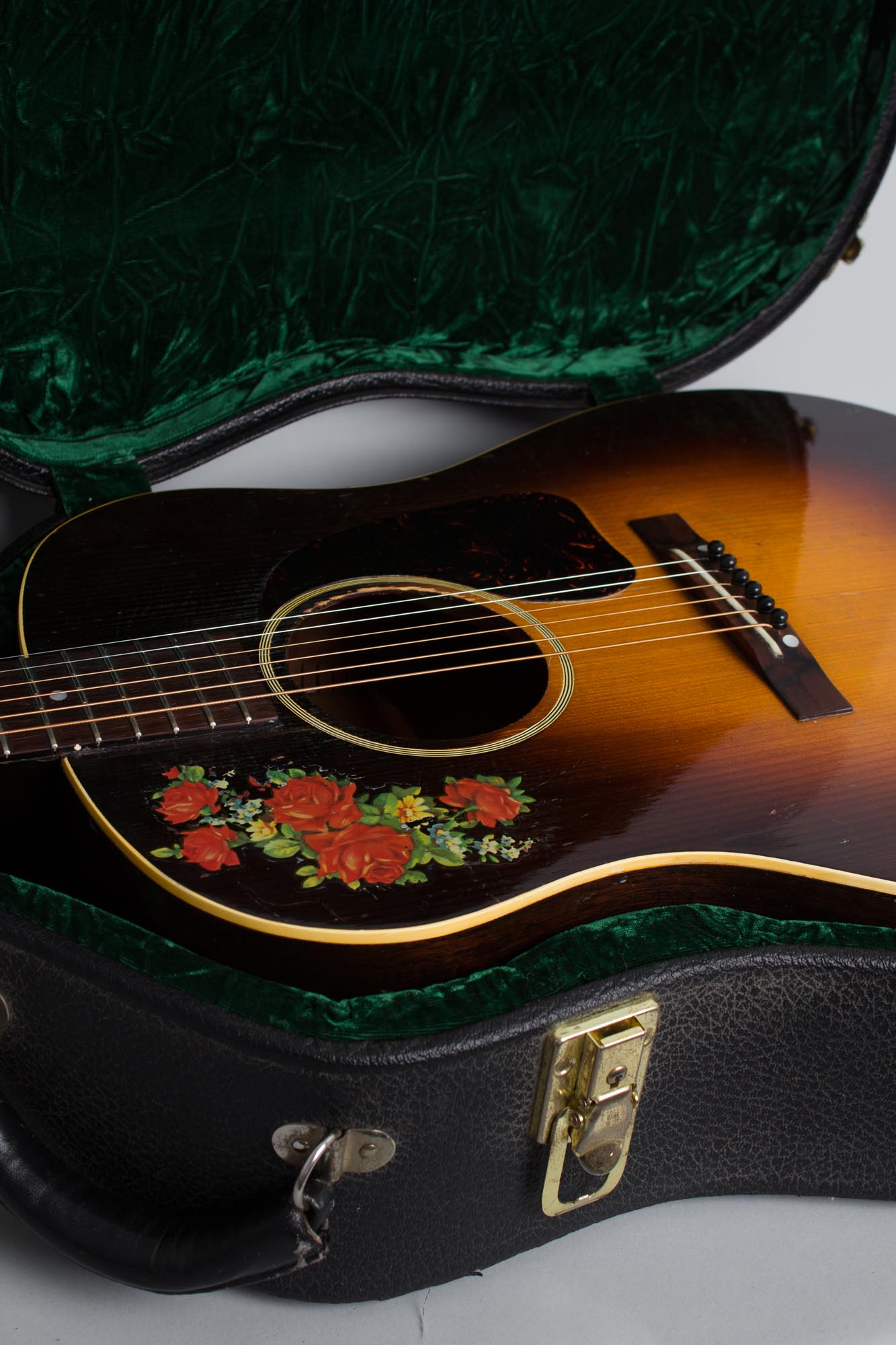
The sunburst top finish is deep and rich with a stately hue; the upper top is additionally decorated with a period floral decal we find rather endearing. These sort of added decorations turn up on Gibson flat tops from this era more than on most other guitars, for some reason. This is a great playing, big sounding instrument that has survived nearly 80 years in fine condition, showing some scars but with its added rosy bouquet one of the more charming "Banner" J-45s we have had.
Overall length is 40 3/4 in. (103.5 cm.), 16 1/8 in. (41 cm.) wide at lower bout, and 4 3/4 in. (12.1 cm.) in depth at side, taken at the end block. Scale length is 24 3/4 in. (629 mm.). Width of nut is 1 11/16 in. (43 mm.).
This guitar is relatively clean overall for an early J-45; the Gibson flat tops of this era have often been heavily played over the decades since WWII and many of the survivors are quite well worn by now. The instrument shows some light wear and some typical maintenance repairs but no serious damage or alteration, except for the rose tattoo on the top.
Overall the finish is cleaner than most, still retaining the relatively shiny patina as it had when FDR was at the nation's helm. There is some typical checking and dings, dents and scratches overall, with some a few isolated areas of pickwear to the top, most notably around the pickguard and next to the treble side of the fingerboard extension. The area around the rose decal has a light overspray added in order to preserve it, but this is not conspicuous. There is a small fragment of another decal on the treble side lower bout and a third area where a decal likely once was under the banner logo on the headstock; these spots show some minor finish disturbance related to the decal removal.
The original bridge was neatly reglued and cut down just a bit, with the original mounting bolts still in place under pearl dots. The original small maple bridgeplate is intact and unaltered. There is one repaired pickguard crack at the "B" string position, this is well sealed. There are no other cracks, but an area of moisture damage on both the back and rims adjacent to the back binding, where both the finish and underlying wood were affected. This is most noticeable where the bass and treble side rims meet up under the end pin. The wood has shrunken a bit and there is a deep press mark into the wood that runs for about two inches, but the finish in the area is still mostly in tact and shows no signs of touch up.
Similarly, the bottom edge of the back next to the binding is slightly wavy as a result of the past moisture situation, but the finish is in tact and the binding itself is undisturbed. At the apex of the lower bout rim on the bass side, there is an area of finish disturbance, most likely the result of contact with a plastic strap at some point in the past. There are a few more lighter marks on the back as well. On the treble rim, there is an area of moisture damage where the clear coat has been worn through to the undercoat, leaving a light mark.
The neck has been very cleanly reset and the fingerboard refretted with period-appropriate wire; the nut was replaced at the same time. The original flat-plate wartime Kluson tuners still function well with their original white plastic buttons in place. This instrument has had some adventures along the way but more recently has been well cared for; all work has been done to a high level. The result is a truly excellent playing and sounding guitar, raw and punchy, but with a very smooth even sound, equally excellent as a strummed rhythm machine or fingerpicked. As it retains the "correct" woods, though without the adjustable truss rod, this is a fairly rare wartime example of the early J-45 as Gibson actually intended it to be! Excellent - Condition.
View full details
This beautiful Gibson J-45 was built smack in the middle of the Second World War when the company's instrument production was severely limited; these flat top instruments were the only product they shipped in any real quantity. While Gibsons can be often inconsistent the specifications of individual instruments in this era often vary widely, dictated by the materials available.
This particular guitar has the standard specified combination of a sunburst-finished spruce top over the mahogany back, sides and neck standard for the J-45. The Gibson adjustable truss rod is not fitted; this was deleted from production in 1943 as metal was severely rationed. As a result the mahogany neck is built to a quite substantial profile; it still has a comfortable round backed feel some call the "Louisville slugger" style although this one is not QUITE that big.
The Gibson Factory Order Number (FON) on the heelblock starts with "22" but the rest is heavily faded; the batch ranking number written in red pencil is plainly visible identifies this guitar as #48 in the run. It was likely made in 1944 (possibly 1943) according to recent research. The soundhole rosette is the earlier 7-ply style, while the top and back are single bound. The headstock bears the wartime gold script Gibson logo over the "Only a Gibson is Good Enough" banner decal that gives this era's guitars their identifying nickname. The tuners are the later wartime Kluson strips with very thin riveted gears using the absolute minimum of metal.
The sunburst top finish is deep and rich with a stately hue; the upper top is additionally decorated with a period floral decal we find rather endearing. These sort of added decorations turn up on Gibson flat tops from this era more than on most other guitars, for some reason. This is a great playing, big sounding instrument that has survived nearly 80 years in fine condition, showing some scars but with its added rosy bouquet one of the more charming "Banner" J-45s we have had.
Overall length is 40 3/4 in. (103.5 cm.), 16 1/8 in. (41 cm.) wide at lower bout, and 4 3/4 in. (12.1 cm.) in depth at side, taken at the end block. Scale length is 24 3/4 in. (629 mm.). Width of nut is 1 11/16 in. (43 mm.).
This guitar is relatively clean overall for an early J-45; the Gibson flat tops of this era have often been heavily played over the decades since WWII and many of the survivors are quite well worn by now. The instrument shows some light wear and some typical maintenance repairs but no serious damage or alteration, except for the rose tattoo on the top.
Overall the finish is cleaner than most, still retaining the relatively shiny patina as it had when FDR was at the nation's helm. There is some typical checking and dings, dents and scratches overall, with some a few isolated areas of pickwear to the top, most notably around the pickguard and next to the treble side of the fingerboard extension. The area around the rose decal has a light overspray added in order to preserve it, but this is not conspicuous. There is a small fragment of another decal on the treble side lower bout and a third area where a decal likely once was under the banner logo on the headstock; these spots show some minor finish disturbance related to the decal removal.
The original bridge was neatly reglued and cut down just a bit, with the original mounting bolts still in place under pearl dots. The original small maple bridgeplate is intact and unaltered. There is one repaired pickguard crack at the "B" string position, this is well sealed. There are no other cracks, but an area of moisture damage on both the back and rims adjacent to the back binding, where both the finish and underlying wood were affected. This is most noticeable where the bass and treble side rims meet up under the end pin. The wood has shrunken a bit and there is a deep press mark into the wood that runs for about two inches, but the finish in the area is still mostly in tact and shows no signs of touch up.
Similarly, the bottom edge of the back next to the binding is slightly wavy as a result of the past moisture situation, but the finish is in tact and the binding itself is undisturbed. At the apex of the lower bout rim on the bass side, there is an area of finish disturbance, most likely the result of contact with a plastic strap at some point in the past. There are a few more lighter marks on the back as well. On the treble rim, there is an area of moisture damage where the clear coat has been worn through to the undercoat, leaving a light mark.
The neck has been very cleanly reset and the fingerboard refretted with period-appropriate wire; the nut was replaced at the same time. The original flat-plate wartime Kluson tuners still function well with their original white plastic buttons in place. This instrument has had some adventures along the way but more recently has been well cared for; all work has been done to a high level. The result is a truly excellent playing and sounding guitar, raw and punchy, but with a very smooth even sound, equally excellent as a strummed rhythm machine or fingerpicked. As it retains the "correct" woods, though without the adjustable truss rod, this is a fairly rare wartime example of the early J-45 as Gibson actually intended it to be! Excellent - Condition.