


Gibson J-185 Flat Top Acoustic Guitar (1953)


1
/
of
15
Regular price
$16,500.00
Regular price
$16,500.00
Sale price
$16,500.00
Unit price
/
per
Item #13861
Gibson J-185 Model Flat Top Acoustic Guitar (1953), made in Kalamazoo, Michigan, serial # A-15391, sunburst lacquer finish, flame maple back and sides, spruce top; mahogany neck with rosewood fingerboard, original brown hard shell case.
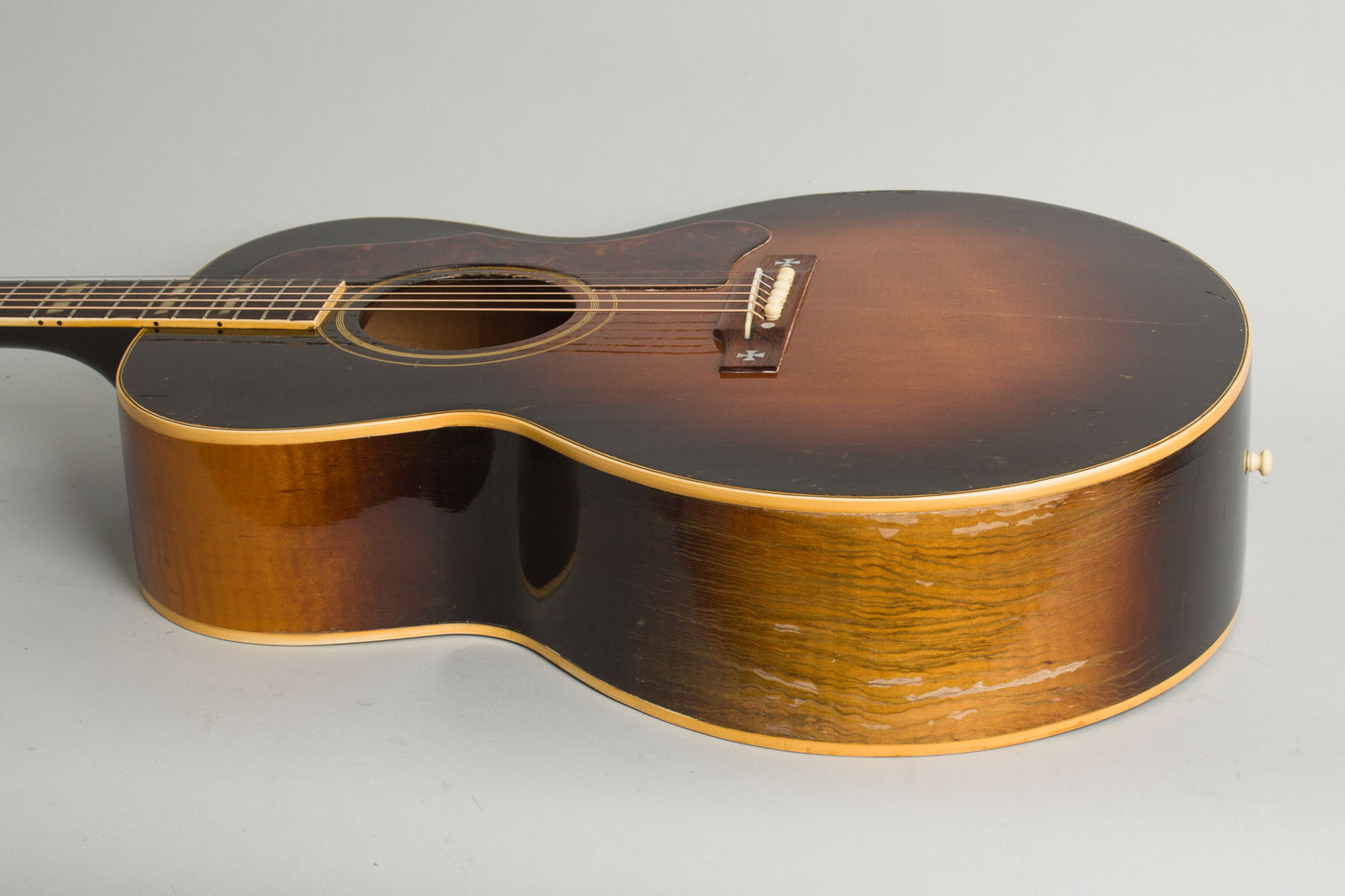
OK, first things first; yes, the finish damage on the back is pretty ugly. BUT, other than that this original sunburst Gibson J-185 is a great sounding and playing guitar, one of the most player friendly of these exceptional flat tops we have had. To some players his unique 16" wide, narrow waisted maple Jumbo is simply one of the best flat top guitars ever made by anybody. In production only from 1951-'58, this model sadly never really established itself at the time but has garnered a splendid reputation over the decades since.
The serial number on the white "Artist" soundhole label indicates this J-185 was shipped around September 1953 and a Y-coded Factory Order Number on the heelblock dates to the same year. It is one of 648 total sunburst J-185's Gibson built over the entire decade of the 1950s, 119 of which left Kalamazoo in 1953. These numbers are VERY small for such a well-regarded guitar, but this model suffered from the "Midline Blues". The J-185 listed for $220 (plus $40 for the "Faultless" hard case) in 1953; it seems most folks who could afford that sort of price went all out and bought the top-line J-200, while the rest stuck with the familiar and more affordable slope-shoulder Jumbo family. After several years of slumping sales the last J-185 shipped out in 1959.
The J-185 represents Gibson's second attempt to create a less expensive guitar to complement the top-of-the-line "King of the Flat-tops" SJ-200, the first being the virtually dead-on-arrival SJ-100 of 1939-41. This is basically a plainer 16" wide version of the overtly "yee-haw" 17" J-200. The smaller body retains the same narrow-waisted shape and materials but has lighter construction resulting in a handier, much more responsive guitar. The cosmetics are a bit plainer, but still make for an impressive-looking instrument. This beauty has subtly flamed maple back and straight-grained spruce top under a shaded sunburst finish. The top and back are triple-bound and the tortoise celluloid pickguard is the same shape as the J-200 but thinner, and not ornamented with any engraving.
The slim but fairly wide round-profile one-piece mahogany neck is topped with a bound rosewood fingerboard sporting Gibson's classic double parallelogram inlay. The unbound headstock has a crown inlay on the face and mounts gold-plated Kluson Deluxe tuners with keystone buttons. A unique feature of the J-185 is pearl Maltese crosses inlaid on the wings of the "belly-up" rosewood bridge, an attractive if eccentric cosmetic touch reserved for this model alone.
Since the 1960s the J-185's unique sound, feel and relative rarity have made it the most sought-after of all post-war Gibson flat-tops. A few name players had one in the 1960s, notably blues legend Skip James at the end of his career. A different blues connection made them much desired among fingerstyle players: Reverend Gary Davis favored a J-200 during the 1960s, but the lighter and more responsive J-185 is a preferred instrument among many who follow in the Reverend's stylistic wake. This is a fine player's example of this very versatile guitar with an exceptionally rich and expansive tone for a maple bodied instrument. This is one of those guitars that truly lives up to its considerable reputation, simply one of Gibson's greatest if originally underappreciated instruments.
Overall length is 41 in. (104.1 cm.), 16 1/16 in. (40.8 cm.) wide at lower bout, and 4 5/8 in. (11.7 cm.) in depth at side, taken at the end block. Scale length is 24 3/4 in. (629 mm.). Width of nut is 1 11/16 in. (43 mm.).
This superb playing 70+ year old example of this much-desired instrument is in excellent structural condition with some heavy checking and flaking wear, largely confined to the upper back and curve of the bass side lower bout. At some point the guitar must have been left in a damp case; there is heavy finish flaking on the back and very heavy checking and some attendant flaking on the upper side. This has been stabilized as much as possible; there are a few errant glue marks from this process. The finish is no longer actively flaking off, but these areas are notable more damaged than the rest of the guitar. Thankfully from the front this is not evident, and the "money side" of the guitar looks much better!
The original lacquer finish over the rest of the instrument shows some typical light checking with dings, dents and scrapes but retains a lovely aged patina. The top has less pick wear than most, most notably a couple of scratches off the upper bass bout edge and some wear to the wood on the soundhole edges. There are some random dings and scrapes and a deep scraped spot on the edge of the lower treble bout. The back of the neck is mostly relatively clean with several small but feelable small dinks and a spot worn to the wood behind the first fret area. There are some small typical chips to the headstock edges.
Structurally the guitar is in excellent playing condition with some fairly minor repairs. The top and back both shows a re-seal to the center seams, with no finish touch-up but a bit of polish out on the top. A spruce grain split along the treble side of the fingerboard edge (along the top of the pickguard) has been neatly sealed with no cleating. The lower side has several noticeable repaired splits in the waist area just above the joint with the back right along the kerning line. A couple of small splits above this do not appear to go through the inside.
The neck does not appear to have ever been reset and the original rosewood bridge is intact; it has been reglued with a little disturbance to the top finish along the front edge. The bone saddle and nut appear newer. Internally the small maple bridge plate is original in excellent shape and the bridge retaining bolts are still intact. The original celluloid pickguard has shrunken up a bit but is not lifting or curling up.
The original small-wire frets have been crowned down lightly but still play fine; there is some light wear to the fingerboard in the first position. This guitar may be cosmetically challenged (from the back anyway) but is truly lovely to play and sounds divine, both crisp and warm and superbly responsive for a large bodied guitar. It rests happily in a correct brown Lifton HSC, not original to the guitar (we'd guess the original was ruined by whatever moisture event scarred the back) but the proper piece, with some external wear and a couple of internal marks from once housing an electric guitar. Overall Very Good + Condition.
View full details
OK, first things first; yes, the finish damage on the back is pretty ugly. BUT, other than that this original sunburst Gibson J-185 is a great sounding and playing guitar, one of the most player friendly of these exceptional flat tops we have had. To some players his unique 16" wide, narrow waisted maple Jumbo is simply one of the best flat top guitars ever made by anybody. In production only from 1951-'58, this model sadly never really established itself at the time but has garnered a splendid reputation over the decades since.
The serial number on the white "Artist" soundhole label indicates this J-185 was shipped around September 1953 and a Y-coded Factory Order Number on the heelblock dates to the same year. It is one of 648 total sunburst J-185's Gibson built over the entire decade of the 1950s, 119 of which left Kalamazoo in 1953. These numbers are VERY small for such a well-regarded guitar, but this model suffered from the "Midline Blues". The J-185 listed for $220 (plus $40 for the "Faultless" hard case) in 1953; it seems most folks who could afford that sort of price went all out and bought the top-line J-200, while the rest stuck with the familiar and more affordable slope-shoulder Jumbo family. After several years of slumping sales the last J-185 shipped out in 1959.
The J-185 represents Gibson's second attempt to create a less expensive guitar to complement the top-of-the-line "King of the Flat-tops" SJ-200, the first being the virtually dead-on-arrival SJ-100 of 1939-41. This is basically a plainer 16" wide version of the overtly "yee-haw" 17" J-200. The smaller body retains the same narrow-waisted shape and materials but has lighter construction resulting in a handier, much more responsive guitar. The cosmetics are a bit plainer, but still make for an impressive-looking instrument. This beauty has subtly flamed maple back and straight-grained spruce top under a shaded sunburst finish. The top and back are triple-bound and the tortoise celluloid pickguard is the same shape as the J-200 but thinner, and not ornamented with any engraving.
The slim but fairly wide round-profile one-piece mahogany neck is topped with a bound rosewood fingerboard sporting Gibson's classic double parallelogram inlay. The unbound headstock has a crown inlay on the face and mounts gold-plated Kluson Deluxe tuners with keystone buttons. A unique feature of the J-185 is pearl Maltese crosses inlaid on the wings of the "belly-up" rosewood bridge, an attractive if eccentric cosmetic touch reserved for this model alone.
Since the 1960s the J-185's unique sound, feel and relative rarity have made it the most sought-after of all post-war Gibson flat-tops. A few name players had one in the 1960s, notably blues legend Skip James at the end of his career. A different blues connection made them much desired among fingerstyle players: Reverend Gary Davis favored a J-200 during the 1960s, but the lighter and more responsive J-185 is a preferred instrument among many who follow in the Reverend's stylistic wake. This is a fine player's example of this very versatile guitar with an exceptionally rich and expansive tone for a maple bodied instrument. This is one of those guitars that truly lives up to its considerable reputation, simply one of Gibson's greatest if originally underappreciated instruments.
Overall length is 41 in. (104.1 cm.), 16 1/16 in. (40.8 cm.) wide at lower bout, and 4 5/8 in. (11.7 cm.) in depth at side, taken at the end block. Scale length is 24 3/4 in. (629 mm.). Width of nut is 1 11/16 in. (43 mm.).
This superb playing 70+ year old example of this much-desired instrument is in excellent structural condition with some heavy checking and flaking wear, largely confined to the upper back and curve of the bass side lower bout. At some point the guitar must have been left in a damp case; there is heavy finish flaking on the back and very heavy checking and some attendant flaking on the upper side. This has been stabilized as much as possible; there are a few errant glue marks from this process. The finish is no longer actively flaking off, but these areas are notable more damaged than the rest of the guitar. Thankfully from the front this is not evident, and the "money side" of the guitar looks much better!
The original lacquer finish over the rest of the instrument shows some typical light checking with dings, dents and scrapes but retains a lovely aged patina. The top has less pick wear than most, most notably a couple of scratches off the upper bass bout edge and some wear to the wood on the soundhole edges. There are some random dings and scrapes and a deep scraped spot on the edge of the lower treble bout. The back of the neck is mostly relatively clean with several small but feelable small dinks and a spot worn to the wood behind the first fret area. There are some small typical chips to the headstock edges.
Structurally the guitar is in excellent playing condition with some fairly minor repairs. The top and back both shows a re-seal to the center seams, with no finish touch-up but a bit of polish out on the top. A spruce grain split along the treble side of the fingerboard edge (along the top of the pickguard) has been neatly sealed with no cleating. The lower side has several noticeable repaired splits in the waist area just above the joint with the back right along the kerning line. A couple of small splits above this do not appear to go through the inside.
The neck does not appear to have ever been reset and the original rosewood bridge is intact; it has been reglued with a little disturbance to the top finish along the front edge. The bone saddle and nut appear newer. Internally the small maple bridge plate is original in excellent shape and the bridge retaining bolts are still intact. The original celluloid pickguard has shrunken up a bit but is not lifting or curling up.
The original small-wire frets have been crowned down lightly but still play fine; there is some light wear to the fingerboard in the first position. This guitar may be cosmetically challenged (from the back anyway) but is truly lovely to play and sounds divine, both crisp and warm and superbly responsive for a large bodied guitar. It rests happily in a correct brown Lifton HSC, not original to the guitar (we'd guess the original was ruined by whatever moisture event scarred the back) but the proper piece, with some external wear and a couple of internal marks from once housing an electric guitar. Overall Very Good + Condition.


Loading...
Just arrived!
Item #