


Gibson F-4 Virzi Carved Top Mandolin (1924)


1
/
of
6
Couldn't load pickup availability
Item #3373
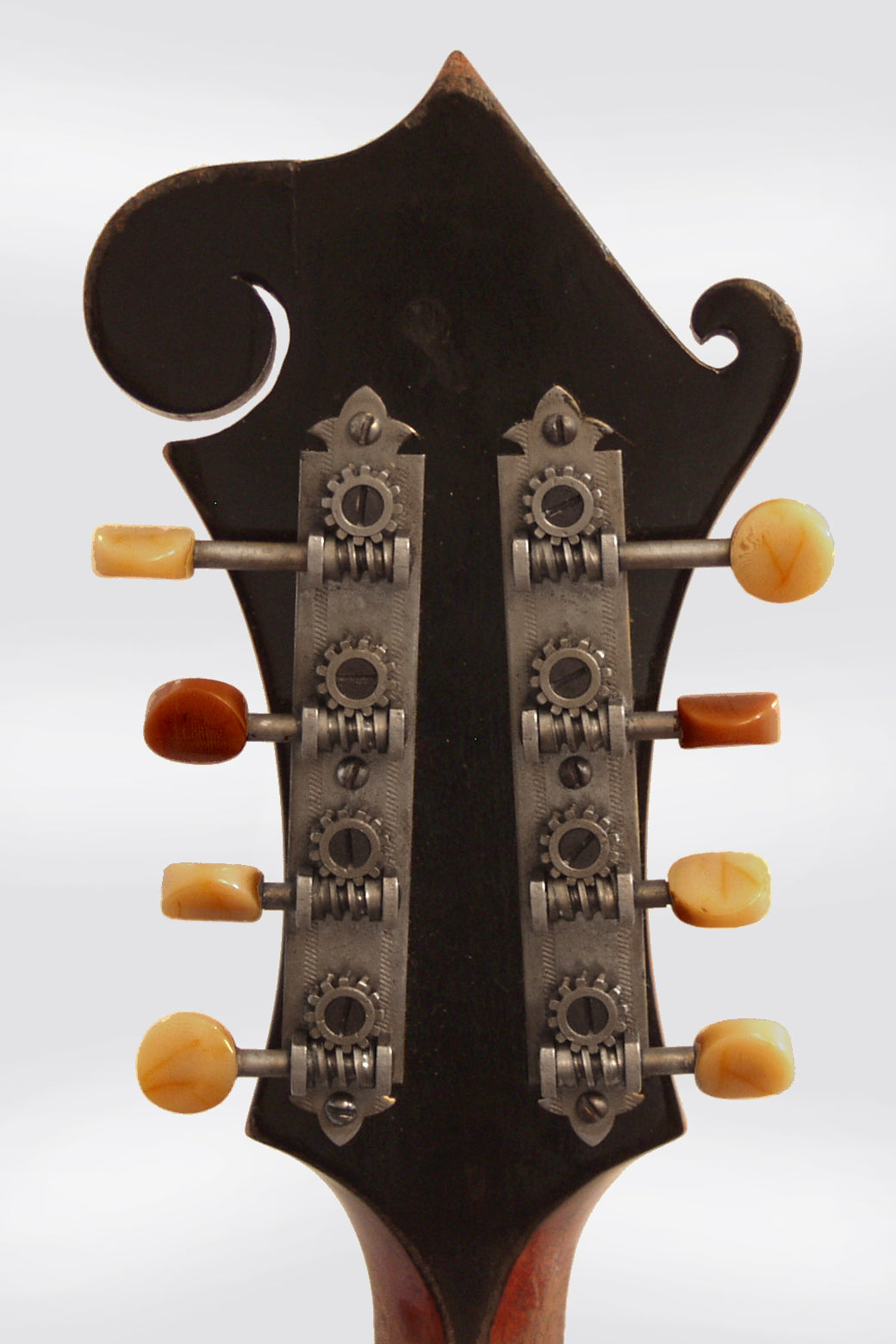
Gibson F-4 Virzi Model Carved Top Mandolin (1924), made in Kalamazoo, Michigan, red sunburst varnish finish, flame maple back and sides, spruce top, mahogany neck with ebony fingerboard, black tolex hard shell case.
As Gibson mandolins go, there are not many more hallowed than a style F-4 Artist model from 1924, the height of the Lloyd Loar era. This is a spectacular example of Gibson's craftsmanship at the apex of the mandolin era, just before the company's focus was shifted to banjos and guitars.
The Mandolins from this particular time are revered for their unmatched sound quality and have all the perfected features of the era including the adjustable truss rod, raised adjustable bridge and slim neck profile. The F-4 was Gibson's highest grade mandolin until the advent of the Master Model F-5 in 1922, and an extremely expensive prestige instrument for its time.
This F-4 features a back and sides of spectacular flame maple; despite Gibson's catalog descriptions, only the Style 4 instruments were actually built with the specified maple body. Top, back, sides, and neck feature a beautiful red sunburst finish and are bound in grained ivoroid. The headstock carries the newer "short" flowerpot inlay that clears the truss rod cover; the earliest truss-rod equipped F-4s have older precut headstock overlays that have some of the inlay hidden by the coverplate.
The F-4 may have been overshadowed somewhat by the new F-5 in 1923-4, but the examples from those years are still the finest ever built and spectacular sounding mandolins. The tone is mellower than the f-hole instruments, but with plenty of body and "bite" when needed.
Lloyd Loar's tenure as "acoustic engineer" at Gibson has become so mythical that sometimes separating fact from fiction is difficult. Certainly the mandolin family instruments made during the period of Loar's employment are the most perfectly realized in Gibson's history, and have become the template for most similar instruments since.
The mandolins of the "Loar Era" show the influence of a master player on both design and execution, although other Gibson employees (especially Thaddeus McHugh and Lewis A. Williams) actually engineered many of the technical improvements. Loar was primarily concerned with 'voicing' the instruments properly; the Master Model Style 5 line was his greatest contribution with their violin-style f-hole tops, but all Gibson mandolin family instruments were refined and improved at the same time.
This F-4 dates to 1924, the last year of Loar's employment. It features another peculiarity of the era, the Virzi Tone Producer mounted under the top. This device, produced by the Virzi Bros. violin company in New York, was championed by Loar and offered as an optional (and extra cost) feature at the time. The Virzi was more commonly installed in Loar's pet Master Model instruments, and it is uncommon to find one in a round hole mandolin: only a handful of "Virzi F-4's" are known to exist.
The "Tone Producer" itself is a small spruce disk suspended beneath the top intended to add extra harmonic partials to the instrument's sound; many players have been disappointed to discover that it does not actually add volume to the instrument. What it does do is help produce a more complex sound with richer overtones�that is the theory, anyway! Many Virzis have been removed from 1920's Gibsons by players who wanted a louder more driving tone, but those that remain are a fascinating part of the Loar era story. This is simply one of the nicest and most historically interesting F-4 mandolins we have ever seen.
Overall length is 26 7/16 in. (67.1 cm.), 10 in. (25.4 cm.) width, and 1 5/8 in. (4.1 cm.) in depth, measured at side of rim. Scale length is 14 in. (356 mm.). Width of nut is 1 1/16 in. (27 mm.).
Beautifully original; definitely played but well taken care of. There is light wear overall, especially to the back of the neck, and the area of the treble side adjacent to the neck joint. There is a noticeable pick scratch on the treble side body point below the pickguard, and some armwear to the top edge. The scroll has been separated and expertly repaired, as is very common with older F-style mandolins. Overall this is a great playing and sounding example of one of the world's classic mandolins. Overall Excellent Condition.
View full details
As Gibson mandolins go, there are not many more hallowed than a style F-4 Artist model from 1924, the height of the Lloyd Loar era. This is a spectacular example of Gibson's craftsmanship at the apex of the mandolin era, just before the company's focus was shifted to banjos and guitars.
The Mandolins from this particular time are revered for their unmatched sound quality and have all the perfected features of the era including the adjustable truss rod, raised adjustable bridge and slim neck profile. The F-4 was Gibson's highest grade mandolin until the advent of the Master Model F-5 in 1922, and an extremely expensive prestige instrument for its time.
This F-4 features a back and sides of spectacular flame maple; despite Gibson's catalog descriptions, only the Style 4 instruments were actually built with the specified maple body. Top, back, sides, and neck feature a beautiful red sunburst finish and are bound in grained ivoroid. The headstock carries the newer "short" flowerpot inlay that clears the truss rod cover; the earliest truss-rod equipped F-4s have older precut headstock overlays that have some of the inlay hidden by the coverplate.
The F-4 may have been overshadowed somewhat by the new F-5 in 1923-4, but the examples from those years are still the finest ever built and spectacular sounding mandolins. The tone is mellower than the f-hole instruments, but with plenty of body and "bite" when needed.
Lloyd Loar's tenure as "acoustic engineer" at Gibson has become so mythical that sometimes separating fact from fiction is difficult. Certainly the mandolin family instruments made during the period of Loar's employment are the most perfectly realized in Gibson's history, and have become the template for most similar instruments since.
The mandolins of the "Loar Era" show the influence of a master player on both design and execution, although other Gibson employees (especially Thaddeus McHugh and Lewis A. Williams) actually engineered many of the technical improvements. Loar was primarily concerned with 'voicing' the instruments properly; the Master Model Style 5 line was his greatest contribution with their violin-style f-hole tops, but all Gibson mandolin family instruments were refined and improved at the same time.
This F-4 dates to 1924, the last year of Loar's employment. It features another peculiarity of the era, the Virzi Tone Producer mounted under the top. This device, produced by the Virzi Bros. violin company in New York, was championed by Loar and offered as an optional (and extra cost) feature at the time. The Virzi was more commonly installed in Loar's pet Master Model instruments, and it is uncommon to find one in a round hole mandolin: only a handful of "Virzi F-4's" are known to exist.
The "Tone Producer" itself is a small spruce disk suspended beneath the top intended to add extra harmonic partials to the instrument's sound; many players have been disappointed to discover that it does not actually add volume to the instrument. What it does do is help produce a more complex sound with richer overtones�that is the theory, anyway! Many Virzis have been removed from 1920's Gibsons by players who wanted a louder more driving tone, but those that remain are a fascinating part of the Loar era story. This is simply one of the nicest and most historically interesting F-4 mandolins we have ever seen.
Overall length is 26 7/16 in. (67.1 cm.), 10 in. (25.4 cm.) width, and 1 5/8 in. (4.1 cm.) in depth, measured at side of rim. Scale length is 14 in. (356 mm.). Width of nut is 1 1/16 in. (27 mm.).
Beautifully original; definitely played but well taken care of. There is light wear overall, especially to the back of the neck, and the area of the treble side adjacent to the neck joint. There is a noticeable pick scratch on the treble side body point below the pickguard, and some armwear to the top edge. The scroll has been separated and expertly repaired, as is very common with older F-style mandolins. Overall this is a great playing and sounding example of one of the world's classic mandolins. Overall Excellent Condition.


Loading...
Just arrived!
Item #