


Gibson F-4 Carved Top Mandolin (1923)


1
/
of
4
Couldn't load pickup availability
Item #6500
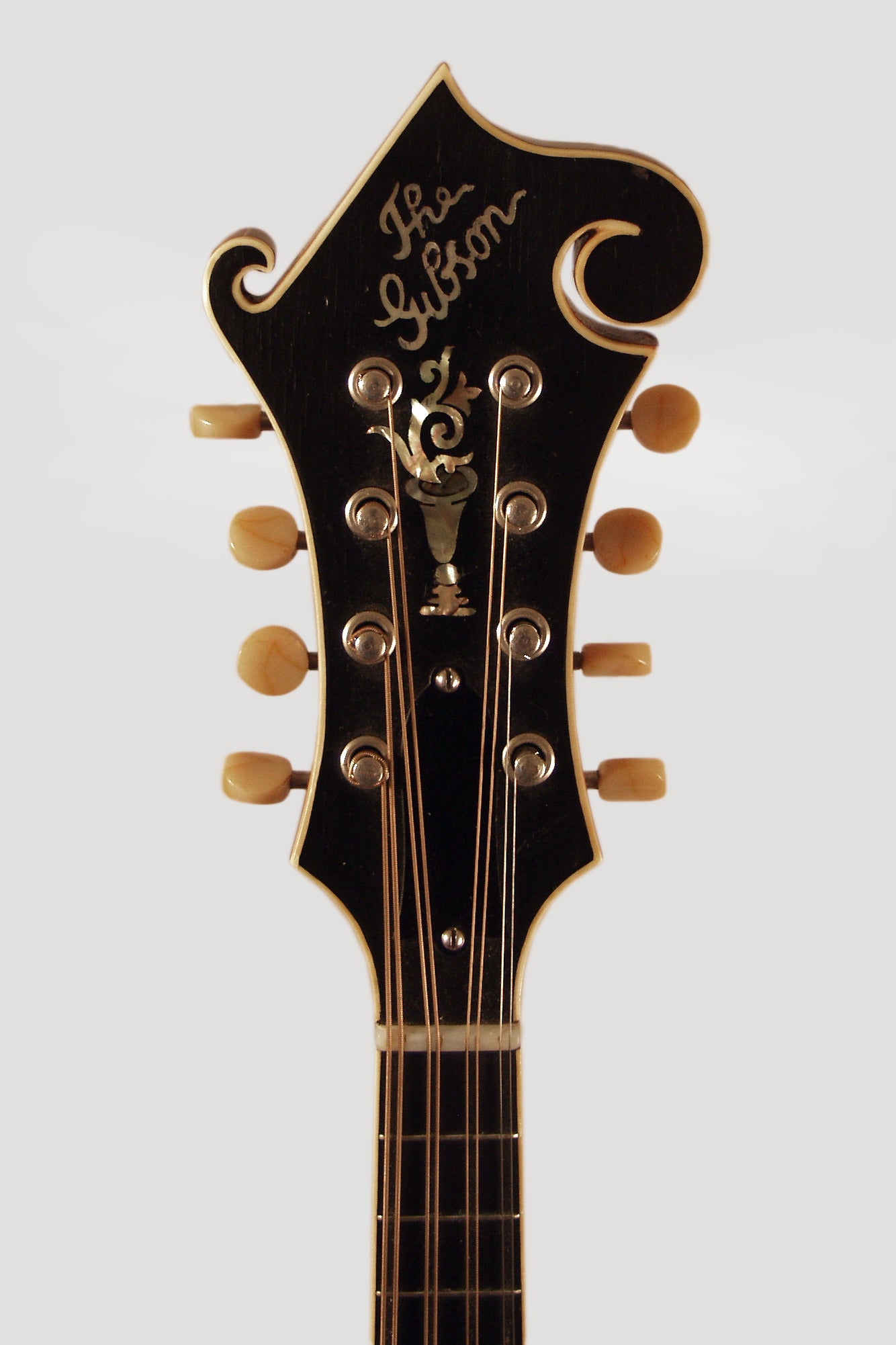
Gibson F-4 Model Carved Top Mandolin (1923), made in Kalamazoo, Michigan, sunburst varnish finish, maple back and sides, spruce top; mahogany neck with ebony fingerboard, original black hard shell case.
As Gibson mandolins go there are not many more hallowed instruments than a style F-4 Artist model from 1923-4, the apex of the "Lloyd Loar" period. This is a spectacular example of Gibson's craftsmanship at the height of the mandolin era, just before the company's focus shifted to banjos and then guitars. The Mandolins from this particular time are revered for their unmatched sound quality and have all the perfected features of the era including the adjustable truss rod, raised adjustable bridge and slimmer neck profile. The F-4 Artist's model was Gibson's highest grade mandolin until the advent of the Master Model F-5 in 1922, and even after that model's introduction remained at a price of $150.00 an extremely expensive prestige instrument.
This F-4 features a one-piece back and sides of subtly flamed maple; despite Gibson's catalog descriptions, only the Style 4 instruments were actually built with the specified maple body. Top, back, sides and neck feature a beautiful red sunburst finish and are bound in grained ivoroid. The headstock carries the newer "short" flowerpot inlay that clears the truss rod cover; the earliest truss-rod equipped F-4's have older precut headstock overlays that have some of the inlay hidden by the coverplate. The F-4 may have been overshadowed somewhat by the new F-5 in 1923-4, but the examples from those years are still absolutely the finest ever built and spectacular sounding mandolins. The tone is mellower than Gibson's f-hole instruments, but with plenty of body and "bite" when needed.
Lloyd Loar's tenure as "acoustic engineer" at Gibson has become so mythical that sometimes separating fact from fiction is difficult. Certainly the mandolin family instruments made during the period of Loar's employment are the most perfectly realized in Gibson's history, and have become the template for most similar instruments since. The mandolins of the "Loar Era" show the influence of a master player on both design and execution, although other Gibson employees (especially Thaddeus McHugh and Lewis A. Williams) actually engineered many of the technical improvements. Loar was primarily concerned with 'voicing' the instruments properly; the Master Model Style 5 line was his greatest contribution with their violin-style F-hole tops but all Gibson mandolin family instruments were refined and improved at the same time. This mandolin dates to 1923, the height of Loar's period of influence over Gibson's direction. It remains in lovely original condition and rates as one of the nicest F-4 mandolins we have ever seen.
Overall length is 26 1/4 in. (66.7 cm.), 10 in. (25.4 cm.) wide, and 1 3/4 in. (4.4 cm.) in depth, measured at side of rim. Scale length is 14 in. (356 mm.). Width of nut is 1 1/8 in. (29 mm.). This mandolin remains in beautiful, all original condition with only very minor wear. The only imperfection we can see is a small surface check to the veneer on the back of the headstock just by the throat of the neck; The varnish finish on the headstock rear has been polished out just a bit, likely when this was sealed up. Thre are no other apparent issues or changes and this remains a superb piece and one of the nicest playing and sounding F-4's we have seen. Excellent Condition.
View full details
As Gibson mandolins go there are not many more hallowed instruments than a style F-4 Artist model from 1923-4, the apex of the "Lloyd Loar" period. This is a spectacular example of Gibson's craftsmanship at the height of the mandolin era, just before the company's focus shifted to banjos and then guitars. The Mandolins from this particular time are revered for their unmatched sound quality and have all the perfected features of the era including the adjustable truss rod, raised adjustable bridge and slimmer neck profile. The F-4 Artist's model was Gibson's highest grade mandolin until the advent of the Master Model F-5 in 1922, and even after that model's introduction remained at a price of $150.00 an extremely expensive prestige instrument.
This F-4 features a one-piece back and sides of subtly flamed maple; despite Gibson's catalog descriptions, only the Style 4 instruments were actually built with the specified maple body. Top, back, sides and neck feature a beautiful red sunburst finish and are bound in grained ivoroid. The headstock carries the newer "short" flowerpot inlay that clears the truss rod cover; the earliest truss-rod equipped F-4's have older precut headstock overlays that have some of the inlay hidden by the coverplate. The F-4 may have been overshadowed somewhat by the new F-5 in 1923-4, but the examples from those years are still absolutely the finest ever built and spectacular sounding mandolins. The tone is mellower than Gibson's f-hole instruments, but with plenty of body and "bite" when needed.
Lloyd Loar's tenure as "acoustic engineer" at Gibson has become so mythical that sometimes separating fact from fiction is difficult. Certainly the mandolin family instruments made during the period of Loar's employment are the most perfectly realized in Gibson's history, and have become the template for most similar instruments since. The mandolins of the "Loar Era" show the influence of a master player on both design and execution, although other Gibson employees (especially Thaddeus McHugh and Lewis A. Williams) actually engineered many of the technical improvements. Loar was primarily concerned with 'voicing' the instruments properly; the Master Model Style 5 line was his greatest contribution with their violin-style F-hole tops but all Gibson mandolin family instruments were refined and improved at the same time. This mandolin dates to 1923, the height of Loar's period of influence over Gibson's direction. It remains in lovely original condition and rates as one of the nicest F-4 mandolins we have ever seen.
Overall length is 26 1/4 in. (66.7 cm.), 10 in. (25.4 cm.) wide, and 1 3/4 in. (4.4 cm.) in depth, measured at side of rim. Scale length is 14 in. (356 mm.). Width of nut is 1 1/8 in. (29 mm.). This mandolin remains in beautiful, all original condition with only very minor wear. The only imperfection we can see is a small surface check to the veneer on the back of the headstock just by the throat of the neck; The varnish finish on the headstock rear has been polished out just a bit, likely when this was sealed up. Thre are no other apparent issues or changes and this remains a superb piece and one of the nicest playing and sounding F-4's we have seen. Excellent Condition.


Loading...
Just arrived!
Item #