Gibson ES-330TD Model Thinline Hollow Body Electric Guitar (1961), made in Kalamazoo, Michigan, serial # 30391, sunburst top, dark back and sides finish, laminated maple body, mahogany neck, rosewood fingerboard, black tolex hard shell case.
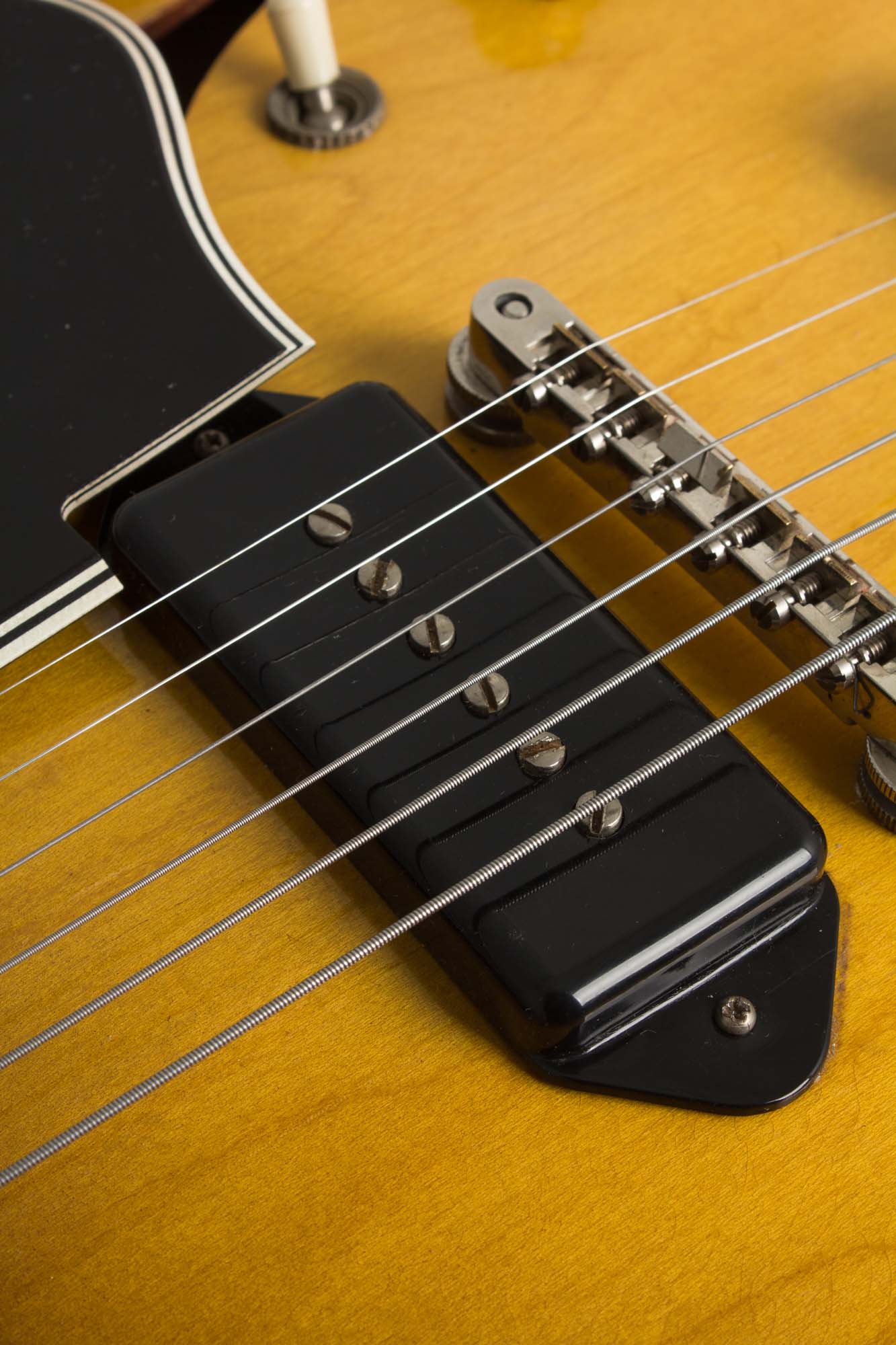
This is a nice example of a first-generation sunburst ES-330TD from mid-1961, the model's second full production year. It retains all the earliest features including a bound dot-inlaid rosewood fingerboard, rounder "Mickey Mouse" cutaway horns and black plastic P-90 pickup covers. The dark shaded sunburst still has a very 1950s look to it.
The ES-330T And ES-330TD debuted in late 1959 as lower-budget additions to the ES-335 line launched the year before. The initial announcement in the October/November '59 GIBSON GAZETTE described them as "Thrilling modern instruments...Double cutaway body and thin silhouette make it wonderfully east to hold and play". The single pickup 330T only lasted into the early 1960s, but this far more versatile double pickup "TD" was a much more popular instrument.
In 1961 a total of 542 of these sunburst, two pickup 330s were shipped out of Kalamazoo, a big drop from the year before as the newer cherry-finished version was really taking off. The model was priced at $275 (up from $250, plus case), later in the year just under the cost of a sunburst Stratocaster! The ES-330 was regarded as a very successful model for Gibson and would remain so into the late 1960s, when the trend to hyper amplification depressed the sales of many fully hollowbody guitars.
We (mostly) play at lower volumes today, so these sweet guitars have enjoyed a welcome renaissance. This 1961 ES-330TD has a classic set of mid-line Gibson features, but a distinctive feel. While grouped with the thin-line semi-solid 335 range this is actually a very different instrument to play. The slim single-bound body is fully hollow without any center block, making it much lighter and more resonant. This also led to another distinguishing feature of the 330, the neck joining the body farther in at the 16th fret to allow the joint to be stronger.
The neck profile on this guitar is the slim, flatter 1960 style, a feature specific to this period. This one has a rounder back with a shade more "meat" to it than some 1960s. The headstock has just a pearl Gibson logo, the tuners are single-unit enclosed Kluson deluxe with plastic buttons. The two P-90 pickups are mounted under black plastic dog-ear covers, which would be replaced with metal the next year. They are controlled by the standard Gibson 4-knob one switch wiring rig, with the then-new metal-capped plastic bonnet knobs.
Despite being intended as "amateur' instruments early ES-330TDs are great-sounding, extremely versatile guitars that have been heard live and on record in many styles of music. Jazz great Grant Green used an early model like this extensively on his classic early 1960s recordings, while Slim Harpo relied on one for his deep swamp blues. The ES-330 and its nearly identical sister the Epiphone Casino were featured by countless '60s British invasion bands including the Beatles, Rolling Stones, Kinks, Manfred Mann, and many more. This is an exceptional example, one of the cleanest the early ES-330TD's we have seen, a light and handy guitar with a killer feel and sound.
Overall length is 39 3/4 in. (101 cm.), 16 in. (40.6 cm.) wide at lower bout, and 1 3/4 in. (4.4 cm.) in depth, measured at side of rim. Scale length is 24 3/4 in. (629 mm.). Width of nut is 1 11/16 in. (43 mm.).
Overall this is a great looking, and playing and sounding guitar, showing only light wear for 65 years on the planet. It remains largely original, the only alterations being a correct style repro trapeze tailpiece (many of the originals have sheared at the base) and a repro Tune-O-Matic bridge. There is also a period Gibson metal strap button added at the heel which is extremely common. The finish is a very dark two-tone sunburst, with no red at all; it is hard to tell it was shot this way or has faded somewhat but it has a very stately look. It shows some mostly light checking; there is some minimal scuffing and tiny chips, dings and dents with a couple of small spots of strap burn on the back. The back of the neck has a few small dings.
Except for the bridge and tailpiece as noted the hardware including pickups and wiring is original and complete with some minor wear. There are a few errant screw holes under the tailpiece base indicating something else fitted for a time. The original frets remain in excellent shape, crowned down a bit with no subsequent wear even in the lower positions. This is a simply superb playing and sounding guitar, very light and super comfortable. Many ES-330's were not originally purchased with hard cases (many came housed in chipboard!) as it added $47.00 to the price; whatever this one originally came with it is now equipped with a proper modern HSC. Overall Excellent - Condition.