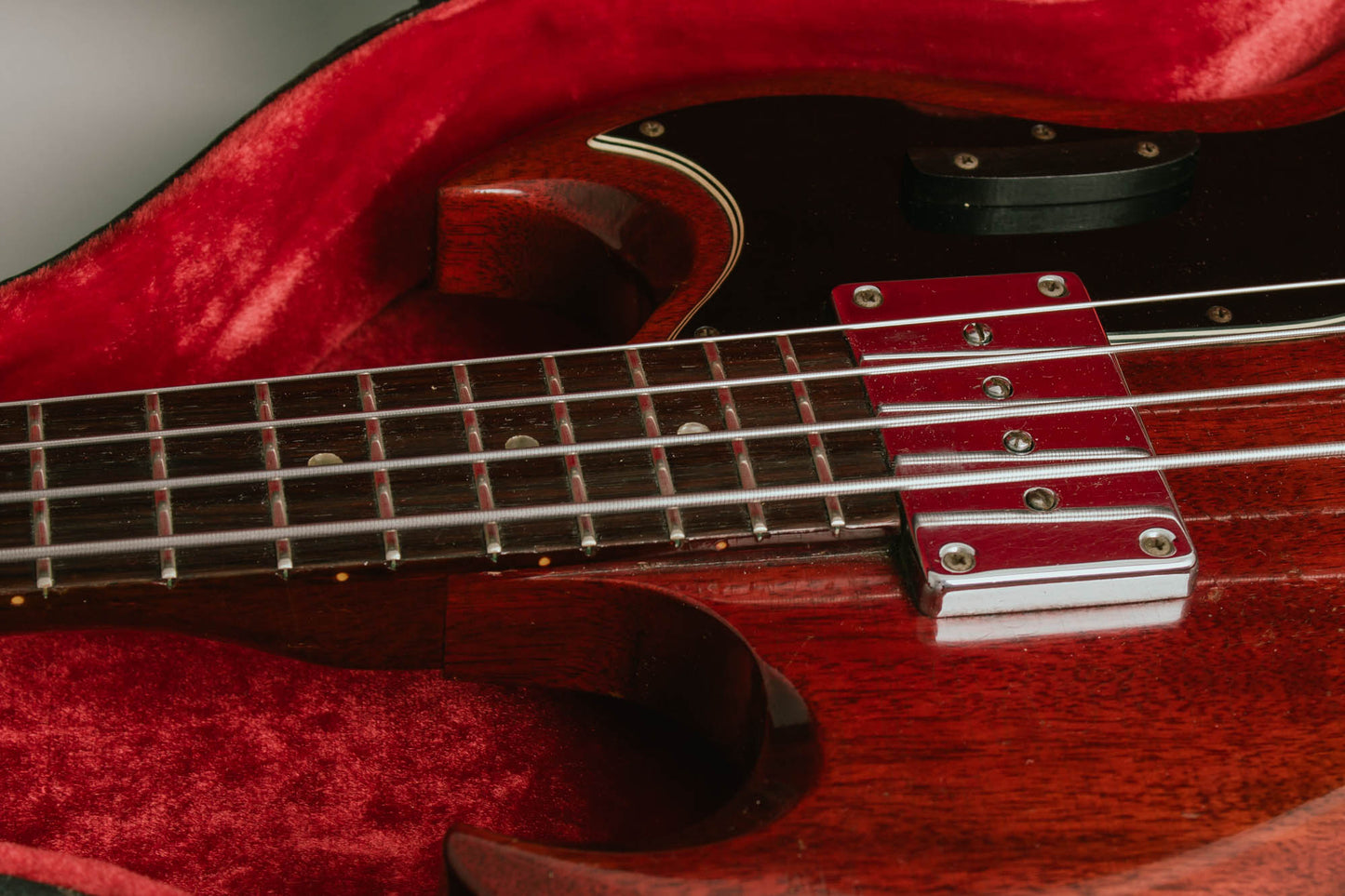
Gibson EB-3 Model Solid Body Electric Bass Guitar (1968), made in Kalamazoo, Michigan, serial # 518642, cherry lacquer finish, mahogany body and neck, rosewood fingerboard, black hard shell case.
This is a slightly worn in but good playing example of a later 1960s Gibson EB-3 bass, an instrument mostly celebrated for its use by Cream bassist Jack Bruce. While the EB-3 had been in Gibson's line since 1961 it was an expensive and relatively unpopular instrument until Bruce started using one in 1967 giving the model massive exposure on Cream's recordings and extensive road work, creating a connection most players still identify almost 60 years later. This original 1968 EB-3 has a mix of older and newer features, generally similar the 1964-5 "Bruce" spec but with some detail changes.
This bass' most noticeable difference from earlier models is the bridge, a very early example of the "Tune-O-Matic" style bass bridge that Gibson had just introduced to replace the old one-piece unit. This has individual nylon saddles allowing each string to be intonated for the first time on Gibson's short-scale bass models. There are still small screw holes on the body from the central handrest and mute assembly under the bridge this bass once carried; the Gibson factory deleted the mute and moved the handrest to become a bridge cover shortly after this bass was made.
The neck on this bass has the very slim 1 1/2" nut adopted in 1965-6, and the neck joint is streamlined from earlier models. The tuners are Kluson, which Gibson had abandoned for a while in 1967 but re-appeared in 1968. Oddly the serial number la largely obscured by them, indicating this headstock may have been originally intended to carry the smaller Japanese-made tuners standard the year before. As with all Gibson basses of the time the rosewood fingerboard is unbound and dot inlaid, the nut is larger than in previous years.
One feature that did not change was the EB-3's signature mix of one large "Mudbucker" and one small mini-humbucking pickup controlled by a 4-way selector, giving a much wider range of tone than the much more common EB-0. The options are bass pickup or treble pickup alone, both together or bass pickup through a choke coil. This bass has the "close mounted" knob arrangement introduced in 1965 when the company standardized the electronics cavity pattern among all SG models. Three of the four pots are original coded 6826 (the 26th week of 1968) one was replaced not long ago.
Although the EB-3 was suddenly a "star" model surprisingly only 565 were produced in 1968; the total went up dramatically over the next couple of years. It listed at $365 in mid-1968, which was relatively expensive for a bass at the time. While the EB-3 subsequently fell out of favor in the hi-fi later '70s and '80s, this easy-to-play and very distinctive-sounding bass was used by a number of (mostly English) rock bassists in the 1960s and '70s, including Jack Bruce, Andy Fraser, Pete Quaife with the Kinks, Chris White with the Zombies, Rolling Stone Bill Wyman in the early '70s, Tom Evans of Badfinger, Glenn Cornick of Jethro Tull, Trevor Bolder with the Spiders from Mars, Jim Lea of Slade, and many others. The EB-3's distinctive growl is one of the most recognizable electric bass tones on record. This is a nice playing example.
Overall length is 41 1/2 in. (105.4 cm.), 13 in. (33 cm.) wide at lower bout, and 1 1/4 in. (3.2 cm.) in depth, measured at side of rim. Scale length is 30 in. (762 mm.). Width of nut is 1 1/2 in. (38 mm.).
This bass shows some wear and tear overall but no major repairs or large areas of finish loss. The finish is still a very deep cherry with some fine checking but very little fade. There are dings idents and scratches overall with some light finger wear to the top above the strings, belt buckle wear to the back and some finish loss to the lower body edge. The back of the neck has some dings and dents but no major finish loss.
The hardware is largely original; three of the knobs are original and one is a repro (over the replaced upper volume pot). The pickups are original, as most of the complex wiring rig; there has been some re-soldering around that replaced volume pot. The tone caps are not matched but this appears to be the original layout. As noted the handrest and mute are long gone, but all other hardware remains intact. This is a very handy and good playing bass with the almighty thump Gibsons are famous for and a range of other tone options besides. It rests in a period but not standard Gibson issue HSC. Overall Very Good + Condition.